
Jewish Thought and Philosophy

To think Jewishly is to stand at the edge of certainty and still choose to believe, question, and seek. Jewish thought lives in the tension between faith and doubt, law and freedom, eternity and change.

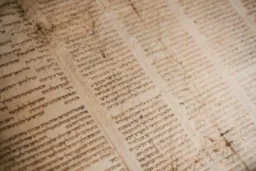
  • Torah parchment

    Is the Torah Divine?

    Thoughts for Shavuot

    In Jewish Thought and Philosophy and Shavuot by Rabbi Nathan Lopes Cardozo

    A flame grows or diminishes depending on the combustibility of the material it comes in contact with. So it is with human openness to the divine. Their receptivity to the divinity of Torah is proportionate to the condition of their soul.

  • Majestic Mountains, Rembrandt, and Music Baths

    In Jewish Thought and Philosophy, Rav Kook and Parashat Matot by Rabbi Nathan Lopes Cardozo

    Natural beauty, art, and music exist to disturb our complacency. Their purpose is to awaken in us a sense of wonder. And while beauty, art, and music facilitate that wonder, the role of religion is to provide us with the means to respond to it.

  • My Chareidi and Modern Orthodox Struggles

    In Jewish Thought and Philosophy by Rabbi Nathan Lopes Cardozo

    It’s important to realize that nobody can inherit religion, not even from oneself. It has to be an ongoing discovery. I converted when I was 16, but over the years I’ve come to realize that to convert only once is almost meaningless.

  • Book Review: The Passover Haggadah of Rabbi Dr. Eliezer Berkovits

    In Jewish Thought and Philosophy and Passover by Rabbi Nathan Lopes Cardozo

    It is a great joy to study Faith and Freedom: Passover Haggadah, With Commentary from the Writings of Rabbi Eliezer Berkovits. In this Haggadah, not only do we find very interesting insights by Rabbi Berkovits on themes that relate to Pesach, but we also get somewhat of an introduction to his philosophy and unique halachic approach in general.

  • The Hardship and Privilege of Honest Teaching: The Baal Teshuva Movement Impasse

    In Education, Jewish Thought and Philosophy and Rav Kook by Rabbi Nathan Lopes Cardozo

    I strongly believe that new ideas, ideologies and movements are God-given and have great religious meaning. This means that we are religiously obligated to incorporate them into Judaism—sometimes by just accepting them and other times by reworking them.

  • Critics, Laughter and Writing Serious Stuff: Ten Questions for Rabbi Cardozo – Question 7 (Part 2)

    In Jewish Thought and Philosophy and Rav Kook by Rabbi Nathan Lopes Cardozo

    It is important to remember that great controversies are also great emancipators. They give us new and fresh insights. We are in dire need of them. We should not only allow them but encourage our students to advance them!

  • My Controversy with the Mainstream Orthodox Community – Part 1

    In Jewish Thought and Philosophy by Rabbi Nathan Lopes Cardozo

    I am often attacked for my views, and I understand that. To question our views, with the implication that we may need to change our ways, is not always pleasant. But if we want to make sure that Judaism has a future, we have no option but to take that road.

  • My Controversy with the Mainstream Orthodox Community

    In Jewish Thought and Philosophy by Yael Shahar

    Rabbi Cardozo presents his own account of why his ideas provoke resistance, arguing that Judaism must remain a “protest movement” that challenges complacency rather than reinforcing rigid conformity.

  • My Fascination with the Chaotic World of the Talmud: Ten Questions for Rabbi Cardozo

    In Jewish Thought and Philosophy by Rabbi Nathan Lopes Cardozo

    The Talmud is the ongoing discussion of what God wants from us while, for the most part, not giving us a final answer and leaving us in limbo. Why is this? Because it is only through discussion and disagreement that a tradition can stay alive and be relevant. Once it is finalized, it will die. This is the reason that I object so strongly to the codification of Jewish law.

  • The Kotzker, Spinoza and I – Ten Questions for Rabbi Cardozo by Rav Ari Ze’ev Schwartz

    In Jewish Thought and Philosophy, Spinoza and The Kotzker Rebbe by Rabbi Nathan Lopes Cardozo

    I've always wondered what would have happened if Spinoza had met the Kotzker. Both were obsessed with truth, but each approached it from a different point of view. In Spinoza's pantheism, there is a strong Kabbalistic element but, simultaneously, a denial of a personal (biblical) God. However much some Spinoza scholars want to claim that all of his philosophy was based on pure reason, it is very clear that there are elements in his philosophy that reveal aspects of mysticism. Both were searching for God and knew no compromise.

  • My Search for, and Momentary Loss of, God: Ten Questions for Rabbi Cardozo by Rav Ari Ze’ev Schwartz

    In Jewish Thought and Philosophy by Rabbi Nathan Lopes Cardozo

    What is holiness? It has something to do with the constant awareness that God is to be discovered in all that one does, speaks, thinks, and feels. But that’s nearly unattainable. How does one live up to this?

1 9 10 11 12 13 20