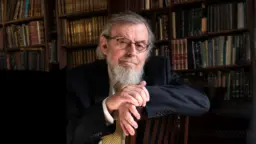
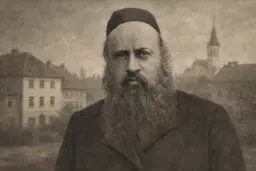
The Ishbitzer

Mordechai Yosef Leiner (1801-1854)

Mordechai Yosef Leiner, known as the Ishbitzer Rebbe, was a 19th-century Hasidic master and the author of the Mei HaShiloach.

Born in Poland, he was a leading disciple of Menachem Mendel of Kotzk before founding his own court in the town of Ishbitz (Izbica). There, he developed a distinctive approach to Hasidic thought that emphasized radical honesty, inner struggle, and the search for God’s will within the complexities of human life.

His teachings, preserved in Mei HaShiloach, are known for their bold and often controversial ideas, particularly regarding free will, sin, and divine providence. The Ishbitzer Rebbe suggested that even human failings may have a place within a larger divine plan, a view that has continued to challenge and inspire readers. His legacy was carried on by his son, Yaakov Leiner of Ishbitz-Radzyn, and remains an influential voice in Hasidic and Jewish philosophical thought.

  • Between Apathy and Zealotry

    The Peril and Promise of Tolerance

    In The Ishbitzer and Parashat Pinchas by Rabbi Nathan Lopes Cardozo

    Is tolerance always a virtue? Parashat Pinchas challenges our modern assumptions, revealing that the line between moral courage and dangerous zealotry is often thin—and blurred. What can we learn from those who refuse to remain indifferent?

  • The Perfect Torah Versus The Evolving Torah – Part 7

    In Jewish Thought and Philosophy and The Ishbitzer by Yehuda DovBer Zirkind

    This is the last of a seven-part series on the thoughts of the Mei HaShiloach, the famous and highly unusual work by the Chassidic thinker, Rabbi Mordechai Joseph Leiner of Izbica. In this essay, Yehuda DovBer Zirkind discusses how the ideas of Mei HaShiloach may impact the future evolution of halachah. Many observations by the Mei HaShiloach touch on my opinion that Halacha will have to liberate itself from what we can only call “Defensive Halacha,” which became the norm while the Jewish people were living in exile.

  • The Perfect Torah versus The Evolving Torah

    The Philosophy of The Mei HaShiloach and Its practical Consequences

    In Jewish Thought and Philosophy and The Ishbitzer by Yehuda DovBer Zirkind

    This is the sixth part of our discussion on the philosophy of the Chassidic thinker, Rabbi Mordechai Yosef Leiner of Izbica, author of the Mei HaShiloach, a most unusual work which in many ways goes far beyond the established norms of orthodox Halacha as we know it today. Yehudah DovBer Zirkind continues to discuss Rav Cardozo's observations, and adds much important information and insights of his own.

  • The Perfect Torah Versus the Evolving Torah – Part 5

    In Jewish Thought and Philosophy and The Ishbitzer by Yehuda DovBer Zirkind

    The Mei HaShiloach’s highly unusual teachings are becoming more and more relevant in our days, as we face greater challenges to Halacha and the Jewish lifestyle. Among these challenges are the establishment of the State of Israel, numerous religious crises, and the challenge of modernity. Can Halacha—which can no longer rely on the strict adherence to its rules, but gets more and more dependent on its ideological and spiritual message and spirituality—guide us in the future?

  • The Perfect Torah Versus the Evolving Torah – Part 4

    In Jewish Thought and Philosophy and The Ishbitzer by Yehuda DovBer Zirkind

    In these trying times, it is of great value to focus on spiritual matters that may move us to a different plain. This will give us comfort, broaden our minds and enlarge our souls, as we carefully follow all the health regulations prescribed by our authorities. Here is the fourth part of Yehudah DovBer Zirkind’s reflections on the ideas of the Mei HaShiloach and my own comments.

  • The Perfect Torah Versus the Evolving Torah – Part 3

    In Jewish Thought and Philosophy and The Ishbitzer by Yehuda DovBer Zirkind

    The two different approaches to the Torah: the “perfect Torah” and the “evolving Torah” approaches are related to a broader theological question about the nature of the mitzvot: Do the mitzvot reflect God’s ultimate and unconditional will (kvayachol), or do they reflect God’s instrumental will for humanity, providing an instruction manual for how to redeem the world? In other words, is the main purpose of the mitzvot for the sake of God (i.e. that humankind should fulfill God’s wishes) or for the sake of man (i.e. that God’s plan for humanity should be realized)?

  • The Perfect Torah versus the Evolving Torah – part 2

    In Jewish Thought and Philosophy and The Ishbitzer by Yehuda DovBer Zirkind

    The giving of the Torah has radically altered the course of Judaism and we cannot revert to a pre-Torah age. Nevertheless, Rabbi Cardozo believes that the vision and spirit of this formative era, i.e. the vibrancy of an inchoate and incipient Judaism - or to borrow a metaphor from biology, a “stem cell” based Judaism - should be kept alive and maintained as a counterweight against the ethos of textual fixation and rigid Halachic codification which is so prevalent within the contemporary Orthodox Jewish world.

  • The Perfect Torah vs. the Evolving Torah

    In Jewish Thought and Philosophy and The Ishbitzer by Yehuda DovBer Zirkind

    Part 1 of a series discussing the ideas of the Chassidic master, Rabbi Mordechai Yosef Leiner of Izbica, Poland (1800-1854), also known as the Mei Hashiloach, after the title of the book containing his teachings.

  • The Perfect Torah Versus the evolving Torah

    In The Ishbitzer by Rabbi Nathan Lopes Cardozo

    Announcing a new initiative by the Cardozo Academy Think Tank: a series of guest essays by Yehudah DovBer Zirkind, based on Rabbi Cardozo's discussion of the Mei Hashiloah, Torah and Halacha.

  • Torah beyond Halakhah – Interview with Rabbi Cardozo – Part Two

    In Halacha, Jewish Thought and Philosophy and The Ishbitzer by Rabbi Nathan Lopes Cardozo

    In last week’s Thoughts to Ponder (no 623), we published the first half of an interview with Rabbi Cardozo. At the end of his observations, Rabbi Cardozo discussed the codification and dogmatization of Jewish Law and religious beliefs as they took place in the diaspora and showed that these developments did not do justice to—and in fact opposed authentic Judaism. Here is the continuation of his arguments.

  • Plato’s Haggada in the “Dialogues”

    In The Ishbitzer and Passover by Rabbi Nathan Lopes Cardozo

    When we read the text on the Seder night, we should be aware that it only provides the opening words. The real Haggada has no text. It is not to be read, but is rather to be heard. And, just as with the Torah, we have not even begun to understand its full meaning. We are simply perpetual beginners.

  • The In-Authenticity of Codifying Jewish Law

    In Halacha, Jewish Thought and Philosophy, Maimonides and The Ishbitzer by Rabbi Nathan Lopes Cardozo

    Halacha is the practical upshot of unfinalized beliefs, a practical way of life while remaining in theological suspense. In matters of the spirit and the quest to find God, it is not possible to come to final conclusions. The quest for God must remain open-ended to enable the human spirit to find its way through trial and discovery.