
Halacha

The Jewish Law

Halakhah is often translated as “Jewish law,” yet its literal meaning is “the way” — the path along which Jewish life unfolds. Rooted in the Torah and shaped through centuries of debate, interpretation, and responsa, Halakhah is not a static code but an ongoing conversation. It seeks to sanctify daily existence, bringing Divine presence into the concrete details of life.

  • Daughters of Tzelafchad

    National maturity and Halachic humility

    In Halacha and Parashat Masei by Yael Shahar

    This week’s Torah reading, parashat Masei, rounds off Sefer BaMidbar (Numbers). Among the narratives of battles, conquests, and politics, we can also discern a subtle shift in divine-human relations: only in the last few parshiot do human beings begin bringing questions and requests to change the law.  In last week’s parashah, the Daughters of Tzelophahad […]

  • Is Halacha Always Indispensable?

    The Tent of Meeting and the Danger of Organized Religion

    In Halacha, Rav Kook and Parashat Pekudei by Rabbi Nathan Lopes Cardozo

    After the sin of the Golden Calf, something fundamental changed in Judaism. According to several classical commentators, the Mishkan and the expansion of mitzvot may represent a Divine concession to human weakness. Could it be that the elaborate structure of Jewish law emerged as a Divine response to human spiritual fragility? But what happens when religion becomes routine? It’s quite possible that Halachah, while indispensable for most, might also carry unexpected risks.

  • Pinchas — Murder or Righteousness?

    In Halacha and Parashat Pinchas by Rabbi Nathan Lopes Cardozo

    There are situations when law itself fails. It cannot legislate for moments of total breakdown. And so someone must act — but this “law” cannot be written into any code.

  • Rabbi Cardozo, guest presenter on The Philosophical Jew

    In Education, Halacha and Jewish Thought and Philosophy by Rabbi Nathan Lopes Cardozo

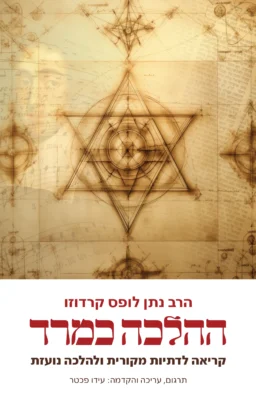
    In this thought-provoking interview on the Philosophical Jew podcast, Rabbi Nathan Lopes Cardozo, delves into the dynamic nature of Halakha and the importance of spiritual authenticity in modern Judaism. Drawing from his work Jewish Law as Rebellion, Rabbi Cardozo challenges us to view Torah not as a static legal code but as a living, breathing call to moral and spiritual revolution.

  • Ido Pachter’s Introduction to Jewish Law as Rebellion – Conclusion

    In Halacha by Rabbi Nathan Lopes Cardozo

    The essence of halakha is to go against the flow of routine. It trains us to find depth and meaning in every action. Through its guidance, all aspects of life gain new perspective, a sense of awe and elevation.

  • Ido Pachter’s Introduction to Jewish Law as Rebellion – Part 3

    In Halacha by Rabbi Nathan Lopes Cardozo

    This week we continue with Rabbi Dr. Ido Pachter's Introduction to the Hebrew translation of Jewish Law as Rebellion. In this week's excerpt, Rabbi Pachter discusses how Rabbi Cardozo's experiences as an outsider contributed to his unusual views on halacha and faith.

  • Ido Pachter’s Introduction to Jewish Law as Rebellion – Part 2

    In Halacha by Rabbi Nathan Lopes Cardozo

    Rabbi Ido Pachter explains how Rabbi Cardozo's upbringing--in particular one memorable encounter with a fervent atheist in synagogue--influenced his unique take on faith and Jewish tradition.

  • A Summary to Nathan Lopes Cardozo’s new Hebrew book: Halacha Ka-Mered

    In Halacha by Rabbi Nathan Lopes Cardozo

    Rabbi Pachter’s new introduction to the Hebrew edition of Jewish Law as Rebellion is very helpful in facilitating a better understanding of the book and of my philosophy. I have translated it into English from the original Hebrew and will be posting it in the coming weeks. To increase the clarity of some of the ideas, I am posting here a kind of “introduction” to Rabbi Pachter’s introduction for those who are not familiar with my perspective on Judaism and Halacha.

  • Horizin through filter

    Panic: The Visible and Invisible

    In Halacha and Jewish Thought and Philosophy by Rabbi Nathan Lopes Cardozo

    Genuine religiosity is demanding - it requires a sensitivity to the physical human condition as well as the hidden, divine dimension. Living in a manner that combines the visible and the invisible, and more so, harmonizing the two as equal components of our lives, is a tremendous challenge. It is too easy to make a selection - as many individuals and even religions do - between the visible and invisible, preferring one over the other. However, living the one with an imbalance regarding the other is not what Judaism teaches.

  • New moon rising

    Adar Sheni and God Awareness

    In Halacha by Rabbi Nathan Lopes Cardozo

    The Jewish Calendar is an intricate, complex and complicated system that requires the input of the greatest sages, astronomers and mathematicians in order to have a calendar based on the lunar year yet coincide with the solar calendar and seasons. Seemingly, it would be far simpler to follow either the lunar or solar calendar. The secret of the Jewish calendar is the creation of a constant awareness of God's presence.

1 2 3 8