
Halacha

The Jewish Law

Halakhah is often translated as “Jewish law,” yet its literal meaning is “the way” — the path along which Jewish life unfolds. Rooted in the Torah and shaped through centuries of debate, interpretation, and responsa, Halakhah is not a static code but an ongoing conversation. It seeks to sanctify daily existence, bringing Divine presence into the concrete details of life.

  • Chimpanzee

    Shemita: How not to be a Chimpanzee

    In Halacha, Jewish Thought and Philosophy and Parashat Behar by Rabbi Nathan Lopes Cardozo

    What defines us? Is it what we do, or rather, who we are? If a human being is nothing more than the tasks he performs on a daily basis, then a mere chimpanzee can take his place and possible perform these tasks as well and even better. However, if we understand that the tasks themselves do not define us, but rather can act as a means to an end, as the means that allows us to realize our dreams, then only we can perform the tasks successfully over time. The Sabbatical year, Shemita, that we mark during the current year teaches us this important lesson; all that is left for us to do is to open ourselves to the Torah's teachings in this sphere.


  • Chanukah Menora

    Is it Possible to Be Religious?

    In Halacha and Hanukkah by Rabbi Nathan Lopes Cardozo

    One of the great problems any religious person should struggle with is whether it is actually possible to be religious. In fact, what is the essence of genuine religiosity? The concept at the root of all religions is the awareness that it is extremely difficult to live up to the awe of the moment. The famous dispute regarding the order of lighting the Chanukah lights illuminates a practical approach to this issue.

  • Man against horizon

    Happiness: Crawling Through One’s Own Web

    In Halacha and Jewish Thought and Philosophy by Rabbi Nathan Lopes Cardozo

    Question: My whole life I saved and saved, and as a result lived a very modest life - I was always told to prepare for a rainy day. Now I am already toward the end my life, have amassed significant funds, and am able to leave an inheritance for my children. However, on reflection I feel something is missing... did I live my life correctly?

  • The Wisdom of the Bus Driver: Love Your Fellow As Yourself!

    In Halacha and Jewish Thought and Philosophy by Rabbi Nathan Lopes Cardozo

    Loving one's fellow as oneself is a central tenet and practical commandment of our religion. And yet, as simple as it sounds, its application is extremely difficult. Even those well-versed in the intricacies of the significance and laws governing this precept have difficulty incorporating it into their inner selves and actions. On occasion, it takes the insight and words of a bus driver to properly inculcate this love for one's fellow.

  • Truth, Compromise, and Meta-Halakhah

    In Halacha and Jewish Thought and Philosophy by Yael Shahar

    The Talmud manages to do what few legal systems even attempt: it integrates psychological and moral issues seamlessly with normative legal guidelines. But to appreciate the full extent of this integration, it's important to pay attention to something that is too often left out of today's Gemara classes: the aggadah.

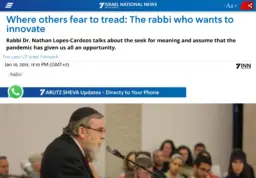
  • Where others fear to tread: The rabbi who wants to innovate

    In Halacha by Yael Shahar

    Rabbi Dr. Nathan Lopes-Cardozo talks about the seek for meaning and assume that the pandemic has given us all an opportunity.

  • Rav Kook & Aggadata

    Aggadah and the Tragedy of “Secularism” in Religious Jewish Education

    The Upcoming Post Corona Crisis - Part 5

    In Halacha, Jewish Thought and Philosophy and Rav Kook by Rabbi Nathan Lopes Cardozo

    In returning the prophetic spirit to Judaism, the world of Aggadah is of crucial importance. Aggadah is the prophetic voice within Judaism, where prophecy not only speaks, but allows the reader to answer. It is the part of Judaism that deals with the sum total of human life. It prevents mechanical observance by freeing our inner spirit. Whereas Halacha is the consummation, Aggadah is its aspiration.

  • The Upcoming Post Corona Crisis – Part 3

    In Halacha by Rabbi Nathan Lopes Cardozo

    Halacha was meant to rely heavily rely on the prophetic voice to give it its spirit and motivation. Because of the absence of prophecy, this spiritual component is missing or overlooked in our day-to-day experience. It is the absence of this prophetic dimension that underlies the spiritual malaise in which we currently find ourselves.

  • Musical notes

    Bach, Mozart, and Beethoven: How to be a Genuine Halachic Expert

    In Halacha, Jewish Thought and Philosophy and Parashat Yitro by Rabbi Nathan Lopes Cardozo

    To be an arbiter of Jewish law is to be the conductor of an orchestra. It is not coercion but persuasion that makes it possible for the other to hear the beauty of the music and to accept a halachic decision, just as one would willingly listen to the interpretation of a conductor—because one is deeply inspired.

  • Jerusalem light rail

    Some Bold Ideas

    How to Observe Shabbat, take the Tram and go to a Restaurant!

    In Halacha and Shabbat by Rabbi Nathan Lopes Cardozo

    It is clear a greater number of secular Israelis would like to become more observant. However, for various practical reasons, or due to social pressures, they are unable to make this switch. One of the great challenges, if not the greatest, is Shabbat, the only official day of rest in Israeli society, when people enjoy visiting people, or meeting friends at a restaurant. But none of this is possible without the use of cars or taxis and with no open restaurants. Here are some suggestions to overcome these obstacles

  • The Purpose of Judaism is to Disturb

    Halacha and the Microscopic Search for God

    In Halacha, Jewish Thought and Philosophy and Parashat Re'eh by Rabbi Nathan Lopes Cardozo

    Judaism is a protest against taking life for granted. There are no insignificant phenomena or deeds in this world, and it is through Halacha's demands and interference in our daily life that we are made aware of God as our steadfast Companion.