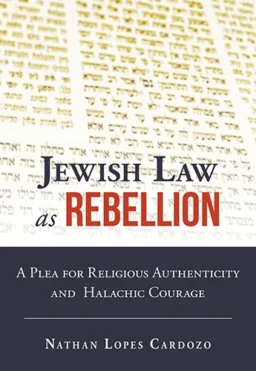

Halacha

The Jewish Law

Halakhah is often translated as “Jewish law,” yet its literal meaning is “the way” — the path along which Jewish life unfolds. Rooted in the Torah and shaped through centuries of debate, interpretation, and responsa, Halakhah is not a static code but an ongoing conversation. It seeks to sanctify daily existence, bringing Divine presence into the concrete details of life.

  • Halacha means Liberty

    To Be Secular Would Be Hell: Everything Would Be Forbidden

    In Halacha by Rabbi Nathan Lopes Cardozo

    A strictly secular approach to major moral issues may have to be much more restrictive than that which any religion would ever demand. In fact, a secular moral attitude may make life extremely difficult and even impossible.
  • The In-Authenticity of Codifying Jewish Law

    In Halacha, Jewish Thought and Philosophy, Maimonides and The Ishbitzer by Rabbi Nathan Lopes Cardozo

    Halacha is the practical upshot of unfinalized beliefs, a practical way of life while remaining in theological suspense. In matters of the spirit and the quest to find God, it is not possible to come to final conclusions. The quest for God must remain open-ended to enable the human spirit to find its way through trial and discovery.

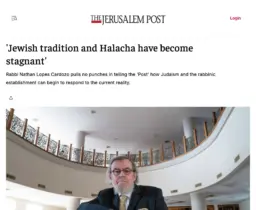
  • Jewish Tradition & Halacha Have Become Stagnant – An Interview

    In Halacha by Yael Shahar

    In this interview, Rabbi Cardozo argues that Halacha must evolve to meet modern realities while maintaining its ethical core, while remaining true to the framework of Orthodox Judaism.

  • The Bet Midrash of Avraham Avinu: Embryonic Judaism

    In Halacha by Rabbi Nathan Lopes Cardozo

    Every generation must find its own way to God and subsequently to the Jewish tradition. From a religious point of view, were this not the case, there would be little reason for that generation to exist. What, after all, is the meaning of human existence if not to reveal another dimension of God’s multi-colored world and Torah, and thus to gain a greater understanding of self?

  • The Bet Midrash of Avraham Avinu – The Scandal of Halachic Performance

    In Halacha by Rabbi Nathan Lopes Cardozo

    The very fact that today we encounter a serious endeavor to see Halacha as the only expression of Judaism, and that some halachic authorities constantly attempt to bring the hashkafa (religious philosophy) of Judaism back to finalized dogmas, is a clear indication that those very authorities try to Halacha-ize issues of faith. But doing so robs Judaism of its vital flowing life force. We need to understand that Halacha is the practical upshot of un-finalized beliefs, a practical way of living while remaining in theological suspense.

  • Open Think Tank meeting - March 2017

    Survey of 5777 Activities at the DCA Think Tank

    In Education and Halacha by Yael Shahar

    We're delighted to share with you a full-color bulletin with photos detailing what the David Cardozo Academy Think Tank has been up to this year - our regular activities plus an Open Think Tank for the public in March. There are also questions for you to ponder - it wouldn't be the DCA Think Tank without them! 

  • Betraying Judaism in the Name of Halacha

    In Halacha by Rabbi Nathan Lopes Cardozo

    In Biblical days the Halacha was astir while the world was sleeping. Today the world is astir while the Halacha is sleeping.  Only when it wakes up and starts to challenge our society with novel ideas and rulings will it once more be the vital mover of Jewish life. It must be prepared to look inward, challenge its own verdicts and once again understand that its main function is to protest and rebel.

  • Halacha: To Trouble the Comfortable

    In Halacha by Rabbi Nathan Lopes Cardozo

    For a nation to maintain sensitivity and concern for “the other,” it must continue to live in some form of strangerhood. It must never be fully secure, and must constantly be aware of its own existential uncertainty. As such, the Jew is to be a stranger.

  • The Problem and Future of True Halacha

    In Halacha by Rabbi Nathan Lopes Cardozo

    Like the generation of the Tower of Babel, in which the whole world was “of one language and of one speech,” we are producing a religious Jewish community of artificial conformism in which independent thought and difference of opinion is not only condemned, but its absence is considered to be the ultimate ideal.

  • In Defense of Rabbi Dweck and Orthodox Judaism

    In Halacha by Rabbi Nathan Lopes Cardozo

    If the Spanish-Portuguese community and Chief Rabbi Mervis give in to blatant blackmail by ultra-Orthodox elements then rabbis will no longer be able to speak their minds. The S&P and other communities will lose their independence and be subject to censure by all sorts of self-acclaimed rabbinical extremists, creating a situation that will terribly compromise Judaism.

  • In Defense of Rav Soloveitchik – A Response to Rabbi Cardozo

    In Education, Halacha and Jewish Thought and Philosophy by Yael Shahar

    A sharp critique of Rabbi Cardozo’s views, arguing that his analysis of Rav Soloveitchik is mistaken and reflecting broader resistance to his reinterpretations of traditional Orthodox thought.

  • Rabbi J.B. Soloveitchik and his Paradoxical Influence

    In Halacha and Jewish Thought and Philosophy by Rabbi Nathan Lopes Cardozo

    While I greatly admire Rabbi Soloveitchik’s essays such as The Lonely Man of Faith, I wonder why he never addressed some of the issues that keep many people away from Orthodoxy, such as the issue of Torah Min HaShamayim and Bible criticism. It may be true that the Rav avoided the issue of Bible criticism out of principle. But if so, then he was out of touch with reality. At the time, Bible criticism was a major topic of discussion, as it still is. This subject is of utmost importance, and if anyone could have dealt with it head-on it was the Rav.