
Spinoza

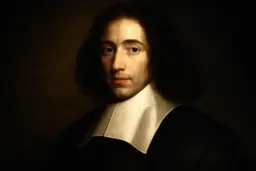
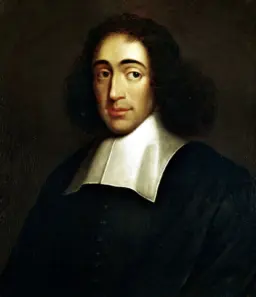
Baruch Spinoza (1632 – 1677)

Baruch Spinoza was a Dutch philosopher of Portuguese-Jewish descent, often considered one of the great rationalists of the 17th century, alongside Descartes and Leibniz. His major work, the Ethics, presents a bold and systematic vision of reality, God, and human nature.

  • Tolerance and the Obsession with Spinoza

    In Rav Kook and Spinoza by Rabbi Nathan Lopes Cardozo

    Does lifting the ban on Spinoza honor intellectual freedom—or quietly endorse his misunderstandings of Judaism? As we wrestle wrestles with this question, we reveal a deeper tension: reason itself may not be as neutral—or as reliable—as we assume.

  • Korach, Spinoza, and Other Heretics

    In Spinoza and Parashat Korach by Yael Shahar

    Both Korach and Spinoza were great minds, and both overreached. Ambition, grievance, or subconscious longing coloured how they understood and read their tradition.

  • Spinoza, the Alter Rebbe, and the Eternal Fire

    In Jewish Thought and Philosophy, Spinoza and Parashat Tzav by Rabbi Nathan Lopes Cardozo

    The Talmud states that all the sacrifices were consumed by a heavenly fire, not by the fire lit by the Cohanim. This seems to imply that there was absolutely no need to keep the human fire on the altar burning so as to consume the sacrifices. So why were the Cohanim commanded to keep the fire on the altar lit? It seems that an answer may be found in contrasting the teachings of two very different thinkers--Spinoza, who famously did not believe in miracles, and the Alter Rebbe, who believed the existence itself is a miracle.

  • An Open Letter to Rabbi Serfaty, The Portuguese-Spanish Synagogue, Amsterdam

    In Jewish Thought and Philosophy and Spinoza by Rabbi Nathan Lopes Cardozo

    As an orthodox Rabbi who studied in the ultra-Orthodox Gateshead Yeshiva in England for many years and who has read all of Spinoza’s works, I am of the opinion that Spinoza sometimes deliberately misrepresents Judaism. I am also aware that Spinoza wrote remarkable, noble observations about human beings, nature and society which have helped all of us. I strongly object to deeming anyone who studies, researches and teaches Spinoza a “persona non grata.”

  • A Short Introduction to God

    In Jewish Thought and Philosophy and Spinoza by Rabbi Nathan Lopes Cardozo

    While in pantheistic and other non-monotheistic philosophies, the Divine has no moral input, nothing could be further from the Jewish concept of God. For Judaism, God is the source par excellence of all moral criteria. And yet, on occasion He Himself seems to violate these very moral criteria — such as in the case when He causes a devastating flood in the days of Noah. God is a conscious Being Who created the world with a purpose. And this world is real and by no means a mirage. The human being’s deeds are of great value, far from an illusion; they are the very goal of creation. Judaism objects to the pantheistic view of the human being since it depersonalizes him, ultimately leading to his demoralization.

  • My Father and Spinoza

    In Spinoza by Rabbi Nathan Lopes Cardozo

    My father constantly spoke about the famous, highly controversial philosopher Baruch Spinoza (1632-1677). Spinoza was raised in the Portuguese Spanish Jewish Community whose members had fled from Spain and Portugal to the Netherlands after the Inquisition in 1492, a fate shared by my own family. Spinoza's attacks against Judaism made me wonder what Judaism was all about and why he so strongly opposed it. Thus, paradoxically, it was Spinoza who set me on the road to Judaism.

  • The Kotzker, Spinoza and I – Ten Questions for Rabbi Cardozo by Rav Ari Ze’ev Schwartz

    In Jewish Thought and Philosophy, Spinoza and The Kotzker Rebbe by Rabbi Nathan Lopes Cardozo

    I've always wondered what would have happened if Spinoza had met the Kotzker. Both were obsessed with truth, but each approached it from a different point of view. In Spinoza's pantheism, there is a strong Kabbalistic element but, simultaneously, a denial of a personal (biblical) God. However much some Spinoza scholars want to claim that all of his philosophy was based on pure reason, it is very clear that there are elements in his philosophy that reveal aspects of mysticism. Both were searching for God and knew no compromise.

  • The Modern Day Inquisition against Rabbi Joseph Dweck

    A Tragic Story of Rabbinical Small-mindedness

    In Jewish Thought and Philosophy and Spinoza by Rabbi Nathan Lopes Cardozo

    When Orthodox rabbis are told that they are no longer able to speak their minds, offer new insights into Orthodox Judaism, or try to find solutions to serious problems by using innovative ideas, we are faced with a rabbinical world that is wearing blinders, is comprised of yes-people looking over their shoulders, and is generating a hazardous small-mindedness that has far-reaching effects.

  • Rambam and Spinoza

    Progressive or Regressive Judaism?

    In Maimonides, Spinoza and Parashat Vayikra by Rabbi Nathan Lopes Cardozo

    We need to ask ourselves a pertinent question: Is our aversion to sacrifices the result of our supreme spiritual sophistication, which caused us to leave the world of sacrifices behind us? Or, have we sunk so low that we aren’t even able to reach the level of idol worshipers who, however primitive we believe them to have been, possessed a higher spiritual level than some of us who call ourselves monotheists?

  • Video Recordings of the Spinoza Symposium in Amsterdam

    In Spinoza by The Cardozo Academy

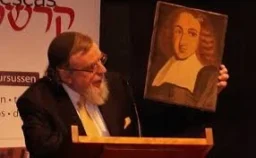
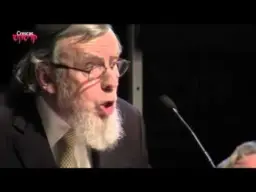
    Dear Friends, Shalom U-vracha. Below is the link to the video recordings of the Spinoza Symposium in Amsterdam, which was held on December 6, 2015, organized by the University of Amsterdam and the Crescas Center. All lectures are in English. Enjoy, Nathan Lopes Cardozo http://www.crescas.nl/video/baz/de-casus-spinoza-sprekers-en-rondetafel-discussie/

  • Spinoza and the Question of Orthodoxy

    Reply to a Jerusalem Rabbi

    In Education, Jewish Thought and Philosophy and Spinoza by Rabbi Nathan Lopes Cardozo

    Should Judaism fear its heretics? The centuries-old ban on Spinoza raises a deeper question: is banning an admission of strength—or of insecurity? This essay challenges us to reconsider whether a confident tradition needs protection from ideas, or whether it should confront them head-on.