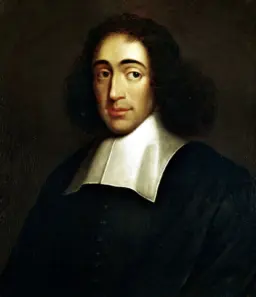

Spinoza

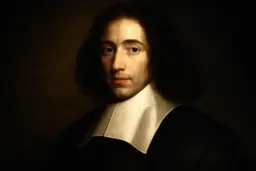
Baruch Spinoza (1632 – 1677)

Baruch Spinoza was a Dutch philosopher of Portuguese-Jewish descent, often considered one of the great rationalists of the 17th century, alongside Descartes and Leibniz. His major work, the Ethics, presents a bold and systematic vision of reality, God, and human nature.

  • Spinoza’s Blunder And Noach’s Misguided Religiosity

    In Spinoza, The Kotzker Rebbe and Parashat Noach by Rabbi Nathan Lopes Cardozo

    In his Tractatus Theologico-Politicus, Spinoza accuses Judaism of demanding obsessive and outrageous obedience. Parashat Noach teaches us that while Spinoza’s assessment is entirely mistaken, it is a warning to many religious Jews who know nothing other than "negative" obedience as opposed to positive obedience. Judaism teaches us to stand on our own feet and make our own decisions.

  • Spinoza’s Sub Specie Aeternitatis and Yeshiva Students

    In Halacha and Spinoza by Rabbi Nathan Lopes Cardozo

    Whenever I think of the huge demonstration of Chareidi yeshiva students at the beginning of this month, I think of Gateshead Yeshiva in England where I spent many years studying Talmud.

  • Halakhah as Symphony

    From the Ideal to the Idyllic

    In Halacha and Spinoza by Rabbi Nathan Lopes Cardozo

    Critics from Paul to Spinoza saw Jewish law as a system of rigid rules that suffocate the spirit. But what if the opposite is true? Perhaps Halacha is not meant to suppress creativity but to awaken it. Like the notes of a musical score, the mitzvot guide human action until life itself becomes a living composition—one in which the soul finally hears the music of God.

  • Baruch Spinoza and Johann Sebastian Bach

    The tragedy of the meeting that never happened

    In Halacha and Spinoza by Rabbi Nathan Lopes Cardozo

    What if two of Europe’s greatest minds had met—Baruch Spinoza, the philosopher who rejected Jewish law, and Johann Sebastian Bach, the composer who obeyed every rule of musical composition? Bach’s music provides the perfect response to Spinoza’s critique of Halacha: true creativity is not born from rejecting rules, but from mastering them. The law, far from suppressing the soul, becomes the instrument through which it sings.