Thoughts to Ponder is a weekly invitation to think dangerously and question passionately. Drawing on the Torah portion, classical Jewish sources, philosophy, and the crises of contemporary life, Rabbi Cardozo challenges religious complacency and spiritual comfort. These essays are written for readers who seek a Judaism that disturbs, questions, and ultimately deepens the human encounter with God and responsibility.
While important in its own right, fighting antisemitism is not an answer to assimilation. We need to bring an uplifting and transformative Judaism to our young people and turn being Jewish into an experience of moral and religious grandeur. We must show that Judaism ennobles the commonplace, endowing all worldly matters with hieratic beauty and transcending holiness.
The biggest questions about life are unanswerable. Not one philosopher has ever given a satisfactory answer to these questions; neither has science or any other form of human knowledge. Logic and science tell us about the “what” and the “how” but not about the “why”. They fall flat when it comes to the “ultimate” questions. But if this is the case, why ask questions which are unanswerable?
Chanukah, the Jews, and the Nature of Anti-Semitism
It must have been an extraordinary experience when the Kohanim in the days of the Chashmonaim suddenly realized that a tiny amount of oil which should have lasted for only one day would last for eight days. A solemn terror must have overtaken them.
This is the foundation of genuine religiosity; the dawning of awareness that all things cannot be explained by the ordinary. It is radical amazement, which shatters the commonplace and makes us realize that our wisdom is sometimes inferior to dust.
And so it is with the Jews. Like the Chanukah lights, they keep on reminding the world that there is exceptionality, which transcends history and ordinary human accomplishments.
With the terrible pogrom which took place in my hometown, Amsterdam, and the ongoing Anti-Semitism in Europe, the United States, and indeed worldwide, it is time to give proper attention to one of the great mistakes of modern Jewish history. This is the myth that if Jews would only “normalize” themselves, anti-Semitism would come to an end. This constantly repeated mantra has proven to be entirely wrong and in fact, dangerous.
Ido Pachter’s Introduction to Jewish Law as Rebellion – Conclusion
The essence of halakha is to go against the flow of routine. It trains us to find depth and meaning in every action. Through its guidance, all aspects of life gain new perspective, a sense of awe and elevation.
The Shofar, my Grandchildren, and the Sound of the Great Lion
We are God’s stake in human history and we could not make a greater mistake than to believe that we could ever be a nation like other nations. This is our great challenge. Will we remain complacent, letting the shofar sit in the cupboard, never daring to go beyond ourselves? Or will we have the nerve to blow the shofar and produce something which surpasses ourselves?
Ido Pachter’s Introduction to Jewish Law as Rebellion – Part 4
When I decided to study at the ultra-orthodox Gateshead Yeshiva, I learned that Judaism consists of a world view of tremendous depth, which is expressed in deeds and rituals that penetrate the deepest dimensions of the human being. I discovered Judaism in a different way than my fellow Yeshiva students did. They had grown up within Judaism, and thus were not able to see it from the outside as I did. They were so used to the splendor of Judaism that they were blinded by it and so no longer could they perceive it. At a later stage of my life, I myself fell victim to this same problem. I realized that I had lost my earlier fascination and had to start all over again. In this essay, Rabbi Pachter explains how I tried to do this.
Ido Pachter’s Introduction to Jewish Law as Rebellion – Part 3
This week we continue with Rabbi Dr. Ido Pachter's Introduction to the Hebrew translation of Jewish Law as Rebellion. In this week's excerpt, Rabbi Pachter discusses how Rabbi Cardozo's experiences as an outsider contributed to his unusual views on halacha and faith.
Ido Pachter’s Introduction to Jewish Law as Rebellion – Part 2
Rabbi Ido Pachter explains how Rabbi Cardozo's upbringing--in particular one memorable encounter with a fervent atheist in synagogue--influenced his unique take on faith and Jewish tradition.
Ido Pachter’s Introduction to Jewish Law as Rebellion – Part 1
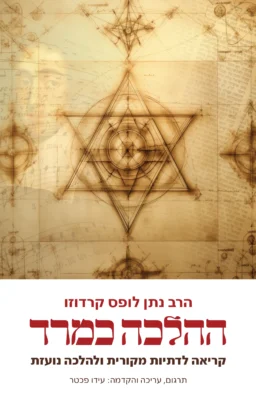
Rabbi Dr. Ido Pachter has provided an intriguing introduction to his Hebrew translation of my book: Jewish Law as Rebellion, A Plea for Religious Authenticity and Halachic Courage (Urim Publication, 2018). The book was published by Yediot Acharonot in May of this year under the title: ההלכה כמרד: קריה לדתיות מקורית והלכה נועזת
I have translated Rav Pachter’s introduction into English, Part 1 of which is included here.
A Summary to Nathan Lopes Cardozo’s new Hebrew book: Halacha Ka-Mered
Rabbi Pachter’s new introduction to the Hebrew edition of Jewish Law as Rebellion is very helpful in facilitating a better understanding of the book and of my philosophy. I have translated it into English from the original Hebrew and will be posting it in the coming weeks. To increase the clarity of some of the ideas, I am posting here a kind of “introduction” to Rabbi Pachter’s introduction for those who are not familiar with my perspective on Judaism and Halacha.
Parashat Chukat – The Red Heifer and the Meaning of Life
This week’s parashah opens with the perplexing law of the Red Heifer, whose ashes purify one who has come into contact with the dead. This strange ritual requires that “a red cow without blemish, in which there is no defect and on which no yoke has been laid” be slaughtered, then burned and its ashes mixed with water. This water would be held in reserve to be sprinkled over an individual who had come into contact with a corpse and was consequently ritually “impure”. Even stranger is the fact that the priest who prepares this purifying water, by his involvement with the preparation process, become impure!
This law is held up as the exemplar of a “Chok”—a commandment for which no obvious rationale can be found. Such a law is very different from the “Mishpatim”—those commandments whose moral or intellectual underpinnings are clear and reasonable. What are we to make of this “irrational law” of the Red Heifer?