Beginning Again
God is the ultimate paradox. Every truth about Him has its counterpart which contradicts it. Every philosophy about Him carries within it its own contradiction.
Donate now to our High Holiday Campaign


Thoughts to Ponder is a weekly invitation to think dangerously and question passionately. Drawing on the Torah portion, classical Jewish sources, philosophy, and the crises of contemporary life, Rabbi Cardozo challenges religious complacency and spiritual comfort. These essays are written for readers who seek a Judaism that disturbs, questions, and ultimately deepens the human encounter with God and responsibility.
God is the ultimate paradox. Every truth about Him has its counterpart which contradicts it. Every philosophy about Him carries within it its own contradiction.
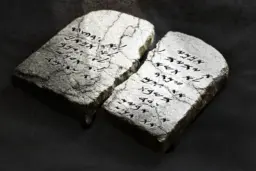
The Breaking of the Tablets
In Moses, The Kotzker Rebbe and Parashat V'Zot HaBerachah by Rabbi Nathan Lopes Cardozo
Moshe Rabbenu’s greatest deed wasn’t splitting the Sea or ascending Sinai. It was shattering the God-engraved Tablets when Israel danced around the Calf. And yet, for this act, Moshe is praised by our sages. Moshe’s audacity saved Torah from becoming stone: a law without music, ritual without spirit. What he broke, he preserved—so that covenant could live.

In Heschel and Parashat Ha'azinu by Rabbi Nathan Lopes Cardozo
Moshes’ final ascent in Ha’azinu is not a defeat but a masterclass in how to die—by first learning how to live. Ha’azinu invites us to hear life as a composition: rehearsed through daily practice and resolved in a final, dignified cadence. To live and die with grace is not resignation but art: shaping a soul that can leave a world more awake than we found it.
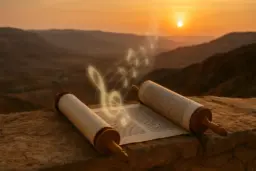
In Vayelech, God tells Moshe not only to teach Torah—but to write a song. Why a song at the edge of exile and failure? Because melody reaches where prose cannot. From the Levitical choir to the sing-song of the beit midrash, song resists staleness, awakens teshuvah, and turns text into encounter—until we no longer just read Torah; we become its music.
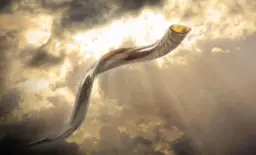
In Rosh Hashanah and Yom Kippur by Rabbi Nathan Lopes Cardozo
Rosh Hashana and Yom Kippur are a protest against the most dangerous of all human character traits: the curse of indifference—they are a protest against taking life for granted.
Maps, Courage, and the Call of Nitzavim
We often accept maps that omit the landmarks that matter most, because accurate maps would oblige us to change. Nitzavim counters: the commandment is not distant but close. This essay argues that mediocrity grows where fear governs, and that faith means becoming a ‘text‑person’—a living Sefer Torah—who acts on the truth already inscribed in the heart.

In Moses and Parashat Ki Tavo by Rabbi Nathan Lopes Cardozo
Ki Tavo’s strangest verb—he’emarta—hints at a mutual avowal: Israel “says” God into the world by living the commandments, and God “says” Israel into being as a holy people. This essay moves beyond proofs of “existence” to ask how God becomes audible in history, from Maimonides to a Hasidic teaching about the silent Aleph of “Anochi.”

In Abraham and Parashat Ki Teitzei by Rabbi Nathan Lopes Cardozo
The Talmud seems to compare marriage to the purchase of land. But is this comparison really what it seems? In fact, we can flip the script: the Talmud’s comparison isn’t reducing a woman to property; it elevates the Land of Israel to a covenantal spouse. A ring becomes a down payment on lifelong responsibility; the land, a living partner that must be continually ‘courted.’ What if marriage teaches us how to love a land—and a land teaches us how to be a partner?
What kind of state is Israel meant to be — a halachic theocracy, or a secular democracy with Jewish values? Long before the founding of the State, Rabbis Yitzchak Herzog and Chaim Ozer Grodzinski debated this very question. Surprisingly, it was the ultra-Orthodox Grodzinski who favored allowing secular law, while the Zionist Herzog objected. This essay explores a forgotten halachic precedent, the role of the King in Torah law, and why the clash between divine justice and human law still shapes Israel today.

When the Torah tells us to choose between a blessing and a curse, it means: Choose after the struggle. The blessing can only be recognized by those who have grappled with its alternative. What one calls a blessing, another may call a curse. What one sees as life, another may call death.
Parashat Ekev commands us to “remember” — but in Torah, memory is never nostalgia. It is the radical act of making covenantal history a living, breathing reality in every generation.
For what great nation is there that has God so near to them… Only take heed and guard your soul diligently, lest you forget the things your eyes have seen… Devarim 4:7–9 In June of 2025, an essay began circulating in social media that raised some intriguing points about Western animosity toward Israel. The essay, […]