The Eternal spoke to Moses, saying: This shall be the ritual for a metzora at the time of being purified. When it has been reported to the priest, the priest shall go outside the camp. If the priest sees that the metzora has been healed of the affliction, the priest shall order two live pure birds, cedar wood, crimson stuff, and hyssop to be brought for the one to be purified.
Vayikra 14:1-3
I write this as Israel’s war against its arch enemies enters a new stage. More and more Israelis are discussing what will happen “the day after”.[1] They wonder how the current highly unusual unity in Israeli society will prevail after things go back to “normal”.
They are fully aware that before the war, Israel was split into two camps, and bitter animosity was slowly taking over Israeli society, to the extent that many people were afraid of civil war. It was as if Israel was imploding.
Once the war started, all this came to an abrupt end and suddenly an unprecedented harmony settled upon us in which “arch enemies”, suddenly found themselves serving together in the same army units. The common purpose and infinite love among the people of Israel overcame all differences.
All this does not mean that people suddenly agreed. That would be illogical and would indicate a kind of totalitarianism. Differences of opinion, even sharp ones, are part of human nature and are necessary for a healthy society. Surely serious discussions concerning religion, government and politics are of the greatest necessity in Israeli society.
What needs to change radically in Israel is the way differing opinions are expressed.
Unity has never relied on uniformity of opinion but on honest and respectful argument.
The most important condition for a genuine debate is to attack the message and not the messenger. Personal animosity has no place in any debate. To attempt to silence one’s opponents is not a “difference of opinion” but an attack on human dignity, a dehumanization of the other. Ad hominem attacks result in deep resentment, and prevent an honest exchange of opinions.
The Jewish tradition of debate
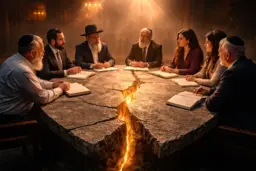
If there is one value we can learn from Judaism, it is its love for debate. Looking at the Talmud, the great reservoir of Jewish wisdom, reveals that this work of more than twenty-five huge volumes consists mainly of fierce arguments among hundreds of sages who lived over a time span of about four hundred years. Most remarkable is the fact that many of these sages never met each other, and did not even live at the same time. Their statements were purposely set out against each other by the redactors of the Talmud. These arguments are often called “arguments for the sake of Heaven” — “holy arguments”.
While these arguments were sharp — and perhaps painful — they never turned into personal attacks. The sages were fully aware of the enormous damage which could result if debates turned into personal attacks. They would ultimately lead to evil speech, slander, and false accusations.
The Metzora
The sages learned this from a phenomenon described in the Torah (Vayikra 14:1-37). There, we find the case of the “metzora”, a person afflicted with an unusual condition, in which his home, his possessions, and ultimate his own skin was stricken. This malady was called “tzara’at”. It has mistakenly been translated as leprosy, but is really a kind of miraculous infection which can spread throughout all of society, penetrating its very fiber.
The Rambam, in his famous work, Mishneh Torah (Hilchot Tumat Tzara’at, 16,10) gives a remarkable account of this:
Tzara’at is a collective term including many afflictions that do not resemble one another. For the whitening of a person’s skin is called tzara’at, as is the falling out of some of the hair of his head or beard, and the change of the color of clothes or houses.
This change that affects clothes and houses which the Torah described with the general term of tzara’at is not a natural occurrence. Rather, it is a sign and a wonder prevalent among the Jewish people to warn them against lashon hara, “undesirable speech.” When a person speaks lashon hara, the walls of his house change color. If he repents, the house will be purified. If, however, he persists in his wickedness until the house is destroyed, the leather implements in his house upon which he sits and lies change color. If he repents, they will be purified. If he persists in his wickedness until they are burnt, the clothes he wears change color. If he repents, they will be purified. If he persists in his wickedness until they are burnt, his skin undergoes changes and he develops tzara’at. This causes him to be isolated and for it to be made known that he must remain alone so that he will not be involved in the talk of the wicked which is folly and lashon hara.
This is a most remarkable process. The more the slanderer speaks evil of others, the more he is excluded from society. His neighbors see how his home is physically affected, then his furniture, his garments, and ultimately his body.
This is visible to everyone. He cannot hide his sin. This must be extremely embarrassing. One wonders why this person does not immediately stop speaking evil. Who wants his sins to be exposed in public? He will be pointed at wherever he goes!
If such a condition no longer causes outrage, then there can only be one answer: people have ceased to care! Lashon hara is contagious. It becomes the norm. Once one human being starts speaking slander, it will spread, and many more people will follow. In that case a whole society will convince itself that there is nothing wrong with it.
Instead, they will explain the illness of tzara’at as a rash, a genital infection, or a skin disorder.
The modern affliction of tzara’at
In our days we see how true this is. The entire tone of public conversation has turned into lashon hara, aided by smartphones and social media. The enormous damage this causes is no longer recognized and is argued away.
Even when it is as clear as the sun why our society is disintegrating — the reason its moral values are undermined — people will insist that this has nothing to do with the way they relate to one another and speak about each other. Instead, they will blame a bad economy, lack of leadership, an epidemic, religious fanaticism, wars . . .
Not a word is said about the real root of many of these disasters: evil speech. And note that “evil speech” includes not only speaking ill of someone, but also speaking ill to someone!
The current plague of hostile speech is also caused by the ease and anonymity of modern communication. The more smartphones and other devices have taken over our society, the easier it is to speak lashon hara without physically interacting with another human being, and the freer people feel to be cruel and crude.
It is this huge problem which the punishment of tzara’at was meant to counter. And yet, after the time of the Temple we see no evidence that God ever applied this “ailment”. The reason is probably that people continued to speak lashon hara and argued this Divine castigation away. God, so to speak, gave up on trying to help people who refused to help themselves.
Why is lashon hara so prevalent?
After thinking a little more about why we speak lashon hara, we realize that the reason we continue to do so lies deeper than we think. The underlying reason that lashon hara is so attractive is that it is a smokescreen for our own shortcomings. We distrust ourselves, and we cover this up by speaking badly of others.
It is a bit like the optical illusion where two glass elevators move in opposite directions. At the moment that one of them descends, we get the impression that the other one we’re in is going up.
This is the charm of lashon hara, and also its cowardice.
In general, people who have nothing of substance to say are the ones who speak lashon hara. They compensate for their intellectual and spiritual emptiness, and looking for a way out, they seize on the easiest thing to speak about: their fellows.
The need for “tongue control”
What is needed is a campaign throughout the country to teach people how to express their opinions respectfully, while emphasizing that lashon hara is demeaning to the speaker no less than to the victim. People need to learn that their words will be much more effective when they speak calmly and show love and respect to those with whom they disagree.
Above all, social media companies must stop fostering an atmosphere of animosity and depersonalization. In many ways it is this atmosphere that does the greatest harm. The constant incitement undermines the possibility of an honest national debate.
Even worse is the constant sense of doom. Social media’s focus on the negative creates feelings of hopelessness, as if all is already lost. But it definitely is not. While Israel finds itself in a very difficult and painful situation, it is most remarkable how well Israeli life keeps itself together and performs formidably under war conditions. Most of life is relatively good. The incredible courage of our soldiers, the ongoing charity, altruism, kindness, and mutual assistance among our people is beyond our wildest imagination.
In these days it is the moral obligation of social media users to help foster a more optimistic atmosphere, so that we see the good and not only the bad. Television and other media outlets should do everything to advance this and stop setting leaders and other people up against each other.
In the meantime, it is of utmost importance that our families, as well as the educational system in Israel provide us and our children with the tools to control our speech. For this is one of the hallmarks of great people. The noble teachings of the Jewish Tradition could greatly help with this.
Once this happens, the spirit in Israel will change for the better and an honest debate can take place about its future. This is something we would all like to see.
Questions to Ponder
- Rabbi Cardozo writes: “Differences of opinion, even sharp ones, are part of human nature and are necessary for a healthy society.” Do you agree that differences of opinion are necessary for a healthy society? What might a society without differences of opinion be like? Would you like to live in such a society?
- Rabbi Cardozo notes the prevalence of ad hominin attacks as being particularly harmful to respectful debate. Can you think of a time when someone close to you attacked the messenger, rather than the message in an argument? If you were on the receiving end, how did it make you feel? If you could reframe the terms of discourse in that particular argument, in order to rule out ad hominin attacks, how might you go about it?
- Do you feel that the anonymity of the internet has increased the animosity and lack of civility in online debates? If so, what can be done about it?
- Rabbi Cardozo makes a connection between lashon hara — speaking slander of others — and ad hominin attacks — speaking disrespectfully to others. Do you feel that there is a connection between these two acts? How would you characterize the commonalities and differences between these two modes of speech?
- Rabbi Cardozo argues that social media companies themselves help to foster an environment of hostile discourse. Do you agree? Who do you feel is responsible for fostering a less hostile environment, the users of social media or the platforms themselves? If you owned a worldwide social media platform, what steps might you take to enforce civilized discourse? As a social media user, how can you help to foster a better environment for respectful debate?
- Several generations ago, debating societies were very common in schools. Students learned how to construct a valid argument, and how to find any hidden weaknesses in an opponent’s argument, all without descending into animosity. Do you think such activities should be mandatory in schools now? If you could set up a debating society on social media, what sort of rules for discussion would you make to ensure civilized discourse?
[1] Written in summer of 2024, during the war against Hamas.