To think Jewishly is to stand at the edge of certainty and still choose to believe, question, and seek. Jewish thought lives in the tension between faith and doubt, law and freedom, eternity and change.
As a woman anticipates giving birth, so the people of Israel await the redemption. The labour pains start with ten plagues. Toward the end, the people are confined to their homes: "You shall not leave your houses until morning." They await the birth.
Why is it prohibited to eat or to possess chametz (leaven) on Pessah? What is there in the nature of leaven that makes it forbidden, and why only on Pessah? The Talmud offers an insightful answer.
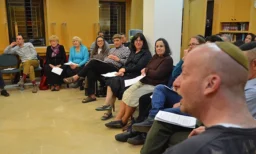
Last night, the DCA Think Tank members discussed the concept of “Yirat Shamayim”: what it means to them, what role it plays in their religious lives, and whether critical thinking and academic analysis affects it negatively. Tell us in the comments how you would answer these questions.
One of the most puzzling laws in Judaism is the prohibition of mixing milk and meat.
Strangely enough, this mysterious law has had the greatest influence on the daily life of Jews for thousands of years, right up to this very day.
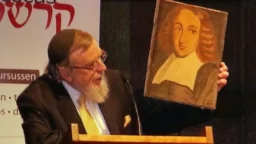
Should Judaism fear its heretics? The centuries-old ban on Spinoza raises a deeper question: is banning an admission of strength—or of insecurity? This essay challenges us to reconsider whether a confident tradition needs protection from ideas, or whether it should confront them head-on.
A ban is a sign of fear, and since when is Judaism afraid? While the ban may have been necessary in the seventeenth century, today it only embarrasses Judaism.
Since its earliest days, Jewish Tradition has instilled in people a healthy anticipation for retirement. It has created in its followers an “early retirement plan” by giving them a taste of its joy while they are still young.
If you were Abraham, would you have interceded for Sodom? Do you think that he was delighted at the existence of an entire city filled with evil as Sodom was? This man who the midrash describes as cursing the builders of the Tower of Babel for caring more for the loss of bricks than of human laborers? The answer is no, undoubtedly their behaviour nauseated him; yet still he tried to salvage it through the presence of ten righteous inhabitants.
Religious thinkers should refrain from giving primary reasons for forbidden sexual relations. There is no objective reason why homosexuality and incest are forbidden.
It is in those who are still uncomfortable with God that new insights about Him are formed. And it will be in those uneasy environments that Judaism will be rediscovered and developed. The need for religious transcendence, and for the spiritual thread that keeps many young people on their toes, is enormous. Numerous secular people are joining a new category of spiritual theologians. Matters of weltanschauung are pivotal to many secular Jews now. The problem is that for them, and for the religious, the Torah is transmitted on a wavelength that is out of range of their spiritual transistors’ frequency. Yes, we turn on the radio, but we hear strange noises and unusual static. There is serious transmission failure. We are no longer sure where the pipelines are. God has relocated.
Make Anti-Semitism a Source of Jewish Pride
To the 5th Global Forum on Combating Anti-Semitism
While we must help to combat anti-Semitism in every way possible, we should be aware that it is not a Jewish problem. Its solution will be possible only when the world makes peace with ethical Judaism. Only when Jews will be able to convince the world of the power of Jewish ethics, and will ensure that it is taught in every classroom, church and mosque is there a chance that anti-Semitism will slowly come to an end.
Judaism is about new ideas. It is dependent on fresh concepts deeply rooted in its tradition. Innovative thinking is the need of the hour. It is time for halachic authorities, rabbis, and religious thinkers to take notice of the immense changes that have taken place in our day. Never has the world gone through so many adjustments in so short a time. Never have the Jewish people been confronted with so many challenges. It is not only the security of the State of Israel that is at stake, but even more so, its very spirit and spiritual future.