Remember what Amalek did to you on the way . . . how he fell upon you and cut down all the stragglers in your rear. . . . You shall blot out the memory of Amalek from under heaven. Do not forget.
Devarim 25:17–19
What do we mean when we say that the Torah is min HaShamayim, from Heaven? After all, many of the stories in the Torah concern human beings acting as human beings do. And human beings have free will. They could have acted differently.
What if Amalek had not attacked the Israelites? Would the episode still have appeared in the Torah as we know it? Presumably not. The text would have been different.
The same question can be asked about Avraham, Yitzchak, and Yaakov. What if Avimelech had not taken Sarah into his palace? What if Avraham had refused God’s command concerning Yitzchak? What if Yaakov had not deceived his father and taken the blessing intended for Esav? And what about the sale of Yosef by his brothers? What if they had resisted their jealousy and never sold him? Would the Israelites still have gone down to Egypt?
Or consider Moshe. What if he had spoken to the rock instead of striking it? Would he then have entered the Land of Israel?
All these stories could apparently have unfolded differently. So in what sense can the Torah that records them be eternal?
Can an eternal Torah contain contingent history?
The difficulty becomes even greater when we place Torah min HaShamayim alongside the ancient rabbinic idea that the Torah preceded the creation of the world. Bereshit Rabbah famously describes the Torah as the blueprint through which God created the universe.[1]
But if Torah is rooted in eternity, how can its narratives depend upon decisions freely made by human beings within history?
Perhaps our difficulty begins with the way we imagine eternity. We tend to picture it as an unimaginably long stretch of time extending infinitely backward and forward. But eternity may not be endless time at all. It may be a reality outside time.
From our human perspective, events unfold one after another: first a decision, then an action, then its consequences. But if Divine reality is not confined by time, perhaps past, present, and future do not stand in that same relationship to one another.
This does not solve the problem. In fact, it makes it even more disturbing. For if all of history is somehow present within eternity, where is human freedom?
The Divine Alila
A remarkable midrash confronts precisely this problem.
Rabbi Yehoshua ben Korcha states that even the events God brings upon human beings are brought about through an alila—a pretext, or circuitous Divine plot. Before Adam was created, says the midrash, the Angel of Death had already been created. Yet Adam is subsequently told that death will enter the world if he eats from the Tree of Knowledge.[2]
The implication is astonishing. If death already belonged to the structure of creation, was Adam ever really capable of avoiding it?
The Torah nevertheless presents Adam and Chava as choosing to eat from the tree and therefore as responsible for the consequences.
The midrash then offers an even more provocative analogy: A man wishes to divorce his wife. Before entering his house, he prepares the bill of divorce and carries it with him. He asks his wife for a drink. When she brings it to him, he complains that it is lukewarm and hands her the bill of divorce.
She responds, quite reasonably: If you already had the divorce document prepared before I served you the drink, then my lukewarm drink cannot really be the reason for the divorce.
Adam makes essentially the same argument before God. Long before Adam existed, the Torah already spoke of “a man who dies in a tent.” If death was already written into Torah, how can Adam be blamed for having introduced death into the world?[3]
The question is devastating.
Are we therefore to conclude that Amalek had no real choice? That Avraham, Sarah, Yaakov, Yosef’s brothers, and Moshe could not have acted otherwise? Is history itself a Divine alila?
If so, there are ultimately no villains and no heroes. Amalek is merely playing the part assigned to him. Pharaoh is playing his. The righteous and the wicked are both actors following a Divine script.
And then moral responsibility collapses.
Yet the Torah insists on precisely the opposite. Human beings are responsible. Amalek is condemned for attacking the weak. Pharaoh is condemned for his cruelty. Yosef’s brothers must confront what they have done. Moshe bears the consequences of his actions.
How can both be true?
Everything foreseen—and freedom given
This is the ancient conflict between Divine providence and freedom of the will.
We must believe in free will—we have no choice.
Even outside religious thought, the problem does not disappear. If every event in the universe is completely determined by the conditions preceding it, then our decisions, thoughts, and desires would also seem to be the inevitable effects of earlier causes.
Yet we experience ourselves as choosing.
Jewish tradition does not try to hide the contradiction. Rabbi Akiva states it with extraordinary simplicity: “Everything is foreseen, yet freedom of choice is given.”[4]
The Talmud similarly declares: Hakol biydei Shamayim chutz miyirat Shamayim—“Everything is in the hands of Heaven except the fear of Heaven.”[5]
And Isaac Bashevis Singer gave the dilemma its most delightful formulation: “We must believe in free will—we have no choice.”[6]
Perhaps we make a mistake when we assume that providence and freedom must exclude one another. We imagine them as two competing causes: either God determines my action or I determine it. But perhaps they do not operate on the same level.
Maimonides offers an intriguing solution. In the Guide for the Perplexed, he connects Divine providence with the human intellect and with our apprehension of God. The closer the human being comes intellectually and spiritually to Divine reality, the more profoundly he participates in providence.[7]
Providence, in this reading, is not simply an external Divine hand pushing events from above. It is connected with our deepest awareness of the reality in which we exist.
Perhaps free will and predestination are therefore not enemies. Perhaps their apparent contradiction emerges only when viewed from inside time.
The primordial Torah
This brings us back to the Torah. The Torah Moshe received at Sinai is, according to a profound mystical tradition, rooted in a Torah that precedes the world—the Torah Kedumah, the Primordial Torah.
Ramban writes in his Introduction to the Torah that the Torah preceded creation and was written as black fire upon white fire. He even suggests that its letters, before being divided into the words and narratives familiar to us, could be read as combinations of Divine names.[8]
I have elsewhere argued that the Torah revealed at Sinai can therefore be understood as a human translation of this primordial Torah: an infinite Divine reality entering human language, human consciousness, and human history.[9]
The Torah we possess is not therefore “less Divine” because it speaks the language of human beings. Its very Divinity lies in the possibility that the infinite can clothe itself in the finite.
The primordial Torah is beyond words. Our Torah enters words.
The primordial Torah is beyond time. Our Torah enters history.
And once Torah enters history, it must encounter human beings who choose.
Why is the Torah a scroll?
Perhaps this also explains something about the physical form of a Sefer Torah. Why is the Torah not a book like other books, with separate pages? Why a scroll?
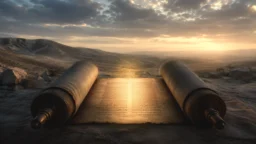
A scroll has a peculiar form. When it is closed, its text disappears. We see only the outside of two cylinders. There is no visible first page and no visible last page. The words have vanished into the scroll. It is almost an image of eternity.
Then the baal koreh (Torah reader) opens it. Suddenly one small column becomes visible. This is the here and now. The reader does not see the entire Torah at once. He sees only the portion that has emerged before him.
He reads it. Then the scroll moves. The words that were visible disappear once more into the cylinder, while words that had been hidden emerge into view. The text comes out of concealment, enters the present, and disappears again.
Perhaps this is more than an accident of bookmaking.
The primordial Torah is symbolized by the closed scroll: present, but unreadable; containing everything and yet displaying nothing.
The human Torah appears only when the scroll is opened and a particular passage emerges into time and space.
Amalek emerging into history
Amalek, then, may be eternally rooted in the primordial Torah without being eternally compelled to perform one predetermined action.
So too Avraham, Yitzchak, Yaakov, Yosef’s brothers, and Moshe. Their stories emerge within time. Their choices are genuine because human life takes place within time, responsibility, uncertainty, and decision.
Yet those same stories are rooted in a Divine reality that transcends time. From within history, they choose. From beyond history, they belong to the eternal Torah.
We, physical mortals, cannot stand in both places at once, and therefore we experience a contradiction.
But contradiction may sometimes tell us more about the limitations of the human mind than about reality itself. As Friedrich Dürrenmatt observed, “He who confronts himself with the paradoxical, exposes himself to reality.”[10]
What kind of freedom?
Perhaps we also ask too much when we demand that human freedom mean freedom from Divine reality itself. I may not be free of the laws of existence, but I am still free to raise my hand—unless someone has tied it down. Freedom always exists within a larger reality.
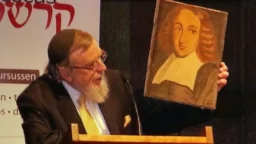
Spinoza, the great determinist, makes an illuminating distinction here. He defines as free that which acts from the necessity of its own nature rather than being compelled from outside. For Spinoza, freedom does not mean escaping causality. It means increasingly acting from what one truly is. And such freedom grows through understanding: the more clearly we understand ourselves, our passions, and reality, the less we are enslaved by forces we do not comprehend.[11]
That may offer us an unexpected way of understanding religious freedom as well. We cannot become independent of God, because ultimately there is no reality outside God upon which such independence could stand.
But that does not make us puppets. The more deeply we act from our own essence rather than from compulsion, ignorance, fear, or passion, the freer we become as we approach the Divine.
Perhaps Divine providence and human freedom are therefore not two realities struggling against one another. Perhaps, seen from eternity, they are one.
And perhaps that is why the Torah must be a scroll. We live in the few lines that are open before us. We do not see what lies rolled up on either side.
And precisely because we do not see it, we must choose.
Notes
[1] Bereshit Rabbah 1:1, which compares the Torah to the plans used by an architect and states that the Holy One consulted the Torah in creating the world.
[2] Midrash Tanchuma, Warsaw ed., Vayeshev 4:1–2; see also Tehillim 66:5 and Bereshit 1:2.
[3] Midrash Tanchuma, Vayeshev 4:2; see Bamidbar 19:14.
[4] Pirkei Avot 3:15.
[5] Berakhot 33b.
[6] Isaac Bashevis Singer, quoted in Stefan Kanfer, “Isaac Singer’s Promised City,” City Journal, July 1, 1997.
[7] Maimonides, Guide for the Perplexed, III:17–18 and III:51.
[8] Ramban, Introduction to his Commentary on the Torah. See also Midrash Tanchuma, Bereshit 1:1; Devarim Rabbah 3:12.
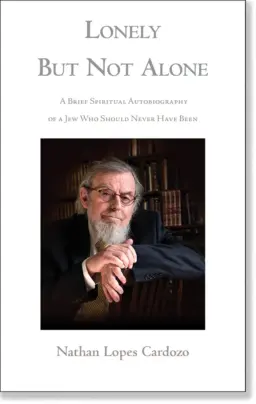
[9] See Nathan Lopes Cardozo, The Torah as God’s Mind: A Kabbalistic Look into the Pentateuch (New York: Bep-Ron Publications, 1988).
[10] Friedrich Dürrenmatt, Plays and Essays (New York: Continuum, 1982), 156.
[11] Benedict de Spinoza, Ethics, trans. R. H. M. Elwes, Part I, definition 7; Part V, proposition 3 and corollary.