Rabbi Meir Simcha HaCohen of Dvinsk (1843-1926), author of Meshech Chochma, one of the most penetrating commentaries on the Torah, draws our attention to one of the most powerful messages Jewish education has to offer.
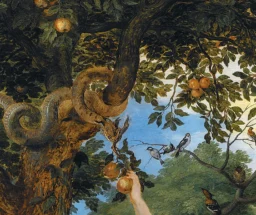
When discussing the failure of Adam and Chava (Eve) to abstain from the Tree of Knowledge, the Meshech Chochma points out one of the most common mistakes made in Jewish education. Why did Adam and Chava eat from the tree? Did the Garden of Eden not include many trees with the most appealing fruits and delicious tastes? Why would primordial man become obsessed with one forbidden tree while all other trees were permissible?
Our sages, along with many psychologists, would no doubt respond that this is due to the fact that human nature desires the forbidden more than it is attracted by the permitted. “Stolen waters are sweetest” is a well-known saying. It is not the water, as such, that is sweet, but the fact that it is stolen.
But does this mean that resisting the forbidden is beyond the capacity of most human beings? In that case, God’s commandment not to eat from the tree would become a trial that no one could pass. The prohibition would be morally unjustifiable.
From a surface reading of the text, it indeed seems that God’s first commandment to Adam was an uncompromising prohibition to eat from the Tree of Knowledge. This would mean that mankind’s first encounter with the will of God was a negative experience: a restriction.
But the Meshech Chochma maintains that this is far from true: This restriction was not the first commandment! Careful analysis of the text shows that the very first commandment to Adam and Chava was to eat from all the other trees and enjoy them: “God the Eternal commanded Adam, saying: ‘From all the trees in the garden ‘achol tochel.’” (Bereshit 2:16) This Hebrew expression does not mean, “You are permitted to eat,” but “You shall eat!”
In other words, God’s first communication with man was not a negative restriction, but a positive commandment to eat and enjoy.
However, Adam’s negative psychological makeup made him misunderstand this communication. Instead of seeing his encounter with God in a positive light, he started his religious life on the wrong foot, believing that religion should start with prohibitions. This notion is disastrous! The story of the Tree of Knowledge teaches us that the way to deal with prohibitions and restrictions is to precede them with positive commands and enjoyment.
Once religious life starts on a positive note, with God’s first commandment to human beings being to enjoy His creation, our perspective even of the forbidden changes. Our attitude towards restrictions is influenced and penetrated by optimism.
Without any doubt, the emphasis on prohibitions has become one of the gravest stumbling blocks of religious education. When Judaism is introduced as a religion of taboos, permanent damage is done to its very structure. Too often, young people become victims of such negativity, and consequently are unable to find their way to the Jewish experience.
One of the greatest tasks of Jewish educators today is to turn the tide on this sense of negativity, and to show our people that Judaism is, first and foremost, the art of enjoying God’s world.
Once it becomes clear that God started His conversation with humanity on a positive note, all the prohibitions fall into place. The goal of Judaism’s restrictions is not to form a tradition of taboos with the purpose of making life more difficult. A closer study of those prohibitions will show that their main purpose is to give life a higher meaning. And no meaning will ever become apparent unless it is shaped by discipline. Life, after all, is an art, and art is an emotion controlled by an idea. But such discipline must be preceded by the need to enjoy.
The bottom line is this: if one does not teach oneself first to enjoy God’s world, one will end up in transgression.