I make this covenant, with its sanctions, not with you alone, but both with those who are standing here with us this day before the Eternal our God and with those who are not with us here this day.
Devarim 29: 13-14
The Yamim Noraim, the Days of Awe, confront us with the challenge to be authentic; how to live up to our potential.
When we were in kindergarten and primary school, we were still innocent. We were still who we were, with no extraneous elements added to our personalities. We were still clean of any artificiality forced on us from outside our own being. But as we grew older, we absorbed “the facts of life”. And our new reality of living in the world forced onto us a body armor in which we were imprisoned.
Throughout the years, our armor became thicker and thicker, without most of us even being aware of it.
The armor of life
The great Dutch author Willem Bilderdijk (1756-1831) once compared this condition to an opera singer who is given a tiny lavatory as a practice room. The confined space is suffocating.
Most people, unfortunately, learn to live quite happily in this tiny room while wearing their armor.
Only great souls become aware of this predicament and, often with enormous effort, throw off the armor and venture outside. They clash with society and are misunderstood, but they are also the people who move society forward. They are prisoners who have looked through the bars of their personal cell, seen the garden of their lives, bent the bars, and walked out.
Rosh Hashanah takes us back to our childhood, before our armor was forged. We are asked not to be “mature”, but to become innocent again: to feel dissatisfied with what we have become, and to recover the gap between what we are and what we once sensed life could be.
But how are we to do this?
The Torah within us
It is not by accident that in the parasha before Rosh Hashanah, Nitzavim, Moshe Rabbeinu tells us:
It is not with you alone that I am making this sworn Covenant (the Torah) but with those who are standing here with us today before the Eternal our God and with those who are not here with us today.
Devarim 29:13-14
In other words, Moshe obligates all generations, whether now or in the future, to observe all the commandments of the Torah.
At first glance, this makes no sense. Why should future generations, up to today, be obligated to observe the commandments? Why can’t we argue that the Covenant with our ancestors does not apply to us since we were not there? We never gave our consent. We are not bound!
To this the Torah gives a remarkable answer:
This mitzva which I command you this day is not too difficult for you, nor is it beyond your reach…not in heaven or on the other side of the ocean …. No, the thing is very close to you, already in your mouth and in your heart to do it.
Devarim 30:11-14
What this means is that the Torah is not somewhere else, not in some heavenly reality. The opposite is true! We are made in the image of the Torah. The Torah is in our consciousness and in our DNA! It is what has made us who we are.
And should you ask: Why should I be obligated to keep these commandments? The answer is: It is living within you. It is you! It is the most natural thing for you to do. That is why when you observe the commandments, you innately feel good about it.
You have come home, thrown off all the armor of artificiality which was forced on you as you grew up. You are now really true to yourself. This is the highest level of authenticity.
The inadequacy of words
But if this is the case, why did God need to reveal the Torah at Mount Sinai? After all, if it was already in us, why the need to command us at all?
The answer is that we are not always aware of who we are. The purpose of the Torah is to make us aware of what already lives in us. It tells us to throw off the body armor.
The voice of the Torah within our being needs to be activated, so that we can return to our true selves as we were in childhood.
On Rosh Hashanah we return home. We recognize that all of our transgressions of Torah commandments were the result of our not being authentic; of our entrapment in the armor forced on us by the vicissitudes of life.
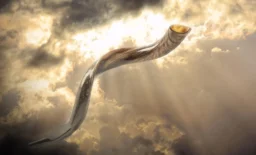
And this also explains the Shofar sounded on Rosh Hashanah.
Because many words of the Torah—and thus in ourselves—cannot be understood on the conscious level. They represent a higher world beyond the reach of words.
And what do children do when they have not learned yet to use words? They laugh, or cry, or make up their own sounds. Sometimes they whistle. Sometimes they blow into something else to make the sound louder.
This is the purpose of the shofar.
When we proclaim that God was King, is King, and will forever be King, we enter a realm in which our words exceed our intellectual capacity. We do not really know what we are saying. This is “Holy Inadequacy”—and precisely for this reason, deeply significant.
There is, as it were, a wisdom “out there”, being transmitted on a wavelength outside the range of our linguistic receiver. We turn on the radio, but hear only strange noises and static. The transmission is real, but we cannot tune in to the frequency.
Rosh Hashanah forces us to admit this.
Our prayers therefore contain an extraordinary tension. We praise God with words, calling Him King, and then become aware that every word is inadequate. Language fails.
And when words are no longer adequate, we resort to pure sound. We sound a primitive cry that tries to pierce all heavenly levels and somehow reach the One who is totally unknown.
What happens when we are confronted with our inadequacy? We could become depressed.
Instead, Judaism surprises us. It asks us to dress like kings and queens, eat festive meals, sing optimistic songs, and make Rosh Hashanah into a holy celebration.
Why? Because we know that the Torah, for all its demands, is our natural place in the world. It is royal. And so are we.
On Rosh Hashanah we return home. We recognize that all of our transgressions of Torah commandments were the result of our not being authentic; of our entrapment in the armor forced on us by the vicissitudes of life.
Hence Moshe was right when he said: “It is not with you alone that I am making this sworn Covenant (the Torah).” The Torah is not the provenance of any one generation, but of all generations. Including ours.
How fortunate we are!!!