
Simchat Torah, The Endless Beginning
In Shemini Atzeret & Simchat Torah by Rabbi Nathan Lopes Cardozo
When it comes to the learning of Torah we are all perpetual beginners. The text may have a beginning but it has no end.
Donate now to our High Holiday Campaign


Thoughts to Ponder is a weekly invitation to think dangerously and question passionately. Drawing on the Torah portion, classical Jewish sources, philosophy, and the crises of contemporary life, Rabbi Cardozo challenges religious complacency and spiritual comfort. These essays are written for readers who seek a Judaism that disturbs, questions, and ultimately deepens the human encounter with God and responsibility.
In Shemini Atzeret & Simchat Torah by Rabbi Nathan Lopes Cardozo
When it comes to the learning of Torah we are all perpetual beginners. The text may have a beginning but it has no end.

An open letter to my friends and students in Chutz La'aretz
In Israel and Yom HaZikaron by Rabbi Nathan Lopes Cardozo
An open letter to my friends and students in Chutz La'aretz on the background of the Arab terror attacks in Israel.
In Jewish Thought and Philosophy by Rabbi Nathan Lopes Cardozo
It is an artform to live as if every moment is new, a challenge, and an encounter with the Divine.

Conventional wisdom has it that Avraham “discovered” God after mankind had fallen prey to idol worship, and that this was his main contribution to the world. This however, cannot be the whole story.
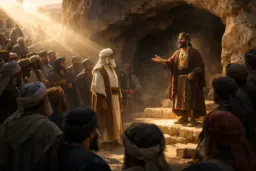
When negotiations hide hidden motives
Why did Efron name such an outrageous price for the Cave of Machpelah? Beneath the surface of a simple negotiation lies a profound insight into human nature—and a warning that echoes far beyond the days of Avraham. Some conflicts are not meant to be solved, because those who sustain them have too much to lose in peace.
In Jewish Thought and Philosophy by Rabbi Nathan Lopes Cardozo
Faith is one of the most difficult attributes to acquire. To have faith in God has become a struggle for many human beings, including those who are desperately looking for it. In modern times with their tendency to secularize nearly anything, the man of faith often feels alone in a world in which religious beliefs are often looked down on.
In Abraham, Jewish Thought and Philosophy and Parashat Vayera by Rabbi Nathan Lopes Cardozo
For the biblical personality and those living in early post-biblical times, the existence of God was apparent. One would discover His fingerprints everywhere: in heaven, on earth, in the colors of a flower, in the stormy sky, in the thunder and lightning, in the smile of a baby or the beauty of the seashore.
In Jewish Thought and Philosophy by Rabbi Nathan Lopes Cardozo
The question to what extent one can actually trust God and rely on His protection is closely related to the question why He created the world. It should be claimed that one can only rely on His protection and help as long as this does not contradict the very purpose of existence.
In Jewish Thought and Philosophy by Rabbi Nathan Lopes Cardozo
We established in part III of "The Struggle for Faith" that it is forbidden to trust in God when this trust contradicts God's purpose for the world. Since man must have the possibility of exercising freedom of will, there must be a natural order to the world. If not for the laws of nature, it would not be possible for man to make any moral decision, since he would never be able to know what the consequences of his decisions would be.
In Jewish Thought and Philosophy by Rabbi Nathan Lopes Cardozo
The Talmud in tractate Pesachim 8b gives an interesting example of the tension between trust in God and the natural order of things while simultaneously adding a new aspect to this problem.
The need for revenge after experiencing a great injustice is very understandable. In the heat of the moment, people easily lose their minds and take to the streets to carry out acts of rampant destruction. They often forget who they are fighting and cause heavy losses to the innocent. While this is understandable, it is wrong.

In Jewish Thought and Philosophy and Parashat Ha'azinu by Rabbi Nathan Lopes Cardozo
While we've had to fight physical battles to ensure our survival, we must never lose sight of the fact that existence would be meaningless if not for the nation’s spiritual purpose.