As I write these words, the Israeli elections have not yet taken place. By the time you read them, the elections will be behind us, though we will probably not yet know the final outcome.
But one thing I do know: this time, as never before, the soul of the Jewish people is at stake. And the stakes are high—very high.
I do not believe that the physical existence of the Jewish people is at stake, although I worry greatly about whether the State of Israel can continue to exist as it does today. Iranian leaders have repeatedly declared their desire to wipe Israel off the map. Yet, partly out of ignorance of Jewish history and the dangers of antisemitism, many Israelis do not seem to take these threats seriously enough and continue to believe that diplomacy is the solution.
But the issue is not pikuach nefesh, the preservation of life, but pikuach neshamah: the preservation and renewal of the Jewish soul.
The Tectonic Plates Beneath Israel
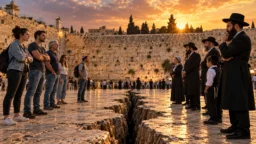
Beneath the surface of the State of Israel, spiritual seismic waves are shaking the ground. Tectonic plates are moving, threatening the very foundations of the Jewish state. The question is most urgent: Is Israel a Jewish state in which Judaism is foundational, or should it be a secular state in which Judaism plays only a minor role—or none at all? As this question becomes more pressing, the tectonic shifts grow wider and deeper. And no Israeli army, however strong, can do anything about them. One cannot fight tectonic upheavals with an army.
This is nothing new. These seismic waves have been with us since the establishment of the Jewish state—in fact, long before. They began with the Emancipation, when Jews became confused about who they were. Were they a nation, a religion, a civilization, or something altogether different—a phenomenon for which there is no linguistic equivalent? Dazzled by the lights of the metropolis, many lost the script of the great Jewish story; falling for secular universalism, communism, hedonism, and, today, postmodernism and secular Zionism.
This confusion was woven into the very fabric of the State of Israel, and the spiritual seismic waves have been moving ever since. For years they seemed to be under control. But the more Israel, became a success story and the stronger its army grew, the more these spiritual tectonic plates began to shift. The State of Israel became confused, particularly in its legal and educational systems. Above all, it became confused about its own identity. And no nation can live on a borrowed identity.
A Nation in Need of Heart Surgery
Until now, the State of Israel has put plaster after plaster over the small cracks beneath the surface. The status quo, compromise, and democracy have served as bandages, and for many years they worked. But now the tectonic plates are moving more violently. Serious surgery is needed. And this surgery must be heart surgery.
It would be a mistake to believe that only the nonreligious population needs this surgery. It is true, and it has become eminently clear, that secular Zionism has left the State with an emptiness of purpose and meaning to which whole communities have fallen victim. Having spent its inherited resources, it has left large segments of Israeli society with a rootless secularism, without memories and without aspirational expectations.
But the religious community, the rabbinate, and the religious school system also need surgery—not merely heart surgery, but open-heart surgery, complete with a heart-lung bypass machine. Not just to circulate the old blood, but to bring new blood into the system.
What this requires is no small matter. It calls for deep soul-searching. Many religious communities and leaders still suffer from a “shtetl” mentality, in which Judaism has been reduced to a religion. Nearly two thousand years of exile have imprisoned it in the private domain.
But the real Torah is much more than a religion. It is a holy mission given to the people of Israel for the benefit of all mankind, meant to shape the foundations of faith and ethics; to engage with all of life—including modern life.
A Halakhah for National Existence
For nearly two thousand years, Halakhah, Jewish Law, has focused almost entirely on Jewish communal life outside the Land of Israel. This means that Halakhah has been unable to live up to its full potential. It must now be redeemed from its state of imprisonment and brought into the public domain of national existence.
This can be done only by halakhic authorities who understand the meaning of national existence. It requires not only immense knowledge of Halakhah, but also an understanding of how it works—of its nature, its music, its ideology, and its dreams for the future. All of this can be found in our sources, but it needs to be revitalized. We must look anew at these sources, understand the background of the great Talmudic debates, and draw fresh insights from them. Only then can we open the way to a renewed Halakhah for the future of the State of Israel.
Above all, halakhic authorities must carefully read the times in which they live. They must feel the vibrations of the seismic waves beneath the Land of Israel and allow these vibrations to influence the way they rebuild Halakhah. It may even mean that certain earlier rabbinic laws will have to be replaced by new approaches that reconnect Halakhah with its ideals and purposes.
The Judaism of a New Generation
Since the terrible onslaught against the State of Israel on October 7, 2023, many young people have reconnected with Jewish tradition. They have realized that a Jewish state cannot survive without Judaism. One cannot disconnect the one from the other. For them, secular Zionism has been laid to rest. It has nothing more to offer the new generation.
But being modern, these young people have carved out their own ways of reconnecting. Their approaches are unconventional and creative. Not all of them fit within the Halakhah as it was applied in exile. And no greater mistake could be made than to force them into an antiquated halakhic straitjacket that was only intended for the exile.
When we see young men with long hair and no kippah on their heads, but with tzitzit hanging from beneath their shirts, or young women who cover their hair and light candles on Friday night, yet dress in the latest unconventional fashions studying Talmud, we must realize that these are not merely temporal phenomena. This is not about Reform or Conservative Judaism, both the result of diaspora conditions, and not even about conventional Orthodox Judaism. They are signs of an emerging trend within Judaism, one that will need time to grow into a spiritual movement.
Dissent, Protest, and Religious Grandeur
Inherent in all religions is the peril of stagnation. What becomes settled and established can easily become profane. Insights become clichés, flexibility becomes stubbornness, spontaneity becomes habit.
What is vital to religious life is the constant need for dissent and protest. This is one of the most essential elements for an authentic Judaism. Its task is to challenge values that are dangerous to spiritual human being. Over time, Judaism has often become dogmatic; a captive to indoctrination. It has slowly become a religion of complacency and trivialities.
Instead of showing fearlessness, it often results in a negation of the spirit. The price is high. Religious people become “all-rightniks,” satisfied that “observance” is just fine. Many no longer see Judaism as something that challenges them. Instead, it becomes self-satisfying and boring. A meager image of orthopractic Judaism replaces an authentic Judaism of boldness. Much of the religious community today has fallen victim to this sad condition, which has led many Israelis to stop seeing Judaism as a manifestation of grandeur.
The religious community must therefore realize that it carries a heavy burden of responsibility for the secularization of Israeli society. If one misrepresents a great ideal, one inevitably pushes people away.
To admit this requires sincere self-examination.
Faith Must Be Lived
Faith is of the greatest importance. Not merely because it is true, but because man needs, above anything else, meaning. The absence of God in man’s life demolishes everything that makes man human. The quest for truth, the distinction between good and evil, and the dignity of man all depend on faith. Without it, man will ultimately become indifferent and destructive.
But this can only be true only when faith is lived, not merely believed. Belief in God alone is often a cop-out unless it is translated into action. This is by far the greatest contribution that Judaism has made to the world.
Faith must be heroic, a fight against the trivialization of human life. This is the task of the commandments. They are the strings on which man plays his soul’s music, often against the established melody.
This must become the crux of the discussion about the future of Judaism in the State of Israel.
A Blessing in Disguise?
One wonders whether, if the religious parties are left out of a new coalition and a more secular government comes to power, this might actually be a blessing in disguise. It would create a crisis of great proportions, perhaps even pandemonium among religious Jews. But a crisis is also an opportunity. No longer able to rely on a sympathetic government, the religious community would have to develop a completely new strategy. It would have to throw off its political trappings, stand on its own feet, and discover inner resources of which it is not yet aware.
It would have to convince itself that Judaism is indeed the vital element on which the State of Israel depends. Freed from the clutches of politics, it might finally breathe freely and understand that gentle persuasion is the only way forward.
It may even be that secular Israelis, who have relied on the religious parties to look after the Jewish character of the State of Israel, would suddenly realize that they themselves must save Judaism from extreme secularization.
Ultimately, Jews are the most challenged people on earth—but also the most remarkable. Secular and religious Jews alike must realize that Judaism is indispensable to the world. Jewish existence is an exalted existence. It is not merely a doctrine, a faith, or an idea, but a covenant between God and this people for the sake of all mankind. Our very existence is a refusal to surrender to normalcy, security, or comfort.
“We are God’s stake in human history,” writes Rabbi Abraham Joshua Heschel. And, as he also warns, “The gravest sin for a Jew is to forget what he represents.”