
Jewish Thought and Philosophy

To think Jewishly is to stand at the edge of certainty and still choose to believe, question, and seek. Jewish thought lives in the tension between faith and doubt, law and freedom, eternity and change.

  • Judaism without God

    In Franz Rosenzweig, Heschel and Jewish Thought and Philosophy by Rabbi Nathan Lopes Cardozo

    With the terrible pogrom which took place in my hometown, Amsterdam, and the ongoing Anti-Semitism in Europe, the United States, and indeed worldwide, it is time to give proper attention to one of the great mistakes of modern Jewish history. This is the myth that if Jews would only “normalize” themselves, anti-Semitism would come to an end. This constantly repeated mantra has proven to be entirely wrong and in fact, dangerous.

  • Ido Pachter’s Introduction to Jewish Law as Rebellion – Part 4

    In Jewish Thought and Philosophy by Rabbi Nathan Lopes Cardozo

    When I decided to study at the ultra-orthodox Gateshead Yeshiva, I learned that Judaism consists of a world view of tremendous depth, which is expressed in deeds and rituals that penetrate the deepest dimensions of the human being. I discovered Judaism in a different way than my fellow Yeshiva students did. They had grown up within Judaism, and thus were not able to see it from the outside as I did. They were so used to the splendor of Judaism that they were blinded by it and so no longer could they perceive it. At a later stage of my life, I myself fell victim to this same problem. I realized that I had lost my earlier fascination and had to start all over again. In this essay, Rabbi Pachter explains how I tried to do this.

  • Ido Pachter’s Introduction to Jewish Law as Rebellion – Part 1

    In Jewish Thought and Philosophy by Rabbi Nathan Lopes Cardozo

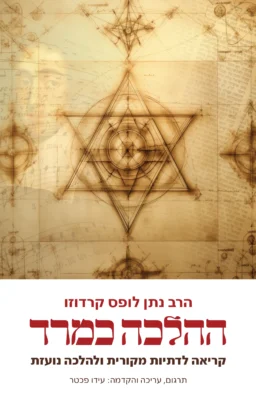
    Rabbi Dr. Ido Pachter has provided an intriguing introduction to his Hebrew translation of my book: Jewish Law as Rebellion, A Plea for Religious Authenticity and Halachic Courage (Urim Publication, 2018). The book was published by Yediot Acharonot in May of this year under the title: ההלכה כמרד: קריה לדתיות מקורית והלכה נועזת I have translated Rav Pachter’s introduction into English, Part 1 of which is included here.

  • Wedding canopy in a sunny meadow

    Rabbi Akiva’s Time Capsule – The Song of Songs in Context

    In Jewish Thought and Philosophy by Yael Shahar

    Imagine that civilization was going to be destroyed within five years, and that you were tasked with deciding what literary treasures to preserve? That is the background of the Tanakh that we have today. The Talmud records the bare bones of discussions where scholars fought for the inclusion of those writings that were dear to them, often against ferocious opposition from their colleagues. Amazingly, of all the possible things to include, the famous Rabbi Akiva chose a collection of bawdy wedding songs! What lay behind such an odd choice?

  • The Miraculous Nature of Normality

    In Jewish Thought and Philosophy and Parashat Tzav by Rabbi Nathan Lopes Cardozo

    The most challenging question in all of life is what do you do, and what do you believe when you are not sure. It is this question that moves the scientist, the philosopher, and most of all the religious personality. We must destroy the security of all conventional knowledge and undo the normalcy of all that is ordinary. To be religious is to realize that no final conclusions have ever been reached, nor will ever be reached.

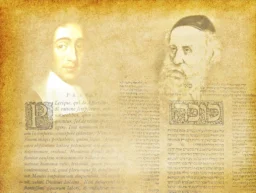
  • Spinoza, the Alter Rebbe, and the Eternal Fire

    In Jewish Thought and Philosophy, Spinoza and Parashat Tzav by Rabbi Nathan Lopes Cardozo

    The Talmud states that all the sacrifices were consumed by a heavenly fire, not by the fire lit by the Cohanim. This seems to imply that there was absolutely no need to keep the human fire on the altar burning so as to consume the sacrifices. So why were the Cohanim commanded to keep the fire on the altar lit? It seems that an answer may be found in contrasting the teachings of two very different thinkers--Spinoza, who famously did not believe in miracles, and the Alter Rebbe, who believed the existence itself is a miracle.

  • Prayer, Sexuality, and the Pleasure Principle

    In Jewish Thought and Philosophy and Parashat Metzora by Rabbi Nathan Lopes Cardozo

    Why are males and females physically attracted to each other? What is there in their physical appearance that makes them so excited that they want to be intimate, to the point where they consider this a great joy? The Sages of Israel understood the enormous power of sex and its immense challenges. Unlike other religions, such as classical Christianity, they never saw sexuality in a negative way. This is because sexual attraction is a reflection of Divine love.

  • Putting God on Trial: The problem of Divine Collateral Damage

    In Jewish Thought and Philosophy, Theodicy and Parashat Acharei Mot by Rabbi Nathan Lopes Cardozo

    The Jewish Tradition never told people not to question divine justice. Such questions are not only legitimate, they are holy because they rise from a deep realization that God is righteous and at the same time honest enough to admit that He is at fault.

  • Sunflowers by Vincent van Gogh

    The War and the Sunflower

    In Jewish Thought and Philosophy by Rabbi Nathan Lopes Cardozo

    The holy task of Halakhic living requires us to see with more than our senses, and to comprehend what is beyond reason. It requires both inner consciousness and the transformation of the deed, by which we express our deepest understanding of the splendor of the world.

  • Sukkot

    The Paradox of Sukkot

    In Jewish Thought and Philosophy by Rabbi Nathan Lopes Cardozo

    Nothing is more crucial for the religious personality than the question as to whether there is a God we can trust and rely on. Often, even one who believes that God exists may still wonder whether he can have faith in Him.

  • Binder folders

    The Future of a Marriage – The Good News File

    In Jewish Thought and Philosophy and The Kotzker Rebbe by Rabbi Nathan Lopes Cardozo

    Experiencing low points in life is par for the course. Contending with these and the accompanying negative emotions and moods can be challenging and difficult. The correct perspective of what we have, our reality, and the true power we hold to alter and improve the direction of our lives is a sure tool in facing life.