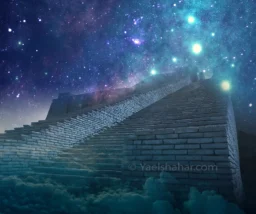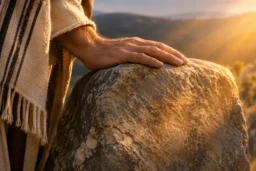
Yaakov woke from his sleep and said, “Surely God is in this place, and I did not know it. … How awesome is this place! This is the house of God and the gateway to Heaven.”
Bereshit 28:16–17
Some of us have had a religious experience.
Such experiences are overwhelming. They cause terror in our souls and can change our lives forever. Rudolf Otto, the famous Protestant thinker (1869–1937), called this mysterium tremendum et fascinans.[1]
For a brief moment, we feel ourselves to be in Heaven, and realize that there is much more to this world than just what we see, hear, touch, smell, or know.
But when we wake up from this slumber, we understand that these experiences are insubstantial and their effects can easily disappear.
To make them endure and continue to inspire us, we need to make these experiences tangible. We need to give them a place and mark them in an ordinary setting, and call it the house of God. We must make these moments more than just a memorial of something that happened, but an experience that lasts, that is deeply rooted in our lives.
This is the purpose of Halakhah: the art of translating Heaven into earthly matters, of bringing eternity within the limits of time. Rabbi Abraham Joshua Heschel spoke of time as “eternity in disguise.”[2]
But who among us realizes that? And who knows the art?
Notes
[1] Rudolf Otto, Das Heilige (Breslau: Trewendt & Granier, 1917); translated by John W. Harvey as The Idea of the Holy: An Inquiry into the Non-Rational Factor in the Idea of the Divine and Its Relation to the Rational (London: H. Milford, Oxford University Press, 1923).
[2] Abraham Joshua Heschel, The Sabbath: Its Meaning for Modern Man (New York: Farrar, Straus and Young, 1951), 101.
Questions to Ponder
1. Have you ever had a moment when ordinary life suddenly seemed filled with something greater? What remained after the moment passed?
2. Yaakov responded to his dream by marking the place where it happened. Why might a physical reminder matter? Could it also become an empty monument?
3. Rabbi Cardozo calls Halakhah the art of translating Heaven into earthly matters. Which mitzvah or ordinary action seems to you to achieve this especially well?
Diving Deeper
When Yaakov awakens from his dream, he marks the place of his encounter with God by erecting a stone at Bethel (Bereshit 28:18–19). Later, the Torah commands the construction of the Mishkan as a dwelling place for the Divine Presence (Shemot 25:8).
Yet holiness can also be established in time. The Torah commands us to sanctify Shabbat (Shemot 20:8–11), while Abraham Joshua Heschel describes Shabbat as a “sanctuary in time” (The Sabbath, chapter 1).
Holiness can also be preserved through repeated actions. The Rambam explains that the mezuzah should remind us of God’s presence whenever we enter or leave our homes, awakening us from our spiritual slumber (Mishneh Torah, Hilkhot Tefillin, Mezuzah veSefer Torah 6:13).
Which of these best preserves a religious experience: sacred places, sacred times, or repeated actions? Can Halakhah truly transform a fleeting encounter with God into an enduring spiritual reality, or does the very act of institutionalizing religious experience risk reducing it to habit and routine?