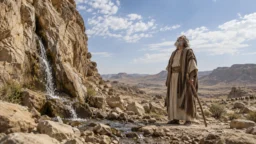
The very day the lord spoke to Moshe: Ascend these heights of Abarim to mount Nebo…. And view the land of Canaan which I am giving the Israelites as their inheritance. You shall die on the mountain, as your brother Aaron died on Mount Hor, for you both broke faith with Me among the Israelites…. at the waters of Meribath-kadesh… by failing to uphold My sanctity among the Israelites. You may view the land from a distance but you shall not enter it.
Devarim 32: 48-52
One of the great mysteries of the Torah concerns the well-known incident in the desert, when Moshe was told to speak to a stone to provide water for the Israelites. Instead of speaking to the stone, Moshe hit it with his staff. For this act, God declared that he would not be allowed to enter the land of Israel.
But why was Moshe so severely punished for hitting the stone to get water for the people of Israel? What difference would it have made had he spoken to it instead? True, Moshe should have listened to God and followed His instructions to the letter. But how great was this sin? What harm could it do?
Is it justified that for this sin God refused to allow Moshe to enter the land of Israel? This was a denial of Moshe’s ultimate goal at the end of his life. He waited for this for forty years with great anticipation!
Why such Divine harshness?
Moshe, under the most difficult circumstances, had shown tremendous dedication to God and His commandments. So why “rub it in” once more in our parasha, as if all mayhem had broken loose with this “small” sin?
In one of the most heartrending Midrashim, Moshe begs for a few more days of life. God refuses.[1] Then Moshe asks whether he can become a bird so that he can fly over the land to at least view it from the sky. The answer is again: No!
The time-honored tradition of arguing with God
This requires our full attention. There must be something very profound in this episode.
The greatest of commentators struggle with this incident, and come up with some remarkable observations.
But perhaps we’ve got it all wrong. After all, one of the most remarkable claims the Jewish tradition makes is that man can argue with God. More than that; it is as if God invites us to do so, and tells us that He will listen.
The most famous example is of course when Avraham takes God to task for wanting to destroy the city of Sodom:
Avraham came forward and said: will You sweep away the innocent along with the guilty? What if there should be fifty innocent people within the city! Far be it from You to do such a thing, to bring death upon the innocent… shall not the Judge of all the earth deal justly?
Bereshit, 18: 23-26.
God then tells Avraham that there are not fifty righteous men in the city. But he does not give up: What about forty-five, thirty, ten? Throughout this entire conversation, God never once loses His patience with Avraham. The opposite is true! It is as if He waits for Avraham’s objections.
There can be no greater joy for God than losing an argument!
The same is true of Moshe after the sin of the Golden Calf. And then there are the prophets, Iyov (Job), and many others.[2] They all argued with God at some point and received a positive or negative response.
In a highly unusual story in the Talmud, God, after trying to make His point through open miracles, gets soundly defeated in a halachic argument and is told by the sages, in a manner of speaking, to mind His own business. The Talmud tells us that God laughed and declared: My children have defeated Me. My children have defeated Me![3]
There can be no greater joy for God than losing an argument!
How can this be?
Jewish tradition makes the surprising claim that God wants us to engage with Him. And that is only possible through arguing with Him and even demanding that He do things differently.
God wants to be “educated” by us in order to draw us into a close relationship, and is even ready to risk His reputation for the sake of this closeness.
No closer relationship can exist than one involving dialogue. God is not a Deus Absconditus, but is active in the life of the man of faith.
God does not want us merely to accept what He tells us to do. We need to argue with Him to appreciate His will. Only when we grasp the deeper meaning of God’s will, seeing it from all different perspectives, will we understand the profundity of Who God is.
God is not a tyrant Who forces us to do what He tells us to do, but a God who wants us to be a partner in the Creation and the Torah, especially the Oral Torah.[4]
The inadequacy of miracles
And so we return to Meribah, and Moshe’s hitting the rock.
God should be pleased with Moshe for this. He should delight in Moshe’s refusal to listen to Him to speak to the rock.
Why?
Because in hitting the rock, Moshe tells God that He is overreaching. He is again creating a spectacle to prove His capabilities.
But He tried this in the past, and it did not work out so well. First there was the splitting of the Reed Sea. Then there was the revelation at Sinai accompanied by thunder and lightning.
But how successful were these miraculous events? Did they really have the impact God had hoped for? These events were too dazzling; the result being that they missed their desired effect. They simply dumbfounded the Israelites and led them to ask that God speak only to Moshe. They were afraid that otherwise they would die.
And soon after the splitting of the Reed Sea, the Israelites complained about the lack of water, and after the revelation at Sinai, they built the golden calf!
What should have been achieved—total faith and trust in God—did not happen. God had overdone it, and the result was disastrous. Pyrotechnics do not work, not even when they are Divine.
Moshe’s argument
So Moshe tells God: Tone it down!!!
Let us not overdo it again. Let the miracle of the waters at Meribah be more humble. When I hit the stone and water comes out, it will certainly be a miracle, but within the limits of the laws of nature. Not a creation ex nihilo.
Moshe could argue: Is this not what You really want; for the Israelites to see You within the laws of nature, and so to see You everywhere?
True, I was annoyed with the children of Israel for asking once again for water, but that does not mean that You were right in telling me to speak to the stone.
Had You first asked me, I would have tried to persuade You not to overdo it, before I hit the stone. I waited for You to do that, but You never did. You overlooked me. By doing so, You undermined our relationship, which was always based on discussion, argument, and persuasion.
And so, at Meribah, I could not sanctify Your name, and thus violated Your honor. I should have begged You to listen to me first. But instead, I hit the stone, also out of anger with You, and only then realized that I just should have waited for You to discuss the matter.
Sure, this was a small mistake. But for a man who spoke to God “face to face”, it was a terrible transgression.
A blessing in disguise?
But for all this, the outcome was also a blessing.
It would have been a mistake for Moshe to enter the land of Israel. Had God allowed him to do so, it would have meant that Moshe’s mission had been accomplished. It would have been a triumph, a pinnacle of success. But it would have been inevitably followed by a period of emptiness, a feeling of loss.
Moshe had to die while there were still things to do, arguments to be settled. He had to be looking forward toward what was still to be accomplished, not backward at the past. To have ultimately accomplished everything could have resulted in his losing his extraordinary humility[5] and thus losing everything he represented.
Moshe had to die in a state of longing, not in a state of satisfaction over his enormous accomplishments. Paradoxically, with his unfulfilled aspiration, he departed this world in a state of contentment that he could not have achieved otherwise. And so, perhaps we’ve had it wrong all this time. God’s refusal to allow Moshe to enter the Promised Land was not a punishment, even if Moshe himself saw it as such at the time. In reality, in allowing him to die with things still left to do, God conferred upon his servant the ultimate blessing.
Notes
[1] Devarim Rabbah 11:10. See also Avot de-Rabbi Natan, Addendum B to Version A, ch. 4.
[2] See, for example, Yirmiyahu 12:1–6; Habakkuk 1:2–4, 12–13; 2:1–4; Iyov 13:3, 15–18; 38:1ff.
[3] Bava Metzia 59b.
[4] See Shabbat 10a, 119b; Jerusalem Talmud, Sanhedrin 4:2; Bava Metzia 59b; Gittin 60b.
[5] See Bamidbar 12:3