If your offering is a sacrifice of well-being — If you offer of the herd, whether a male or a female, you shall bring before the Eternal one without blemish.
Vayikra 3:1
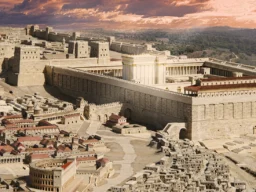
In our times, especially since the establishment of the State of Israel, there is talk of the construction of the Third Temple and the re-introduction of the sacrificial service, including animal sacrifices, the sprinkling of their blood on the mizbe’ach (the altar) and so on.
For some people, this would be the fulfilment of their dreams, and the ultimate manifestation of the messianic age, the greatest event of all time. They anxiously await the moment the Third Temple is built so that these rituals can be reinstated.
For others, this idea is repulsive and totally unacceptable. What is the point in slaughtering animals and offering them to God? It all seems very cruel and childish. It does not seem appropriate to the very structure of Judaism and its mission.[1]
Secularism and the compromise to human weakness
Some, however, claim that this repulsion is itself the result of secularism and its devastating effect on our souls, such that we can no longer relate to the level of religiosity required to appreciate the deeper meaning behind the sacrificial services.
The claim is that there is nothing wrong with such service. Rather the reverse is true — there is something wrong with us. We have lost the highly religious sensitivity to undergo the transformative experience of this service.
Others, among them Maimonides, maintain that animal sacrifices are a compromise to human weakness rooted in earlier non-monotheistic religions, and that the ultimate goal of sacrificial services within Judaism is for us to “outgrow” them. In the earliest days of Judaism, sacrifice was a necessity, because that was generally how people worshipped their gods, and the early Israelites could not release themselves overnight from this kind of worship. So God permitted it to continue under the condition that they would at least bring these sacrifices to Him, rather than to idols. Eventually they would see the futility of all this and find other ways to worship.
And indeed, Judaism is an evolutionary religion that continually refines itself. Following the destruction of the Temple, we have become accustomed to a Judaism without sacrifices, and we do not feel any religious need for them. As such, in this respect the abolition of the Temple sacrifices may perhaps be seen as a blessing, for it ended a more “primitive” form of Judaism.
Seen in this light, Tisha B’Av, the day of the destruction of our Temples, is not about losing the opportunity to bring sacrifices, but about all the other advantages of having a Temple — first and foremost, the intense experience of God’s presence while in this sacred space.
If we have outgrown the sacrifices — which was precisely the ultimate goal — it would be a grave mistake to reinstate the sacrificial service. It would pull Judaism backwards and make it more primitive, which, in this view, is the last thing we should be doing. Perhaps this also means that we are no longer in need of a Temple at all, since the whole universe is God’s “Temple”.[2]
A third approach sees sacrifices to be of value; it is only their nature that must change.[3] Rabbi Avraham Yitzchak Hacohen Kook, among others, maintains that all animal sacrifices will in the future be replaced by agricultural sacrifices,[4] since animal sacrifices have indeed become unthinkable. Why end the life of an animal in the service of God, when our deepest intuitive feelings tell us that this is an ethically tainted act. (Although, it must be noted that many of us continue to eat meat without any compunction!)
Why sacrifices?
But whichever approach we take, we cannot deny that the Temple and its rituals once played an enormous role in Judaism, and that sacrifices were at the very center of the holy service. This is specifically demonstrated by the rituals performed in the Temple on Yom Kippur, the Day of Atonement, the holiest day of the year (See Vayikra 16).
So, what was it that made sacrifices such an essential part of Judaism in bygone times?
Was it mere primitivism, or is there indeed something that, in our day, we are no longer connected to — something that we are missing? What holiness could there have been in the offering of animal sacrifices?
Some commentators believe that the animal offered in sacrifice actually serves as a replacement for the individual, who really should be sacrificed on the altar of God as the ultimate service to Him. But of course, this is categorically forbidden. Even “mercy killing” — active euthanasia — has no place In Judaism.
But why? We are used to the fact that people sacrifice their lives in defense of their country. And Jews throughout the centuries have sacrificed their lives for Kiddush Hashem — the sanctification of God’s name. In Christian Europe, many Jews gave up their lives and those of their families rather than be baptized.
In fact, we believe that sacrificing everything for the sake of God is the greatest merit a person can achieve. But if this is the case our question is even more acute: why is human sacrifice absolutely forbidden?
It may sound like an outrageous question even to ask … But why is this obvious? Why are we not allowed — however bizarre this may sound — to sacrifice human beings? Why is killing animals as a sacrifice permitted while doing the same to human beings is prohibited — especially if one could ensure that no pain is involved?
Why indeed is human life more precious than animal life? Is it that humans are conscious beings and are highly creative? Is that why human beings are considered more valuable and therefore not to be sacrificed?
These questions are not so easy to answer, and many thinkers have struggled with them. In the end, the answer may have more to do with intuition than pure reason.
A higher sacrifice
I believe that human sacrifice is forbidden because human beings are able to sacrifice their lives in a spiritual manner, which by far surpasses the physical act of self-sacrifice.
Were a human to be actually sacrificed, so many other moral and spiritual faculties would be lost as well. The spiritual wealth of human beings is nearly infinite, their intellectual and scientific capacities — but above all their religious, moral and ethical contributions — are invaluable. So the loss of a human being through sacrifice is beyond description.
Since each human being is an individual unlike any other, their premature death obliterates certain spiritual and ethical contributions forever, never to be rediscovered. The loss is infinite, and the potential latent in that person can never be regained. Thus, only God Himself may bring an end to this potential. (And we may ask whether even God has the right to do this!) Even when a human being is no longer able to make any contribution at all — for example, one in a comatose state — the fact that he or she represents the human species is reason enough to prohibit ending his or her life.
Animals, according to some, are solely corporeal; they lack spirituality, hence, nothing spiritual is lost when they die. But human beings are both corporeal and spiritual, and it is through their spirit that they can “sacrifice” their lives on an even higher level, not by dying, but by living. This is a higher kind of sacrifice. In other words: there are different levels of “being” that are incomparable. This is what Avraham learned in the story of the Binding of Yitzchak.
And so, the animal is sacrificed to represent, symbolically, only one facet of the human being, his corporeality, while his spirituality demands that he live. If not for his spiritual uniqueness, he could — perhaps even should — indeed be sacrificed.
The prohibition of human sacrifice is a protest against those who maintain that a human is nothing more than a beast, a sophisticated animal.
Human beings can do something that animals cannot; they can consciously redirect their animal instincts. By offering animal sacrifices, the human being declares that he will never permit his purely animalistic instincts to get the better of him.
The existential meaning of life
I wonder whether the whole argument between those who maintain that sacrifices are of ultimate meaning and those who believe that they are the practices of a primitive cult ultimately comes down to the deepest question of all: the existential meaning of our lives.
The French author and philosopher Albert Camus once stated that there is only one serious philosophical problem — that of suicide — i.e. whether it is really worthwhile to live, knowing the enormous pain and anguish that life offers us.
Rabbi Abraham Joshua Heschel in his critique of Camus’s view, asserted that life comprises moral and religious values so colossal and significant that, paradoxically, they are even worth dying for.[5]
These are two opposite sides of the same coin called Life! Does life have any meaning and purpose, or is it meaningless and accidental? If it is meaningful, then it is worth giving one’s life for the values this life represents. Or if it meaningless, committing suicide is the only reasonable option.
There is no objective answer to these questions: both are built on premises that cannot be proven or disproven. They occupy a space that is beyond us; a space called “God,” whether His existence is real or only imaginary. It is the space of His existence or the space of His absence.
We cannot penetrate that space because we can never know for sure whether there is meaning to life or whether God exists or not. There are strong arguments on both sides. On the simplest level, these arguments are represented by two questions: how can anything exist without a God as a Creator; and conversely, if God does exist, how, then, is it possible that so much evil exists that is not caused by human beings, such as earthquakes or a devastating infant illness?
The same uncertainty accompanies the question of whether there is existential meaning to our lives. If God does not exist, then all we can do is create meaning in the limited sense of the word: through our concern for our families and humankind, but not as a response to a higher calling that surpasses all this: ultimate meaning. From that point of view, life is meaningless.
For the same reason, there is no way of knowing whether there is really any meaning to the sacrificial service, something that only makes sense when we are prepared to give our lives up for God — but are not permitted to do so. If we are not convinced of God’s existence, the sacrificial service is meaningless. Why slaughter an animal to symbolically demonstrate that we are prepared to surrender our animal instincts to God by staying alive whatever the circumstances?
Logic fails us here, since our thinking cannot reach that plateau. It is a space which has no measurements, it is not rooted in time, and it is where absence or presence have no meaning. We may see it in our imagination as we are unable to think without these images, but objectively they do not exist.
Negative space, belief and atheism
This is perhaps the meaning of an enigmatic passage in the Talmud, where we are told that the Ark in the Holy of Holies did not occupy any space.[6] We could see it and touch it, but when we started to measure it, it was absent.
The Ark was the center of the Temple. In fact, it was the real Temple. Everything around it was swallowed up by this non-existing, otherworldly entity. It was from there that God spoke — from a place that did not really exist in the physical sense of the word. This symbolized God, who exists, yet simultaneously does not exist. Here, belief and nonbelief come together, because both are two sides of the same coin. To believe in God means that one does not believe in His existence. To not believe in God is the affirmation of His being.
God’s presence in our lives is only by the force of His absence.
This is called “negative space”. It is a space created not by its presence, but by its surroundings. In the same way, an artist creates a painting and a sculptor creates an image by deliberately causing an absence, leaving an open space that creates images around it. This space is the background out of which the image is born, even though it has no substance of its own.
In the same way, the existence of God is carved out by His absence, His negative space.
This idea, I believe, is the idea behind the concept of the Temple. It is the place where God’s existence is emphasized by His absence, as shown by the immeasurable dimensions of the Ark.
It is for this reason that we cannot grasp the sacrificial services. The sacrificial service can be viewed either as something of the greatest value, or as something repulsive. The truth is that it is both, just as it is God’s absence that can indicate His presence, as represented by the negative space of the Ark.
It is possible to build a Temple only when we fully understand that it is in God’s absence that we can find His presence. As long as we cannot grasp this, the building of a Temple in our days would be avodah zarah (idol worship), and we should stay far away from it. As long as we cannot make sure that the Ark has no measurements, i.e. that it does not “exist,” we are forbidden to build a Temple.
Even if we believe that animal sacrifices have a deep meaning, we cannot offer them. We cannot penetrate the space in which God’s existence is clear, since we do not know how to carve Him out of the surroundings that shape His image, without Him being an image Himself. He is the negative space created by these surroundings that shows His untouchable-ness.
Thus, animal sacrifice may be of ultimate meaning, and yet also be pointless. It is from this awareness that the different and opposing opinions about the sacrifices emerge.
If we can achieve clarity about all this, then Tisha B’Av will become “meaningless.” May it be soon in our days.
Questions to Ponder
- What feelings does the idea of bringing sacrifices evoke in you? If your answer is discomfort, what do you make of the fact that so much of our Torah is dedicated to this subject?
- Is it possible that in “outgrowing the need for sacrifices”, we risk losing a fundamental connection to our ancestors’ practices? Do you think that our disconnect from more primal religious sensitivities has impacted our ability to grasp the deeper meaning behind these rituals?
- If, as the Rambam maintains, animal sacrifices should be seen as temporary and ultimately unnecessary, what does this imply about the continuity and preservation of other Jewish traditions? Can a religious tradition sustain itself if its central institutions are viewed as ultimately dispensable?
- What are the deeper implications of the prohibition against human sacrifice? How does this prohibition challenge our understanding of sacrifice and its role in religious practice?
- Rabbi Cardozo mentions the questions raised by Albert Camus and Rabbi Abraham Joshua Heschel on whether life does or does not have meaning. Do you find yourself wrestling with the fundamental question of whether life has intrinsic meaning or is merely a series of random occurrences? How does this uncertainty influence your perspective on religious rituals and their potential significance in addressing the mysteries of existence?
Notes
[1] See Guide for the Perplexed, 3.32 See however Mishne Torah, Hilchot Melachim 11:1, where he seemingly contradicts this idea For an explanation, see Nathan Lopes Cardozo in Between Silence and Speech, Essays on Jewish Thought, (Northvale, New Jersey: Jason Aronson, 1995), chapter 1 For other views, see Russell Jay Hendel, “Maimonides’ Attitude Toward Sacrifices,” Tradition 13/14, Vol 13, no 4/Vol 14, no 1 (1973): 163-179; Louis I Rabinowitz, “Maimonides on Sacrifices,” Tradition 14, no 2 (1973): 155-159; Rabbi Moshe Shammah, Maimonides on Sacrifices, Parts 1 and 2, accessible online at: https://www.mhcny.org/pdf/MN/Maimonides%20on%20Sacrifices.pdf, https://www.yumpu.com/en/document/read/28806542/maimonides-on-sacrifice-part-ii-judaic-seminar; David Silverberg, “Maimonides’ Approach to Sacrifices,” accessible online at: https://www.mhcny.org/parasha/1024.pdf https://www.mhcny.org/parasha/1024.pdf; Rabbi Eliyahu Safran, “Maimonides: on Sacrifices; Integration and Harmony,” accessible online at: https://outorah.org/p/17446/.
[2] See the commentary of Rabbi Ovadya Seforno on Shemot 24:18; Ibid., 25:9 For a discussion of the view of the Seforno, see Yehudah Copperman, “R Ovadya Seforno on Korbanoth,” Jewish Thought: A Journal of Torah Scholarship 2, no 2 (1996): 33-48.
[3] See Ramban on Vayikra 1:9; Sefer Hachinuch, Mitzvah 95; Rabeinu Bachya on Vayikra 1:9 See also Dov Schwartz, “From Theurgy to Magic: The Evolution of the Magical-Talismanic Justification of Sacrifice in the Circle of Nahmanides and His Interpreters,” Aleph: Historical Studies in Science and Judaism 1, no 1 (2001):165-213.
[4] This is the novel approach of HaRav Avraham Yitzchak Hacohen Kook See his commentary on the Siddur, Olat Re’iyah (Jerusalem, 1962), Vol 1, p 292 and his essay “Afikim Ba-negev,” in Otserot hare’iyah, ed Moshe Tsuriel, ed Otserot hare’iyah, vol 2, (Rishon Letzion, 2002), p 103 See also David Sperber “Future Sacrifices in the Teachings of Rabbi Abraham Isaac Kook,” (Heb.), in Samuel Sperber, Ra’ayot hare’iyah (Jerusalem: Beit Harav, 1992): 97–112; Marc B Shapiro, The Limits of Orthodox Theology: Maimonides’ Thirteen Principles Reappraised (Oxford: Littman Library of Jewish Civilization, 2004): 127-130; Idem, “R Kook on Sacrifices & Other Assorted Comments,” accessible online at: https://seforimblog.com/2010/04/marc-shapiro-r-kook-on-sacrifices-other/.
[5] A J Heschel, Who is Man? p 92.
[6] Bava Batra 98b-99a; Yoma 21a; Megillah 10b