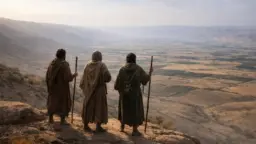
The country that we traversed and scouted is one that devours its settlers. All the people that we saw in it are of great size; we saw the Nephilim there—the Anakites are part of the Nephilim—and we looked like grasshoppers to ourselves, and so we must have looked to them.
Bamidbar 13:33
The story of the Israelites preparing to enter the Land of Israel stands as a profound metaphor for the transition from infancy to adulthood.
For nearly forty years, the Israelites lived in a world of complete Divine protection: clouds of glory shielding them by day, manna falling from heaven, and shoes that grew with them (See Devarim Rabbah 7:10). They wandered in what could be called a pre-natal existence—a perfectly protected, womb-like reality in which no true responsibility was demanded of them. Many commentators note that these years in the desert shaped the childish, untested phase of the new nation’s life.¹
Now, on the threshold of entering the land, the people send spies—each a prince of his tribe—to assess what awaits them. Their alarming report is well known: a land that “devours its inhabitants,” populated by giants of terrifying size (Bamidbar 13:32–33). It is not only the report that is troubling, but the people’s reaction on hearing it: an immediate desire to flee back to Egypt, back to the past, back to the familiar.
Fear of growing up
The spies’ revolt can be understood as an attempt to avoid “birth.” The Israelites had never been independent. In Egypt, they were slaves, absolved of autonomy; in the desert, they were children, carried by their Parent through a landscape where all needs were met.
They had no incentive to leave the paradise of dependence. Why grow up?
Rabbinic literature makes this point with striking clarity. The Midrash teaches that the people were like children frightened of school, clinging to the safety of home.[1] Entering the land meant responsibility, agriculture, economics, political obligation, and danger. It meant adulthood—with all its unavoidable complexity.
The giants that the spies saw (or imagined) were the projected fears of a nation unwilling to mature.
The giants and the Nephilim
The appearance of the Nephilim in the spies’ report is not incidental. These figures appear in the first section of Sefer Bereshit during humanity’s “infant” period—an era in which everything still seemed mythic and oversized (Bereshit 6:4).
The Nephilim represent the fears of early consciousness: the monstrosities we imagine when we have not yet learned to push back on our perceptions.
In the desert, too, the spies saw reality through the eyes of frightened toddlers. The Talmud explains that fear warps perception: “A person sees only what is in his heart.” (Berakhot 55b). When one feels like a grasshopper, the world becomes filled with giants.
Nicolaas Beets, the poet and theologian from Haarlem, the Netherlands, expressed the psychological truth behind this:
“Een mens lijdt dikwijls ‘t meest door ‘t lijden dat hij vreest,
doch dat nooit op komt dagen.”
(A human being often suffers most from the suffering he fears,
which never comes to pass.)[2]
Fear created giants. Fear created a devouring land. Fear created the image of themselves as tiny, helpless creatures.
Allowing others to define us
The spies’ confession is one of the most revealing lines in the Torah: “We were in our own eyes like grasshoppers — and so we were in their eyes.”
Rashi, quoting Midrash Tanchuma, notes that the spies assumed the Canaanites also saw them as insects, projecting their internal sense of worthlessness outward.
This dynamic continues today. Millions of Jews define themselves through the gaze—real or imagined—of others. Some even cling to Jewish identity primarily out of fear of anti-Semitism, an identity shaped entirely by our enemies.
Jean-Paul Sartre famously argued in Réflexions sur la Question Juive that the anti-Semite “creates the Jew.”[3] But as Marek Halter recalls in Le Judaïsme raconté à mes filleuls, when he challenged Sartre on this, Sartre admitted that such a position is ultimately that of a non-Jew. True Jewish authenticity, he conceded, can only arise from self-definition—from within Torah and mitzvot—not from the gaze of the other.[4]
The Israelites’ tragedy in the desert was thus not merely fear, but a surrender of self-definition. They allowed the imagined giants to tell them who they were.
The eternal temptation of the desert
The rebellion of the spies is not a single event lodged in the past. It is a pattern that repeats throughout human history.
Many people today prefer to wander in a metaphorical desert: childhood without end, responsibility deferred, growth postponed. The desert is comfortable. The land—life, adulthood, destiny—is frightening.
As Benjamin Franklin reportedly said: “Many people die at twenty-five and are buried at ninety.”[5]
The tragedy of the spies is the tragedy of refusing to live life.
Notes
[1] See Midrash Tanchuma, Shelach 7; Tanchuma, Beshalach 3. Also see Rambam, Moreh Nevuchim (Guide for the Perplexed) 3:32 on the “training period” in the wilderness.
[2] Nicolaas Beets (1814–1903), “De Moeder,” in Camera Obscura.
[3] Jean-Paul Sartre, Réflexions sur la Question Juive (Gallimard, 1946).
[4] Marek Halter recounts his conversation with Sartre in Le Judaïsme raconté à mes filleuls (Éditions Robert Laffont, 1976).
[5] Widely attributed to Franklin; earliest documented appearance in Most of Us Die Before We Are Dead, by Harold L. Brown (1926).
Questions to Ponder
- The essay portrays the wilderness as a womb-like space of perfect protection. Do you recognize forms of “spiritual prenatal care” in your own religious life—structures that protect you from risk, responsibility, or growth? At what point does protection become suffocation?
- The spies are described as princes—leaders, not weaklings. Why do you think those entrusted with leadership were the ones most afraid to enter adulthood? Does authority sometimes deepen fear rather than dispel it?
- The spies say, “We were like grasshoppers in our own eyes—and so we were in their eyes.” How often do you allow your self-image to be shaped by how you imagine others see you? How much of Jewish identity today is reactive rather than self-generated?
- Sartre claimed that the anti-Semite creates the Jew. Do you see contemporary Jewish identity being shaped more by internal commitment or by external threat? What are the spiritual costs of defining oneself through one’s enemies? Is exaggeration of threat sometimes a subconscious strategy to avoid responsibility and change?