God created man in His image; in the image of God He created him.
Bereshit 1:27
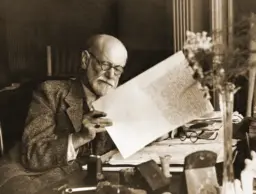
Freud had nothing good to say about religion. He regarded religious beliefs as “…illusions, fulfillments of the oldest, strongest and most urgent wishes of mankind.” [1] Religion, he believed, was a mental defense against life’s hardships, against its threatening aspects, such as earthquakes, floods, storms, diseases and inevitable death, which “rise up against us, majestic, cruel and inexorable.” [2] We look for some kind of security into which we can escape from many of these threatening misfortunes. And if we cannot avoid them, we need to at least feel that these disasters have an exalted purpose. This requires the existence of an ultimate father figure, an infinite being who can stop any disease or natural disaster, or has good reason for causing these calamities to take place.
This, claims Freud, is the reason why millions of people, including highly intelligent ones, believe in God. It is not because they have a high mental capacity to understand this world, but rather because of “the universal, obsessive neurosis of humanity,” [3] which would be left behind if people would finally learn to face the world, relying no longer on illusions but upon scientifically authenticated knowledge.
The Oedipus Complex
In Totem and Taboo, Freud introduced his famous Oedipus complex.[4] Freud uses this complex to explain the tremendous emotional intensity of religious life and the associated feelings of guilt and obligation to obey the dictates of the deity. He postulates a stage of human pre-history in which the family or tribe unit was the “primal horde,” consisting of father, mother and offspring. The father, as head of the family or tribe, retained exclusive rights over all the females and drove away or even killed his sons who challenged his authority. The sons, seeing that they could never challenge their father’s authority, decided to kill him and (being cannibals) consume him! This universal complex, says Freud, is the primal crime of which guilt is born, and which is responsible for so much tension within the human psyche.
This guilt ultimately developed into moral inhibitions and other phenomena now found in religion, since the sons, struck with remorse, could not succeed their father as head of the tribe.
For this reason, the father figure — which later developed into the god idea — became so powerful in the human mind, and that is the reason why people are religious: because of a deep feeling of guilt and the need to rectify the killing or rejection of this god by way of total obedience.
Many scholars have discussed and criticized Freud’s theory. Clearly, Freud was influenced by Charles Darwin and Robertson Smith, two dominant figures of the 19th century who initiated the “primal horde” theory. Modern anthropologists, such as H.L. Philip in his 1956 publication Freud and Religious Belief, have rejected this theory.
While Freud considered himself an atheist and seems to have misunderstood most of religion, he was not entirely wrong when he proposed that many people are religious because they wish a God to exist to whom they can turn when in great need. Surprising, however, is his conclusion that because we wish God to exist, one must conclude that His existence is a fantasy. This makes little sense. The fact that we wish God to exist has no bearing at all on the question of whether He really exists or not. He may quite well exist, and we may simultaneously have a great need for His existence.
Nowhere did Freud offer any justification for his atheism, nor did he understand that he had in fact hit on one of the great foundations of Jewish thought.
Jewish tradition teaches that mankind was created in God’s image. Whatever this may mean, it definitely includes the fact that God created humans in such a way that they, in desperate need to discover themselves, would constantly search for Him. Freud, we believe, gave a most original interpretation of this phenomenon. With his discovery of the father figure, he may have uncovered the mechanism through which God created an idea of Himself as the ultimate Father in the human mind.
Utter dependence
The utter dependence of a child on his or her loving parents may very well have been the way through which God built the foundation for our capacity to believe and trust in Him. One could argue that this was the very reason why God decided in favor of parenthood over other options, such as creating human beings without the need for parents (the creation of Adam and Hava). Rabbinic tradition suggests that God first created the Torah as a primordial blueprint, after which He created the world accordingly.[5] In that case, He may very well have created the need for us to see Him as the great Father Figure and consequently decided to create the need for parents.[6]
Freud, then, may have been motivated, subconsciously and against his better instincts, by a deep Jewish need to explain the foundation of belief, and in this way he contributed substantially to the great tradition of Torah commentary.
Psychology generally gives us a totally different idea of what we thought we knew best about ourselves. The Jew, Shlomo (Sigmund) Freud, proved this point by believing that his arguments opposed religious faith, while in fact supporting it.
Notes
[1] Sigmund Freud, The Future of an Illusion, trans. from the German and ed. by James Strachey, (New York: W.W. Norton & Company, 1961), 30.
[2] Ibid. 16.
[3] Ibid. 43.
[4] Oedipus is a prominent figure in Greek mythology who unknowingly killed his father and married his mother; the Oedipus complex of Freudian theory is the child’s unconscious jealousy of his father and longing for his mother.
[5] Bereshit Rabba, Vilna ed., 1:1; Zohar on Shemot 161b.
[6] See John H. Hick, Philosophy of Religion, 4th Edition (Englewood Cliffs, NJ: Prentice-Hall, 1990), 33-35.
Questions to Ponder from the DCA Think Tank
- How do you understand the concept of humans being created in the image of God? That each of us has inherent value? Absolute freedom of will? A creative spark? Consciousness? Discuss.
- Rather than focusing on guilt, Judaism talks about obligations to keep Mitzvot and discusses the spectrum of carrying out commandments from fear and from love. How do you rank these components in your own religious life? To what extent is guilt a motivating factor in your own observance?