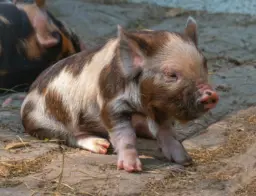
… And the pig, because it has a cloven hoof that is completely split, but will not regurgitate its cud; it is unclean for you.
Vayikra 11:7
Kosher animals, as is well known, can be identified by two simanim (physical signs). They must chew their cud, and their hooves must be entirely cloven.[1] In order to be kosher, the animal must possess both simanim. The Torah goes out of its way to emphasize the fact that an animal that displays only one sign cannot be considered kosher at all.
The following, however, of those that either chew the cud or have true hoofs, you shall not eat: the camel — although it chews the cud, it has no true hoofs: it is impure for you; the hyrax — although it chews the cud, it has no true hoofs: it is impure for you; the hare — although it chews the cud, it has no true hoofs: it is impure for you; and the swine — although it has true hoofs, with the hoofs cleft through, it does not chew the cud: it is impure for you.[2]
A careful reading of this text makes us wonder: Why did the Torah need to state that these non-kosher animals chew their cud or have cloven hooves? After all, clearly having either of these two characteristics does not, by itself, makes them spiritually “unclean.” On the contrary, having one positive sign seems to suggest that perhaps they are, after all, kosher! If the Torah would just mention the negative indicators in these animals that clearly identify them as non-kosher, we would have known enough: Not kosher!
Moreover, why are the kosher signs mentioned before the non-kosher signs? Would the reverse order not be more helpful? Surely the non-kosher signs bear more relevance in a discussion of why these animals are not kosher! In what way, then, do the kosher simanim make the animal more non-kosher than the non-kosher signs themselves?
Rabbi Ephraim Shlomo ben Chaim of Luntshitz, known as the Kli Yakar (1550–1619), gives us a most illuminating explanation for why the Torah specifically chose this wording and no other. In his opinion, we might have thought that indeed the non-kosher aspects of these animals make them impure, but the kosher signs somehow moderate that impurity. Instead, the Torah comes to tell us that the kosher signs of non-kosher animals make them all the more unclean.
Why? Because animals with only one kosher sign represent a negative character trait — namely, hypocrisy. The camel, the hyrax, the hare, and the swine all give the appearance of being kosher. The first three can demonstrate their “kashrut” by emphasizing that they do, after all, chew their cud. The swine, too, can show its cloven hooves in order to “prove” its virtue. They all, therefore, have the ability to hide their true natures behind a façade of purity. Only upon close inspection do we realize that these animals are impure.[3] It is as if they are flying a kosher flag, but hiding impure cargo.
This is indeed much worse than possessing both non-kosher simanim. Animals with both non-kosher simanim don’t try to “deceive” us about their impurity, but rather openly and honestly declare where they stand. With them, there is no hypocrisy and there are no misleading impressions. For this reason, the Torah first mentions the kosher signs of these animals, because it is these deceptive signs that make them even more unclean.
The challenge of honesty
When relating the story of the jealousy between the sons of Yaakov, the Torah states, “His [Yosef’s] brothers saw that their father [Yaakov] loved him more than all his brothers, so they hated him and could not speak with him peacefully.”[4] Rashi comments on this verse: “From their faults we learn their virtues, for they did not speak one way with their mouths and think differently in their hearts.”[5] Even as they erred we see their honesty.
The issue of hypocrisy and religious integrity presents a serious problem. For what is ghastly about evil is not so much its apparent power, but its uncanny ability to camouflage itself.
In our days, when every human deed and thought is the object of suspicion, we begin to wonder whether it is at all possible to live a life of integrity. Is piety ever detached from expediency?[6] Is there not a selfish motive behind every action? Are we not smooth-tongued and deceitful even when we appear to be honest?
Judaism fully recognizes this problem. It is difficult, if not impossible, to know whether one acts out of self-interest or out of absolute integrity. But as long as the question haunts us and we admit to possibly being the victim of our own camouflage, we can try to extricate ourselves from this malaise and we will have done what is humanly possible. Our greatest problem is when we are no longer disturbed by our ability to hide behind our own camouflage. Once hypocrisy becomes a state of mind, it transitions to true evil. “The true hypocrite is the one who ceases to perceive his deception, the one who lies with sincerity.”[7]
When even kosher is not really kosher
This is also true on a very practical level. There is little doubt that one of the functions of the kashrut laws is to protect the animal from pain even during the slaughtering. This is accomplished by the many strict laws of shechita in accordance with Halakhah. Attacks on this method by several European countries and political parties are nothing but expressions of anti-Semitism camouflaged by so-called animal rights arguments. In fact, we see constant and severe violations of these rights in their own abattoirs, where animals are horribly mistreated and sometimes mercilessly killed. In short, this is flagrant hypocrisy.
Still, we cannot deny that in our own slaughterhouses, where proper shechita is done, there have been serious violations of another law — tza’ar ba’alei chaim (the Torah’s prohibition against inflicting unnecessary pain on animals).[8] How are these animals handled just before the shechita takes place? Are they treated with mercy when they are put on their backs so as to make the shechita easier? (This can easily be accomplished with the Weinberg Pen, or by other methods.) What if chickens or other fowl are kept under the most unacceptable conditions, such as in overcrowded containers? Are these animals still kosher, even if the shechita was 100 percent accurate?
Since when is the actual shechita more important than the laws of tza’ar ba’alei chaim? It seems self-righteous and duplicitous on the part of very religious Jews to insist on glatt kosher shechita, with all its stringencies, when the animals are badly treated prior to shechita, in defiance of Halakhah’s requirements. Are they not as treif (non-kosher) as any other animal that is not slaughtered according to Halakhah? Can we hide behind the laws of shechita and then look the other way when the laws of tza’ar ba’alei chaim are violated? Is that any less hypocritical?
Since the massive growth of agribusiness, in which thousands and thousands of animals are slaughtered daily, it has become more and more difficult, if not impossible, to treat animals humanely, as Jewish Law requires.
The laws of shechita and tza’ar ba’alei chaim were meant for Jewish communities who would eat meat occasionally, not for the huge industry we have today where these laws can no longer be properly applied. That being the case, wouldn’t it be appropriate and advisable for religious Jews to become vegetarians?
In all honesty: How many of our glatt kosher kitchens, including my own, are still truthfully kosher? A haunting question, from which we cannot hide!
With devotion’s visage
And pious action
We do sugar o’er
The devil himself
Shakespeare, Hamlet[9]
Questions to Ponder
- Keeping kosher in the 21st century is easier than ever — certainly in Israel and often even in the Diaspora. But alongside the advantages of our era, we have become completely cut off from the sources of our food and are no longer aware of the prices exacted in the course of its production. Should a kashrut-observant person today spend time visiting agricultural settlements to witness firsthand what is going on in the fields and the barns? Is that something you yourself ever considered doing?
- Rabbi Cardozo suggests rethinking whether chickens kept in unacceptable conditions can really be considered kosher. What is your opinion? Have you ever researched the living conditions of chickens in your country?
- Should our kashrut observance be connected to even broader ethical issues than those mentioned in this essay, such as how we treat the waiter, or ensuring an adequate income for farmers, even if that means paying more for fruits and vegetables? Are there other issues surrounding food production that might influence kashrut?
- Rabbi Cardozo asks whether all Jews should become vegetarians. But God gave humankind permission to eat meat after the flood, and that has never been revoked. Moreover, meat is halakhically considered along with wine to bring simcha (joy) on Yom Tov (for men at least). Would becoming vegetarian mean aiming higher than God and the Halakhah might want/need us to?
- Even if you do not believe all Jews should become vegetarians, do you think too much meat is eaten at Jewish celebrations, for example weddings where meat is served both at the reception and at the main meal? Perhaps one might consider refraining from eating meat during the week and only on Shabbat or Yom Tov?
Notes
[1] Vayikra 11:2-3; Devarim 14:6-8.
[2] Vayikra 11:4-7.
[3] See Kli Yakar on Vayikra 11:4.
[4] Bereshit 37:4.
[5] Rashi, ad loc.
[6] See Rabbi Abraham Joshua Heschel, God in Search of Man: A Philosophy of Judaism (NY: Farrar, Straus and Cudahy, 1955), 390.
[7] André Gide, The Counterfeiters, trans Dorothy Bussy (NY: Vintage Books, 1973), 427.
[8] Bava Metzia 32b For a discussion, see Immanuel Jakobovits, Jewish Medical Ethics (NY: Bloch Publishing Company, 1967), 102–103, 297–298 nn30–37.
[9] Hamlet, Act 3, Scene 1, lines 47-49.