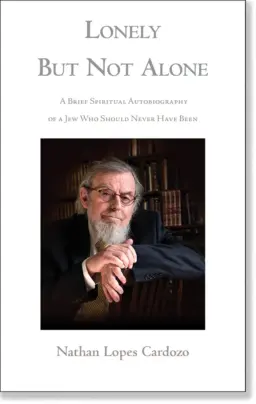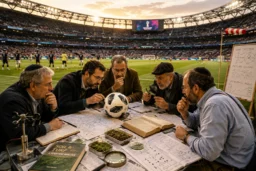
We are in the middle of the FIFA World Cup, and I suffer sleepless nights and struggle with serious depression. For Heaven’s sake, why is it that time after time we Jews find ourselves not at the center of these games? It is outright anti-semitic!
Jews run the world? So why not Football as well?
Let’s be honest. Everyone knows that Jews run the world. We dominate the White House, control the financial world, and win nearly all the Nobel Prizes. Our country is bigger than China, and we occupy more foreign territory than any other country in the world. We are by far the most irritating people on the planet. With such a reputation, the FIFA World Cup should be child’s play. So, why are we not even in the running?
So, I went to Beitar Yerushalayim’s locker room and put my ear to the wall. Then I travelled to the Hapoel Tel Aviv team, once more pressing my ear to listen. Finally, with that same ear, I walked into the rooms of Maccabi Haifa and again listened. My conclusion: there is only one way to fix this:
Jewish football players need serious rabbinical advice!
Jewish football players need serious rabbinical advice!
As everyone knows, I am Dutch and was a close friend of the most famous Dutch football player ever, Johann Cruyff. This gives me the moral obligation to give Israeli football players, such as Yossi Benayoun and Mordche Spiegler, a few tips. That they shall hear and learn!
A romance between the player and the ball
First of all, soccer is a romance between the player and the ball. The real Jewish soccer player must fall in love with the ball and sense where the leather wants to go. He needs to understand its difficulties and needs, and comprehend its relationship with other balls. One doesn’t just run after a ball. One identifies with it and gets into its kishkes. One caresses and kisses the ball ad nauseam.
And then this: The player must not wish to toot his own horn. He must be preoccupied with only one thought: I am nothing; the ball is everything. I must cede my personality to it. I have to be the ball. Once that happens, the goal is suspended in the air, ready to be plucked.
Working with the psychology of the ball
Let me tell you something of my own experience with Cruyff.
When we played in the Dutch team called Ajax there was one thing we both knew. You have to let the ball do the work. To put it in layman’s terms: you must stand exactly in the spot where you know the ball will come. True, it isn’t there yet. It may take twenty minutes. Just have patience.
I remember how Cruyff and I would stand in the middle of the field while others chased the ball. We simply waited, motionless. We ordered a coffee and exchanged a devar Torah. Cruyff would stand with his head bowed, as if listening to something. And indeed he was. He was listening to the movements of the ball—its groans, its pleas. Then he would draw himself up and say to me, “Cardozo, in 18 minutes the ball is here.” And so it was.
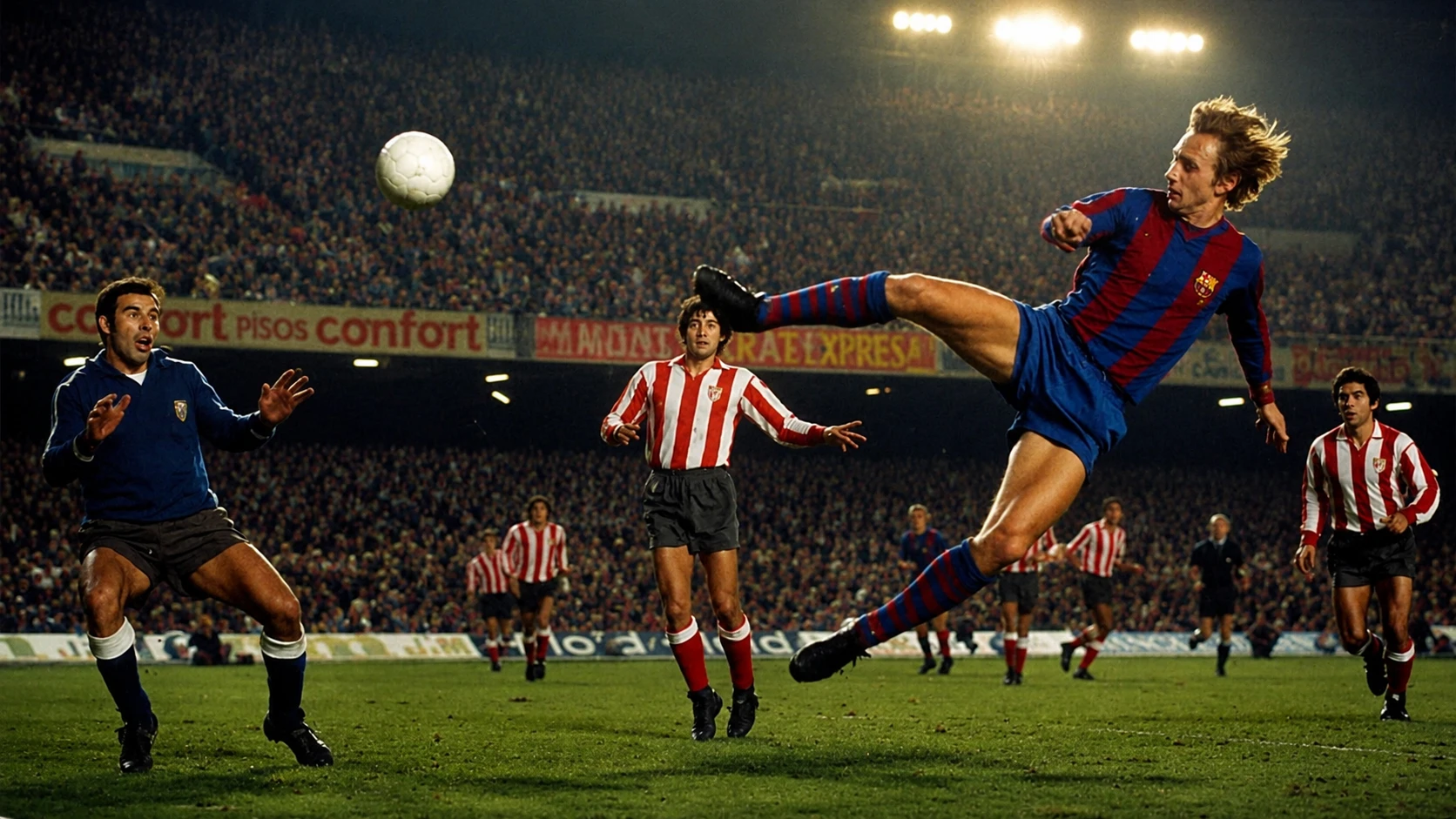
Yes, I stood offside and the goal didn’t count, but that’s of little importance. What mattered is the gesture!
The science of it all
Another thing: Our boys have to be much better prepared. They must study the grass type on the soccer field, the quality of air to be expected, and the direction of the wind. In what language will the fans be shouting? What types of musical instruments will they use to encourage their favoured team?
Israeli grass, for example, is different from the grass in Mexico. The Mexican stalk has fifteen percent higher glucose than the Israeli one, while its strands grow in the opposite direction from the way they grow in Jerusalem. This is because Jews speak their language from right to left. Over the course of hundreds of years, the shouting of Hebrew in the stadium caused a genetic mutation making the grass grow against the natural order of things.
Why is this important? Because when you want to kick the ball to the nearest soccer player, you need to know whether the grass is your enemy or your friend. Does it accommodate the ball, or frustrate it? It’s all about friction and pressure.
And we Jews know about these things. Our entire history has been one of constant friction, with each other and with the world. They have kicked us around left and right. But we have become immune and have outlived all our enemies. So, some Jews think that the ball, too, is immune. But it’s not. It is sensitive to the core and just wants to score.
And let us not forget about the famous Mexican Aztec Death Whistle also called Ehecachichtli, blown by tens of thousands of fans in the stadium. Jews think it’s comparable to the shofar, but it isn’t. The shofar demands serious self-contemplation, while the task of the Ehecachichtli is to irritate and kill the opponent.
Jews may think these are trivialities that don’t matter at all. Wrong again.
The need for Rabbinic advice
And that’s where we, the rabbis, come in. Our advice is indispensable. We rabbis have studied the Talmud and know that trivialities are the stuff the world. We have contemplated and debated every detail of human existence, just as scientists dedicate their lives to studying the habits of insects, or the properties of a plant. To them every minutia is significant. They diligently inquire into the most intricate qualities of things, because God is in the details.
We are experts in how to make a problem out of every solution.
And so it is with us rabbis. We are experts in how to make a problem out of every solution. Therefore, we are unbeatable, even immortal, and know exactly what soccer is all about.
So, what needs to be done to ensure that next time we Jews win the FIFA World Cup?
The first thing we must do is send a group of Jewish scientists—botanists, geologists and meteorologists—to wherever the next World Cup will be held. They will need to test the ground and look into seed time, growing power, root-substances, and above all the pigment of the chlorophyll. Similarly, they must examine the air quality and the various types of wind. Is there upbeat wind, or downbeat air? It is crucial to put all these winds and air substances in special wind sacks and send them for analysis to the Meteorological Center in Beit Dagan, located near Rishon LeZion.
Together with a keen understanding of the emotional makeup of the ball and its neshama, we Jews will be able to start playing soccer properly and win every World Cup. Sure, we need to say some of King David’s Psalms. Just in case. As is well known, it works wonders!
Of course, the United Nations and the Palestinians will object and claim that we didn’t play fair, that we occupied the ball and denied it its freedom.
But we all know the real reason they do not allow us to play at the FIFA World Cup. It is not because we are not good enough, but because we Jews have outlived all our enemies. And the world is afraid that we again will win all the games and put them all to shame. Out of our unprecedented humility we will not make an issue of it. But we know better.
After all, “He who laughs last, laughs loudest”
Inspired by Dutch humorist Godfried Bomans (1913-1971)