And the earth opened its mouth and swallowed them up with their households, all Korah’s people and all their possessions.
Bamidbar 16:32
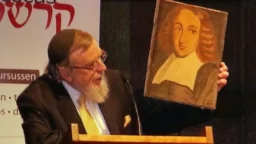
At a symposium organized by the University of Amsterdam and the Crescas Centre in 2015, I was reminded of a much older story in the Torah — the story of Korach, who seems to have been the first “heretic” in Jewish history.
At this gathering, famous Spinoza scholars debated whether or not the notorious 1656 ban on Spinoza should be rescinded. The ban, enacted by the parnasim, lay leaders, of the Portuguese Jewish community, was a response to what they perceived as Spinoza’s heretical ideas. It is perhaps the most famous ḥerem (religious ban) ever pronounced in Jewish history — and still a living point of controversy.
Although Spinoza must be counted among the great philosophers of Western thought, the ban undoubtedly magnified his influence. Some would argue that without it, his ideas may never have achieved the cultural mythos that surrounds them.
I argued that the ban should be revoked. Coming from an orthodox rabbi, this may have sounded strange. Spinoza not only rejected Jewish tradition but often misunderstood and ridiculed it. My argument was not that Spinoza was correct, but that the ban itself portrayed Judaism as insecure, anti-intellectual, and fearful of challenge. This portrayal does untold damage.
Bias and the shaping of ideas
Philosophy is not immune to bias. Cognitive psychologists today speak of confirmation bias, motivated reasoning, implicit bias, and reactive devaluation — the tendency to dismiss what comes from those we disagree with, resent or distrust. These are all powerful forces that shape intellectual conclusions beneath the surface of conscious reasoning.
This may explain much in Spinoza’s case. Was Spinoza’s critique of Judaism purely philosophical, or was it also the result of wounded dignity, alienation, and resentment toward communal authority?
Spinoza had been excommunicated and marginalized by community leaders. It is reasonable to suggest — as modern psychology would — that he may have been influenced by motivated reasoning: forming conclusions that justify emotional needs, such as independence from religious obligation or the desire for acceptance in tolerant non-Jewish circles.[1]
He was revered among Dutch freethinkers. A critique of religion, especially the Hebrew Bible, would have made him appear enlightened and heroic. Spinoza’s philosophical system may therefore have functioned as both intellectual pursuit and personal emancipation.
None of this denies his brilliance. But genius is no safeguard against subconscious bias.
Korach — the prototype of the enlightened rebel
This brings us back to Korach. The Torah presents him as charismatic, clever, and — at least on the surface — justified. “For the entire community is holy,” he argues (Bamidbar 16:3). Was he wrong? Not necessarily.
The Midrash records his halakhic satire:
A tallit made entirely of blue — does it require a single thread of techelet? A house filled with Torah scrolls — does it need a mezuzah?[2]
Korach mocked Moshe’s rulings as arbitrary conventions. His critique had intellectual force. Yet the Torah hints at a deeper motive: “Vayikach Korach — Korach took (himself).”[3]
The Sages read this as self-aggrandizement, a man “taking himself aside” for personal ambition.[4]
His rebellion was not purely ideological, it was a grasp for power. His intellect served his ambition, rather than the reverse. Like Spinoza, he may have believed his arguments sincerely, but sincerity does not rule out bias.
When subconscious desire masquerades as truth
At the 2015 symposium, I was struck by a parallel: Nearly every scholar argued against lifting the ban. One might expect secular admirers of Spinoza to welcome such a gesture — but few did.
Speaking with them, it became clear that many depended on the ban. It allowed them to depict Judaism as fearful and dogmatic. If the ban were lifted, their argument lost force. Their reasoning, too, seemed touched by motivated conclusion-seeking.
Even more striking were those in the audience who claimed Spinoza changed their lives — yet when I asked them, they could not summarize his view of God. They admired not the thinker, but the idea of Spinoza. He was a banner under which they could march into secularism without theological work. It was Korach all over again: intellectual critique masking emotional rebellion.
What might have been
Both Korach and Spinoza were great minds, and both, I suspect, overreached. Ambition, grievance, or subconscious longing coloured how they understood and read their tradition.
Had Korach been more self-aware, perhaps he would not have been swallowed by the earth — both literally and historically. Had Spinoza recognized the emotional foundations of his philosophy, perhaps he might have become Judaism’s greatest thinker rather than its most famous excommunicate.
History might then have remembered them as leaders, not rebels. And Judaism might have benefitted profoundly.
In each case, their lack of self-awareness deprived us of a great leader.
Notes
[1] For a most excellent study on Spinoza’s bigotry and a lack of evenhandedness, see Emile L. Fackenheim, To Mend the World: Foundations of Future Jewish Thought (Schocken Books, 1982), chap. 11.
[2] Midrash Tanchuma, Korach 2–3; Bamidbar Rabbah 18:3.
[3] Bamidbar 16:1.
[4] Rashi ad loc.; Sanhedrin 109b.
Questions to Ponder
- Rabbi Cardozo suggests that what we call heresy may be shaped as much by wounded dignity and resentment as by intellectual insight. How comfortable are you with examining the emotional roots of your own beliefs—especially those you hold most passionately?
- Is there a difference between protecting a tradition and protecting power? How do you tell when boundaries serve truth—and when they serve control? Finally, when you challenge an authority, a tradition, or a belief, how do you know whether you are seeking truth—or seeking yourself
- Korach’s arguments were not foolish; they were clever, even compelling. Does the Torah’s rejection of Korach imply that how a question is asked matters more than what is asked?
- Finally, when you challenge an authority, a tradition, or a belief, how do you know whether you are seeking truth — or seeking yourself.
- Rabbi Cardozo argues that banning Spinoza made Judaism look insecure and fearful.
- Do you think religious communities should ever suppress dangerous ideas—or does suppression inevitably backfire?
- If lifting the ban on Spinoza would undermine the narrative of Judaism as dogmatic, what does that reveal about the emotional investments of secular critics of religion? Do you think anti-religious certainty mirrors religious dogmatism?
- The admiration of Spinoza without understanding his philosophy suggests attachment to a symbol rather than a concrete idea. How often do we adopt thinkers—or movements—as banners rather than engage their actual content?
- Both Korach and Spinoza are portrayed as men who might have become great leaders within Judaism. What inner qualities—beyond intelligence—are necessary for critique to become constructive rather than destructive?
- If Judaism thrives on debate and dissent, as the Oral Torah suggests, what distinguishes the heretic from the sage? Is it belief, loyalty, humility—or something else entirely?