Does Judaism really need animal sacrifices? Would it not be better off without them? After all, the . . . When a man from [among] you brings a sacrifice to the Lord; from farm animals, from cattle or from the flock you shall bring your sacrifice.Vayikra 1:2
Vayikra 1:2
Does Judaism really need animal sacrifices? Would it not be better off without them? After all, the sacrificial cult seems a discredit to Judaism. What does a highly ethical religion have to do with the collection of blood in vessels and the burning of animal limbs on an altar?
No doubt Judaism should be free of such things. Yet it is not.
Is the offering of sacrifices a Jewish value, or not? The answer is an unequivocal yes. And yet, it doesn’t really belong to Judaism. If Judaism had had the chance, it would have dropped the entire institution of sacrifices in a second. Better yet, it would have had no part in it to begin with. How much more beautiful the Torah would be without sacrifices! How wonderful it would be if a good part of Sefer Vayikra were removed from the biblical text, or had never been there in the first place.
So what are these sacrifices doing there?
The Function of Halakhah
The answer is that the Torah doesn’t really represent Judaism in its ideal form, nor in all its glory.
There are actually two kinds of Judaism. There is the Judaism of today, and there is the Judaism of tomorrow. There is realistic Judaism and idyllic Judaism. What fills the gap between them is the world of Halakhah (Jewish Law). Halakhah is the balancing act between the doable and the ideal; between approximate means and absolute ends; between what is and what ought to be. It is a great mediator, and a call for hope.
The Judaism of today is a concession to human weakness, but at the same time it is a statement of belief in the greatness and strength of humanity. It calls upon us to do whatever is in our power to climb as high as possible, but warns us not to overstep and fall into the abyss. Judaism asks humans to be magnificent beings, but never angels — because to be too much is to be less than.
What ought to be can’t yet be
Judaism also believes that humanity may one day reach the point where what is impossible today may be possible tomorrow. What ought to be may someday become reality. It is that gap that Halakhah tries to fill.[1]
Many people believe that concessions to human weaknesses are incompatible with the Divine Will, that the Divine Will should not be compromised by human shortcomings.
But Judaism thinks otherwise.
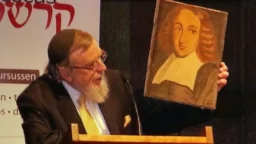
The philosopher who most exemplifies the philosophy of what life ought to be is Baruch Spinoza, whose Ethics laid out a path to the perfect life. Judaism is amused by Spinoza’s ideal world in which passions and human desires have no intellectual place, since they upset the philosopher’s “good life” of amor intellectualis Dei (the intellectual love of God). Spinoza’s philosophy is so elevated that, with perhaps a few exceptions, it is totally unworkable. He himself proved the shortcomings of his own philosophy when he lost his reason after the political murders of the influential De Witt brothers in Amsterdam in 1672. So distraught was he that he attempted to confront the mob with a sign reading ultimi barbarorum (extreme barbarians). He was prevented from doing so by his landlady, who, fearing that Spinoza would himself be murdered, locked the door on him![2]
How different the Ethics would have been if Spinoza had married, fathered children, and understood the limitations of daily life. Perhaps Spinoza’s Ethics presents the ideal way of life, but how immature to believe that it is attainable!
Halakhah is pragmatic. It has no patience for Spinoza’s Ethics and no illusions about human nature. Indeed, it expects us to extend ourselves to full capacity, but it acknowledges the long and difficult road between the is and the ought-to-be. And it understands all too well that the ought-to-be may never be reached in our lifetime.
Judaism teaches that the Divine limits Itself out of respect for human nature. It was God Who created our imperfect species. Therefore, He could not have given the Ethics of Spinoza at Sinai; instead, He gave “divinely imperfect” laws that deal with the here-and-now and offer just a taste of the ought-to-be. Judaism teaches that if the perfect is unattainable, one should at least try to reach the possible — the manageable — that which can be achieved. If we can’t have it all, let us attempt to make some improvement. If we must wage war, let us do it as ethically as possible. If universal vegetarianism is inconceivable, let us try to treat animals more humanely, and slaughter them painlessly. That is doable Judaism.
The Torah is an embarrassment
True, this is not the ideal — indeed, the Torah is sometimes an embarrassment — but it’s all that God could command at Sinai. It is not the ought-to-be Judaism, but it is a better-than-nothing Judaism.
The great art is to make the doable Judaism, with all its problems, as ethical as possible; and instead of despairing about its shortcomings, to live it as joyfully as we can. Spinoza taught us that “Joy is man’s passage from a lesser to a greater perfection.”[3] Oh, Baruch, did you forget your own insights!?
Sacrifices are not part of the ought-to-be Judaism. They are far removed from the Judaism that Spinoza would have liked to see. But they are a realistic representation of the doable with an eye toward the ought-to-be.
In one of his most daring statements, Rambam (Maimonides) argues that animal sacrifices are a compromise to human weakness. The ancient world of idol worship was deeply committed to animal sacrifices. It was so ingrained in the way of life of the Jews’ ancestors that it was “impossible to go suddenly from one extreme to the other.” “The nature of man,” he wrote, “will not allow him to suddenly discontinue everything to which he is accustomed.”[4] Therefore, God permitted the Jews to continue the sacrificial cult, but only for “His service,” and with many restrictions, the ultimate goal being that with time the Jews would be weaned from this type of worship, from the is to the ought-to-be.
By making this and similar statements, Rambam laid the foundations for Spinoza’s dream of an ultimate system of ethics, just as he planted the seeds of Spinoza’s pantheism.[5] But Rambam realized that the time had not yet come, that there was still a long road from the reality to the dream.
In contradiction to his statements in Moreh Nevuchim, Rambam, in his Mishne Torah, speaks about the need for sacrifices even in the future Temple.[6] I believe he thus expresses his doubt that the ought-to-be Judaism will ever become a reality in this world.[7]
Rambam did not live in the Dutch town of Rijnsburg, in an ivory tower far removed from the real world, as did Spinoza. Rambam lived in a down-to-earth world full of human strife, problems, and pain. He was a renowned halakhist, and he knew that the halakhic system is one that instructs us to keep both feet on the ground while simultaneously striving for what is realistically possible.
Sacrifices and deep symbolism
Still, the institution of sacrifice may also be grounded in deep symbolism, the meaning and urgency of which escapes our modern mentality. The fact that idol worshipers made use of it in their own rituals doesn’t mean that it can’t be of great spiritual value when practiced on a much higher plane. The need to bring sacrifices stems from something deeply ingrained in a part of the human psyche, something to which modern man no longer has access. And yet, this doesn’t contradict the fact that it ought to be different, so that even the higher dimensions of sacrifices become irrelevant. When ought-to-be Judaism and Spinoza’s Ethics will one day prevail, there will indeed be no need for sacrifices.
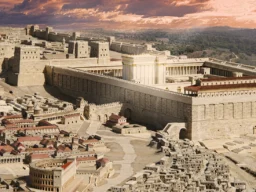
Meanwhile the Temple was destroyed nearly two millennia ago, and sacrificial service came to an end. Is this a step forward or backward? When religious Jews to this day pray for the reinstatement of sacrifices, are they asking to return to the road between the is and the ought-to-be, between the dream and its realization? Or are they praying to reinstate sacrifices as a middle stage, only to eventually get rid of them forever?
We need to ask ourselves a pertinent question: Is our aversion to sacrifices the result of our supreme spiritual sophistication, through which we left the world of sacrifices behind us? Or have we sunk so low that we aren’t even able to reach the level of idol worshipers who, however primitive we believe them to have been, were of a higher spiritual level than some of us who call ourselves monotheists?
This question is of great urgency in a modern world that slaughtered six million Jews and continues to slaughter millions of other people. Have we surpassed the state of is and are we on our way to the ought-to-be Judaism? Or are we on the brink of a lifestyle that is not even at the stage of is, but rather in a state of regression, while we convince ourselves that it is in a state of progression?[8] This is a haunting question — one that we cannot escape.
Questions to Ponder
- The Rambam suggests that the Temple and its sacrificial rites are concessions to human weakness and not the ultimate goal of Judaism.
- Can rituals that are seen as compromises still hold profound spiritual significance, or do they inherently limit the possibility of genuine spiritual growth?
- If Divine commandments can be seen as temporary measures (concessions) rather than eternal truths, how does this affect the authority and timelessness of Torah?
- Does the Halakhah really allow for human weakness? The posek (halakhic expert) can be very humane and figure out loopholes, but there are some absolutes that remain unforgiving. For example, the punishment for eating chametz on Pessah is karet (to be cut off from the Jewish people), which seems quite harsh. Here, it would seem there is no room for human weakness. In your opinion, what differentiates the absolute laws from those that are concessions?
- Should we all become vegetarians? Should we strive for greatness and the ideal, or just rely on the forgiving nature of Halakhah that recognizes and accepts our imperfection? What about people who take on chumrot (stringencies)? Are they negating the spirit of Halakhah?
Notes
[1] See Cardozo on the Parasha, Sefer Shemot, “Torah min haShamayim: The Deliberately Flawed Divine Torah.” I address this issue extensively in Jewish Law as Rebellion.
[2] K.O. Meinsma, Spinoza En Zijn Kring: Historisch-kritische studiën over Hollandsche vrijgeesten (Den Haag: Martinus Nijhoff, 1896), 358 n1 [Dutch].
[3] Benedictus de Spinoza, Ethics, part III, “Definitions of the Emotions.”
[4] Moreh Nevuchim, part 3, chap. 32.
[5] See, for example, Joel L. Kramer, Maimonides: The Life and World of One of Civilization’s Greatest Minds (NY: Doubleday, 2008), 326-329, 373-374; Moshe Idel, “Deus sive Natura – The Metamorphoses of a Dictum from Maimonides to Spinoza,” in Maimonides and the Sciences, ed. Robert S. Cohen and Hillel Levine (Dordrecht: Kluwer Academic Publishers, 2000), 87-110; Carlos Fraenkel, “Maimonides’ God and Spinoza’s Deus sive Natura,” Journal of the History of Philosophy 44, no. 2 (2006): 169-215.
[6] Mishne Torah, Hilchot Melachim 11:1.
[7] An alternative explanation appears in Moreh Nevuchim, where Rambam’s discourse on sacrifices is shaped by a theoretical-philosophical approach. By contrast, his ruling in Mishne Torah is based on strict halakhic-legal criteria.
[8] For a discussion about the various opinions on sacrifices, see R. Meir Simcha ha-Kohen of Dvinsk in his classic Meshech Chochmah, introduction to Vayikra. See, also, the many writings on this topic by the venerable philosopher and mystic, Rabbi Avraham Yitzchak ha-Kohen Kook z.l.