They shall know that I the Eternal am their God, who brought them out from the land of Egypt that I might abide among them, I the Eternal their God.
Shemot 29:46
In an unusual passage, the Talmud reports that King Solomon instituted the laws concerning the Eruv (i.e., “mixing of the realms”) through which one is allowed to carry objects from one domain to another on Shabbat, which would otherwise be forbidden.[1] The Talmud goes on to say that on another occasion King Solomon instituted the ritual washing of the hands. Both decrees were received with Divine favor and a heavenly voice issued forth and proclaimed, “My son, if your heart is wise, Mine will be glad … ”[2]
The great hassidic Sage, Rabbi Menachem Mendel of Kotzk, wondered what great wisdom lies hidden within these laws, such that the Heavenly Master was moved to joyfully approve of them in such a public manner. In his typically profound way, the Kotzker Rebbe explained that both laws demonstrate that a Jew must be both involved (“mixed”) in the world and simultaneously separated enough “to wash one’s hands of it.”[3]
This observation is all the more remarkable since King Solomon was known for being deeply involved in the world (he negotiated international trade agreements and peace treaties, organized public works projects, adjudicated legal cases, etc.) and tasted all of its pleasures. Nevertheless, he maintained, according to the Kotzker Rebbe, a certain distance from the world so that he could detach from it when necessary.
Involvement and detachment
To eat, to drink, to be fully involved, and yet to remain somehow disconnected from the world is indeed a great challenge, and to accomplish this feat requires great wisdom.
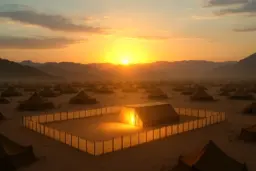
In the construction of the Mishkan, the Tabernacle, built in the days of Moshe, we find another expression of the same idea. As is well known, the Israelites constructed the Tabernacle in the desert, and afterwards brought it into the land of Israel to become the center of their Divine worship. Once they entered the land, the Jews ceased to live in a world of constant, open miracles, but suddenly found themselves obligated to build for themselves a society that would be both political and deeply religious.
This too, was quite a challenge. A successful spiritual culture requires more than just the bare essentials. To foster religious fervor, the Jewish people needed some beauty and refinement (e.g., art and music), which are to some degree, necessary to nourish spirituality. Taken too far, though, luxuries can easily become an impediment to holiness, particularly when they are seen as goals in themselves. As such, a society needs them, but must simultaneously work to keep them connected to the Infinite.
We can divide our needs into three categories:
- Essential — for example, food, clothing, and shelter which are the elementary requirements for human existence.
- Useful — anything that makes life easier, but without which we could still survive (e.g., roads, bridges, tools, and other forms of technology).
- Ornamental — arts that have no practical value, but which elevate the quality of our lives, and make the human experience more pleasant.
At all three levels, fulfilling these needs can be part of religious enrichment. However, taken past the point of moderation, each has the potential for great social evils — over-indulgence, envy, class struggle, corruption, etc.
Shabbat
In plans for the Tabernacle’s construction, we see that all three categories were represented. Some items were absolutely essential to the Tabernacle, such as the outer shell (shelter). Other elements, such as the ramp leading up to the altar, functioned solely to make the priests’ jobs easier. Certain fineries were also added that had no apparent practical value whatsoever, but greatly enhanced the beauty of the Mishkan and the religious experience of those who worshipped there, for example, the ornate embroidery and vivid dyes.
Jewish Tradition states that every category of creative work was represented in the Tabernacle. As such, any human activity that was not needed at any phase in building the Mishkan does not have the status of “work” (melachah) as far as Shabbat is concerned, since it is not an activity that contributes to human society. This is the reason why all these activities are prohibited on Shabbat, when the Jew must abstain from creation and give “the world back to God.”[4]
When we put all these pieces together, a clear message emerges. Before the Jews began building their political state, they first built a place of worship that required them to employ every manner of craftsmanship and labor that they would ever use in the construction of their nation. To make sure that they aligned their priorities correctly, and fully integrated the idea that nothing should ever become an object of over-indulgence, the Jewish people gave their initial bursts of creativity and labor to God. And so they dedicated their thoughts and talents — which would soon be used in the establishment of their new homeland — to Divine service.
As the people toiled to make the Mishkan and all its accessories, the vestments and various articles, they remained constantly aware of God and their mission as members of a holy nation. Later, when they used these same skills in their mundane day-to-day lives, they recalled that the very first time they involved themselves in such work, it was for purely spiritual-religious purposes. In this way, they were able to maintain an elevated state of consciousness while involved in their daily occupations.[5]
Via this ingenious training program, the Jewish people were able to mix with worldly affairs and at the same time, knew how to artfully “wash their hands of it.” This ability to stay mentally focused on spiritual matters, while physically engaging with the world, is the wisdom the Kotzker Rebbe recognized in King Solomon’s dual decrees: the mixing of the realms and the washing of the hands.
Notes
[1] Eruvin 21b. There are different types of eruvin. The eruv under discussion here is the setting up of a symbolic enclosure which turns a semi-public area into a private domain by surrounding it. The eruv has been adopted in cities all over the world, including parts of London, Amsterdam, New York, and, of course, Jerusalem, as well as most other cities in Israel. It allows people to carry things that they need, as well as alleviating situations when not being able to carry on Shabbat would result in undesirable circumstances — for example, by preventing young couples from attending synagogue because their children are too young to walk. The eruv is a typical example of how the Halacha has to work with two opposing spiritual values. As in secular law, it suggests what legal philosopher Sir Isaiah Berlin calls a trade-off for the sake of the realities of life.
[2] See Mishlei 23:15.
[3] See R. Menachem Mendel of Kotzk, Emet Ve-emuna, no. 102 (Jerusalem: Yeshivat Amshinov, 2005), 86.
[4] See Dayan Dr. Isidor Grunfeld, The Sabbath: A Guide to Its Understanding and Observance (Jerusalem: Feldheim Publishers, 1988).
[5] This highly original observation is mentioned by Rabbi Yissachar Jacobson, Binah B’Mikra (Tel Aviv: Sinai, 1964), 93, in the name of Moses Mendelsohn. Obviously many other symbolic, ethical and philosophical reasons have been given for the Mishkan and all its items.
Questions to Ponder from the DCA Think Tank
- The most colorful and shocking reference to hand washing in the Torah is that surrounding the mitzva of the egla arufa, the “broken-necked calf” (Devarim, 21:1-9). When a body is discovered in an unpopulated place between cities in the land of Israel, the elders of the nearest city had to “wash their hands” of the murder by breaking the neck of a calf and washing their hands over its body, as they declared, “Our hands did not spill this blood and our eyes did not see.” What do you think of this example of “washing one’s hands of responsibility”?
- The ritual of the egla arufa is meant to be shocking — making stark a crime that may have resulted partially from the indifference of people who could have protected the victim. At the same time, it provides a ceremony that serves to place limits on responsibility and its consequences. Do you think it is good to have a system in place to limit responsibility? In the USA today, there is a culture of suing whereby the injured party sues everyone who could possibly have a connection to the crime, in the hope that blame, and a resulting payment, will “stick” somewhere. Should there be attempts to limit this behavior? Does a ritual or ceremony provide satisfaction that people in the modern world may otherwise seek in monetary compensation?
- Lady Macbeth famously sought to wash her hands of a crime, and failed. Can one only wash one’s hands of something if one is entirely innocent? Partially innocent? Was the declaration of innocence of the elders over the egla arufa simply a statement of reality, or was it an act of expiation that made up for their partial guilt?
- The Gemara in Eruvin 21b explains that King Solomon enacted the automatic washing of hands before meat offerings (kodshim) could be eaten because, prior to eating, one’s hands may have touched something unclean without one’s knowledge. Could it also be that washing one’s hands before eating something that was once alive is a ceremonial act that relieves one’s potential discomfort over this act by “washing one’s hands” of the responsibility?