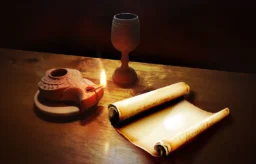
If a spirit of jealousy comes over him, he shall bring her to the priest . . . and the priest shall take holy water in an earthen vessel and take from the dust on the floor of the Tabernacle . . . and make the woman drink the water of bitterness that brings a curse.
One of the most disturbing and mystifying rituals in the Torah appears in Parashat Naso: the case of the Sotah—the woman suspected by her husband of adultery. We read that she must drink water into which the written name of God has been dissolved mixed with dust from the Tabernacle floor.[1]
Should she be guilty, “her belly will swell and her thigh will collapse”. Should she be innocent, she will remain unharmed and “conceive seed”.
The theater of suspicion
A Divine test, with dust, water, and an oath—a moment of high drama and existential fear. But what are we to make of it?
This ritual, unparalleled in Torah law, is effectively a trial by ordeal, the only one of its kind in Judaism. There are no judges, no witnesses, and there is no halakhic procedure; just God, jealousy, and a mixture of water and dust.
This is precisely what makes it so troubling. Judaism is a religion of restraint in judgment, of edim (witnesses), hatra’ah (warning), and due process. Trial by ordeal—a practice associated with medieval Europe’s witch hunts—is rejected by Jewish legal tradition as both primitive and dangerous.
And yet, here it is, near the beginning of Sefer Bamidbar. What is this strange ritual all about?
A Divine lie detector?
Some have tried to frame the Sotah ritual as a kind of ancient lie detector—a means of restoring marital trust when all other legal avenues fail. There may be no witnesses to the possible infidelity, no proof, no certainty that anything has happened, but the emotional toll of suspicion erodes the fabric of a marriage. Jealousy can be corrosive. Trust, once fractured, rarely recovers.
And so, say some commentators, the Sotah ritual is a last resort. It is a Divine intervention not to punish, but to reconcile.[2] The Talmud makes a stunning comment: “Great is peace between husband and wife, for God allows His Name to be erased in the water for the sake of peace.”[3] The Divine name, normally unutterable, unerasable, is dissolved in water for the potential to restore domestic harmony.
In no other area of Jewish Law is such a concession made. We are taught that even in war, even in death, God’s name remains sacred. But that is not the case here. Here, the name is surrendered to calm the storm between a man and a woman.
What does this teach us? That shalom bayit—peace in the home—overrides almost everything. Even Divine dignity, even sacred parchment.
But at what cost?
Between faith and farce
The Rambam treats the procedure as more than an act to restore trust. He sees it as a miraculous historical occurrence, with real-world consequences. The guilty woman may indeed die from drinking the water, and the guilty man with her.
Yet the Sages suggested that the ritual’s effectiveness was conditional. In fact, the Mishnah and Talmud teach that the ordeal was eventually discontinued when adultery among the men themselves became too widespread. The ritual had lost its meaning—or worse, become a farce.[4]
Was the ritual then symbolic all along? A performance? Was it only a Divine theater to appease a husband who could not live with uncertainty—even if he knew, deep down, that nothing could truly be proved?
This would not be the first time Judaism used theatrical ritual to produce inner transformation. Consider the scapegoat that is sent to Azazel in the wilderness on Yom Kippur. Did it truly bear our sins, or did the sight of it simply trigger repentance?
Might the Sotah ritual have worked similarly—not through metaphysical causality, but through psychological catharsis?
A feminist reading?
The modern mind recoils. The woman is humiliated, paraded before the priesthood, subjected to suspicion without trial. The man, meanwhile, is not tested. His jealousy stands as sufficient cause.
But look again.
According to the Mishnah, the husband himself must be morally clean: If he himself were not above suspicion, the water would not work. In other words, the Divine test is effective only when the accuser is innocent. Hypocrisy nullifies the process.
And in the end, the ritual, for all its drama, favors the woman. If she is innocent, not only is she vindicated, but the Torah adds: “She shall be innocent and concieve seed.” She is blessed, fruitful, whole.
In a society where women’s voices were often doubted, the Sotah may be the only case in ancient law where a woman’s innocence is vindicated directly by God.
Lo baShamayim hi?
Still, the metaphysical premise raises theological questions. Why would God intervene in this case and not others? Why is Divine knowledge accepted here, but rejected elsewhere? Take the case of the Tanur Shel Achnai, a certain type of oven.[5] The Sages did not agree on whether this type of oven was subject to ritual impurity. God interfered and sided with one opinion. The Sages rejected God’s opinion with the resounding cry of “Torah lo baShamayim hi”—“The Torah is no longer in Heaven”! The Sages meant that God could no longer interfere in any religious or juridical process. He had given the Torah at Sinai, and He himself declared that the Sages alone had now to decide the law.
The answer may be found in the difference between law and relationship.
The story of the Tanur Shel Achnai affirms that legal interpretation belongs to human beings. God has ceded legal authority to the rabbis. But the Sotah is not about Halakhah; it is about trust, fidelity, love. In the world of relationships, God still intervenes, not as legislator, but as healer.
Perhaps the message is that while Torah law is grounded in human autonomy, emotional pain must still be carried by Heaven.
The trial that should not have been
Ultimately, the Sotah ritual is a relic, a remnant of a lost world. It was abolished by the Sages, who recognized its danger. Perhaps it never truly worked. Or perhaps it worked too well, revealing not just truth, but shame, fear, and the unhealed fractures of intimacy.
Its presence in the Torah is not an endorsement, but a confrontation. It is a reminder that even the Divine system had to evolve; that even sacred ritual must be weighed against human dignity. And that sometimes the pursuit of truth can destroy the very thing it seeks to defend.
In the Sotah ritual, God’s name is erased—not for atonement, not for holiness—but for peace. This is the final paradox. That peace—even an uneasy, fragile peace—is worth more than Divine honor.
In a time of fractured relationships, broken trust, and cynicism, the Sotah reminds us of forgotten truths: that love is sacred, that suspicion is dangerous, and that sometimes the mundane relations between human beings are more important even than the Divine name.
Notes
[2] See, for example, Emet le-Yaakov, ed. Doniel Neustadt, 2nd ed. (1996), 422.
[4] See Mishnah Sotah 9:9; Talmud Bavli, Sotah 47a.
[5] Bava Metzia 59b.
Questions to Ponder
- It would seem that the Sotah ritual violates almost every instinct of Jewish legal restraint: no witnesses, no due process, no human judgment. Why do you think the Torah preserved such a ritual at all? Is its presence a failure of the system—or an honest admission of its limits?
- The law of the Sotah is one of several other prominent Torah laws that raised moral questions in the eyes of the Sages. Some other examples where the sages of the Mishna and Talmud engaged in creative interpretation to “edit” Torah laws are the case of the Eshet Yifat Toar (the beautiful woman captured in battle, and the Ben Sorer u’More (the rebellious son). In the case of the rebellious son, the sages put such onerous limitations on the circumstances in which the accusation could be brought that they could argue “there never has been such a case” (Sanhedrin 71a). In these examples, the Torah seems to be saying: “You want revenge? You want to slake your lust? Your need to control? Sure, but not so fast! There are procedures that must be satisfied first!” And in the course of fulfilling the required bureaucratic requirements, tempers cool, lust subsides, and sanity prevails.
- Do you feel that such laws can successfully regulate or channel natural human responses?
- Do you find this interpretation helpful in making sense of Torah laws where our moral sense recoils?
- There is evidence from other Near Eastern societies that many of the punishments mentioned in the Torah were common practice in the region long before the institution of formal law codes. Stoning, in particular, was a very common “public outrage” measure. The Torah sought to “tame” this punitive response, by regulating how and when it could be put in practice. The Tannaim took this a step further, limiting its application even more, and the Amoraim seem to have legislated it out of practice altogether. Do you think that in the modern day, we still need these laws?
- The essay suggests that the Sotah may have functioned more as theater than as law. Does the idea of “ritual theater” undermine religious truth—or does it reveal a deeper psychological wisdom within Judaism? Where else do you suspect Judaism relies on symbolic performance rather than literal causality?
- From a modern ethical perspective, the humiliation of the woman is deeply disturbing. Does the later rabbinic requirement that the husband be morally innocent sufficiently redeem the ritual—or does it merely soften an irredeemable injustice?
- If the Sotah ritual ultimately favors the woman—vindicating her publicly and blessing her with fertility—does that change how you evaluate it? Or does the process itself remain morally indefensible regardless of outcome? Do you believe sacred texts should include morally problematic rituals as teaching tools—or does this risk sanctifying what should have been rejected outright?