Such is the law for every eruptive affection—for scalls, for an eruption on a cloth or a house, for swellings, for rashes, or for discolorations—to determine when they are impure and when they are pure.
Vayikra 14:54-57
Contrary to what many believe, the laws of ritual purity and ritual defilement in these and other parashiot are just as relevant today as they were in biblical times. It’s just that they aren’t relevant in the same way.
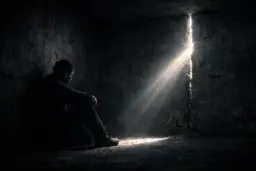
These laws introduce us to an awareness of disquiet and impurity as a state of mind—something we all experience, but which many of us do not wish to recognize, because it makes us feel extremely uncomfortable.
Most of us see ourselves as modern and sophisticated. We pride ourselves on our vast knowledge, our capacity to travel through space and conquer worlds. But we often use these accomplishments as a mask for what we prefer to ignore: the need for meaning in our lives, within our inner, authentic selves, and our capacity to live up to their actualization.
We become limited by boundaries that begin to feel like absolutes. This is due to the human capacity to normalize almost any situation. From fear of that which lies beyond, we stop asking questions—questions that would take us beyond what is comfortable. The ability to envision another reality is crushed by what we want to define as the sum total of our existence.
René Descartes emphasized the need to rely only on normality, within which transcendence has little place. In some sense, we are all Cartesians.
We live in a narrow world. But worse, we have stopped feeling that it is narrow. Over the years, we have normalized even more; our idle chatter has become our sine qua non.
Even when we entertain thoughts of a deeper nature, we leave them rattling in the upper chambers of our minds, without wondering how we can introduce them into our day-to-day lives.
This state of being is the reason why so many people have rejected religion. It is not from any rational consideration, but rather because religion forces them to ask questions that make them uncomfortable. They do not want to hear the answers, because these answers may not only demand that they think differently, but above all that they live differently.
It is much easier to remain constrained by the same narrow definitions, the same silent limitations, the same unchallenged assumptions.
But in doing so, we mistake familiarity for truth.
Many people, especially as they age and become more set in their ways, lack the courage to break out of this confinement, afraid of what they may encounter and what it will demand of them. They fear becoming larger. They fear what their friends will say when they have changed their minds and ways.
This is also true for many religious people. They live by rote without realizing that they live the life of great profundity but do not realize that. All people, religious and secular alike, need to meet the challenge of an existentially meaningful life.
And still, after all is said and done, all of us sometimes hear a voice of transcendence—a call from afar that makes one uncomfortable. Something is missing. There is some remnant of a violated existential purity that has clung to the soul.
This impurity is immune to cleansing and medication, because it is not evil, nor is it dirt or illness. It grows on our imaginary walls like mold. It takes hold of the interior of our psyche. We are no longer able to control our thoughts; we begin to think in ways that feel impure.
It settles upon our psychological garments; it contaminates our bodies, in a manner that we no longer feel completely at home. It reminds us of a deficiency in inner tranquility, causing us to feel nervous, upset, and agitated.
Something is not right.
And we do not truly know why this is happening. We fail to understand that it is this self-imposed confinement—this narrowness—that we have brought upon ourselves, to such an extent that we no longer even recognize that we are confined.
And yet we still feel that our situation is unnatural. It is foreign, and we feel impure.
And that is the highest form of spiritual defilement.
This is the power of the laws of purity and impurity, as found in our parashah. They show that this defilement is not irreparable! With effort—even with struggle against ourselves—we can overcome this narrowness and feel the grasp of genuine freedom.
This freedom at the heart of the laws of purity is sobering because it requires effort. But it is also uplifting, because the effort brings great reward.
As the Talmud says: “If one comes to defile himself he is granted facilities for so doing, and if he comes to purify himself support is given to him.” (Avodah Zarah 55a).
Questions to Ponder for the Shabbat Table
- Why do you think people sometimes avoid asking deep or uncomfortable questions about life? Is it always out of fear, or might there be other emotions at work?
- What does it mean to feel “at home” within yourself? Have you ever experienced the opposite?
- The essay suggests that religion challenges us not just to think differently, but to live differently. Why might that be difficult?
Diving Deeper
Rav Joseph B. Soloveitchik, in The Lonely Man of Faith, describes two archetypes within the human being:
Adam the first is aggressive, bold, and victory-minded… He engages in creative work, trying to imitate his Maker.¹
And in contrast:
Adam the second is lonely… he seeks a redeemed existence… he is covenantal, not majestic.²
Soloveitchik warns that modern man often lives almost exclusively as “Adam I,” focused on mastery, control, and external achievement, while neglecting the inner, searching voice of “Adam II.”
Could the “impurity” described in this essay be the result of living only as Adam I while neglecting Adam II? What would it mean, in practical terms, to restore that balance—to allow vulnerability, questioning, and covenantal depth back into our lives?
- Joseph B. Soloveitchik, The Lonely Man of Faith (New York: Doubleday, 1965), 13–15.
- Ibid., 25–28.