
Thoughts to Ponder is a weekly invitation to think dangerously and question passionately. Drawing on the Torah portion, classical Jewish sources, philosophy, and the crises of contemporary life, Rabbi Cardozo challenges religious complacency and spiritual comfort. These essays are written for readers who seek a Judaism that disturbs, questions, and ultimately deepens the human encounter with God and responsibility.
Since its earliest days, Jewish Tradition has instilled in people a healthy anticipation for retirement. It has created in its followers an “early retirement plan” by giving them a taste of its joy while they are still young.
The Religious Scandal of Akedat Yitzhak and the Tragedy of God
Prior to the Akeda, Avraham still lives in the world where man submits unconditionally to any god, whatever its demands. He is still a child of his times. Only when God, by way of His angel, shouts No! “Do not lay a hand on the boy” does Avraham wake up from his so-called religiosity.
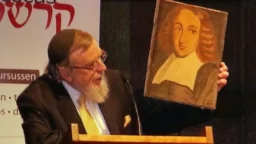
Spinoza’s Blunder And Noach’s Misguided Religiosity
In his Tractatus Theologico-Politicus, Spinoza accuses Judaism of demanding obsessive and outrageous obedience. Parashat Noach teaches us that while Spinoza’s assessment is entirely mistaken, it is a warning to many religious Jews who know nothing other than "negative" obedience as opposed to positive obedience. Judaism teaches us to stand on our own feet and make our own decisions.
How do we live with a God Who sometimes violates all that our own limited thoughts and feelings can grasp and express? It would be easier if we could deny God's very existence, the grandeur of all creation is too powerful to allow us to deny that He is there. But how are we to answer His silence when tragedy strikes?
The Torah reading in synagogue is not conventional Torah learning, but rather a kind of a wake-up call. Although we have read it for many years, the fact that the story appears again an entire year later, and no earlier, gives us a chance to forget it and then rediscover it as never before.
No matter how powerfully the outside walls and the leaking roof reveal our vulnerability and uncertainty, inside these walls we need to make our life as attractive as possible and enjoy its great benefits and blessings.
On Yom Kippur, even a Jew with only the slightest Jewish affiliation knows that he needs to annul his vows to radical secularism and other non-Jewish ideologies. Something deep in his soul tells him that, even for just a moment, he needs to return “home” and be part of his people and its faith.
As we approach Rosh Hashana and ask ourselves what we should do to become better Jews— not just as individuals but also as a community—we must realize the need to change our attitudes and not just our deeds.
Conversion and Annie Fischer’s Interpretation of Schumann’s Klavierkonzert in A Minor
Just as a human being who’s never had an encounter with classical music won’t know what he’s missing until he is introduced to Mozart, Beethoven or Bach, so it is with Judaism. But it all depends on who is playing the music.
Religious thinkers should refrain from giving primary reasons for forbidden sexual relations. There is no objective reason why homosexuality and incest are forbidden.
It is in those who are still uncomfortable with God that new insights about Him are formed. And it will be in those uneasy environments that Judaism will be rediscovered and developed. The need for religious transcendence, and for the spiritual thread that keeps many young people on their toes, is enormous. Numerous secular people are joining a new category of spiritual theologians. Matters of weltanschauung are pivotal to many secular Jews now. The problem is that for them, and for the religious, the Torah is transmitted on a wavelength that is out of range of their spiritual transistors’ frequency. Yes, we turn on the radio, but we hear strange noises and unusual static. There is serious transmission failure. We are no longer sure where the pipelines are. God has relocated.
Make Anti-Semitism a Source of Jewish Pride
To the 5th Global Forum on Combating Anti-Semitism
While we must help to combat anti-Semitism in every way possible, we should be aware that it is not a Jewish problem. Its solution will be possible only when the world makes peace with ethical Judaism. Only when Jews will be able to convince the world of the power of Jewish ethics, and will ensure that it is taught in every classroom, church and mosque is there a chance that anti-Semitism will slowly come to an end.