One wonders about the terrible kelalot, the curses, in Parashat Bechukotai. Are they meant to be purely punishments for not observing the commandments of the Torah, or is the Torah hinting to something much deeper?
At first glance, it appears that they are indeed punishments. After stating all the blessings that we will receive for observing the commandments, the Torah continues:
“But if you do not hearken to Me and will not do all these commandments, and if you despise My statutes… I will appoint over you terror, consumption, and fever… and you shall sow your seed in vain… and you shall be slain before your enemies… and you shall flee when none pursues you… I will smite you sevenfold for your sins… I will send wild beasts among you…” (Vayikra 26:14–22)
These curses will befall the community when it refuses, as a community, to live by the commandments.
As one continues to read the devastating consequences that follow, one is struck by what seems to be a Divine overreaction. What infractions could possibly warrant such overwhelming devastation? After all, we are not speaking only of criminal offenses, but also of ritual ones.
The punishments seem out of proportion to the wrongdoing. It seems as if we are objects of Divine revenge. How are we to reconcile this with God’s mercy?
When nature turns against us
We know that nature sometimes responds to human behavior in ways that lead to utter devastation.
Many natural disasters—earthquakes, tsunamis—are magnified by human irresponsibility. Nuclear leaks and industrial accidents can bring about widespread devastation. Today, pollution of the earth, sea, and sky affects the health of billions.
Some places on earth are so at risk that living there is as if being poised at the precipice of a volcano that may erupt at any moment. One need only think of earthquake-prone regions such as Japan, or wildfire-prone areas like California.
High population density places enormous strain on ecosystems, leading to habitat destruction, biodiversity loss, and climate change. Even the widespread use of pharmaceuticals and hormones introduces endocrine-disrupting compounds into the environment, interfering with the reproductive systems of wildlife.
Many more such cases could be mentioned. All are caused by human beings physically interfering with nature.
But is it possible that even non-physical misbehavior could also lead to disaster? Could the violation of religious precepts bring about actual, physical consequences such as those mentioned in the curses?
Spiritual actions and physical consequences
In his book To Have or To Be?, the psychoanalyst and philosopher Erich Fromm (1900-1980) makes precisely this claim. He argues that modern societies—whether capitalist or communist—are dominated by the “having mode,” focused on possession, power, greed, envy, and aggression. This orientation, he suggests, leads not only to social decay but to profound psychological and even civilizational crisis.
The alternative to the “having mode” is the “being mode,” characterized by presence, shared experience, creativity, and inner growth.
Most striking is Fromm’s observation that Shabbat observance embodies and promulgates this “being mode.”
There is a fundamental need to have a day
in which property and money as well as mourning and sadness are tabu.” “The modern day Sunday is a day of fun, consumption and running away from oneself”….. “even tearing up a blade of grass is looked upon as a breach of natural harmony as is lighting a match. …. “It is for this reason that carrying anything on the street is forbidden, even if it weighs as little as a handkerchief….” On the Shabbat one lives as if one has nothing, pursuing no aim except being, expressing one’s essential powers, praying, studying, drinking, singing, making love.
One might ask if it is not time to re-establish the Shabbat as a universal day of harmony and peace as the human day that anticipates the human future.
To Have or to Be, Abacus,1979, page 58 1
Opening stores on Sunday or Shabbat is not at all progressive. It is regressive. It destroys the fabric of a harmonious society; as does driving a car, using a computer or cellphone on Shabbat. Human beings have become slaves to technology when we are no longer to separate from them on a regular basis. To say no is sometimes the greatest form of human creativity.
We refuse to recognize how much damage our addiction to technology is causing us. We have become increasingly restless, anxious, and fragmented—moving from one crisis to another, often dependent on medication or institutional care.
The physical survival of the human race depends on a radical transformation of the human heart.
Not Punishment, but Consequence
It may be, then, that the curses mentioned in this parasha are not punishments in the conventional sense, but natural consequences of violating the commandments.
Rituals are not mere ceremonies or formalities. They connect us to dimensions of our inner life that cannot be reached otherwise. They cultivate emotional and spiritual states essential to both mental and physical health.
Without them, we may not die—but our lives become impoverished. We feel restless, incomplete, unsettled. A person in such a condition may indeed “flee when none pursues him.”
The Torah may well be among the earliest texts to recognize that mental health is deeply tied to moral and spiritual living. Passions that do not align with the deeper structure of human nature become pathological.
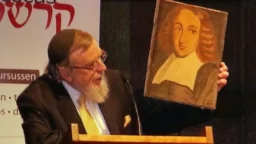
Interestingly, Baruch Spinoza arrives at a similar conclusion in his Ethics (IV, Proposition 44), where he suggests that human flourishing depends on living in accordance with one’s true nature—a life governed not by impulse, but by alignment with what one truly is. He even claims that negative passion can lead to insanity.2 It is not unlikely that these insights were shaped, at least in part, by his early engagement with Torah thought.
This applies as well to the laws of kashrut, the prohibition of greed and the laws governing sexual conduct. These are not arbitrary restrictions, but disciplines aimed at aligning human desire with human dignity. Violating them may cause more harm than we imagine. Just as Shabbat observance is crucial even for gentiles as Fromm maintains , the same may be true for the laws of kashrut and those related to sexuality.
We may thus conclude that the curses in our parasha are not so much Divine punishments as they are the inevitable outcome of a society that has lost its inner balance—one that has ignored the mental and physical needs of human existence.
The Torah does not threaten; it warns. It does not seek revenge; it reveals consequence. The kelalot are not the voice of an angry God, but the echo of a fractured world—a world in which human beings have lost touch with their own deepest nature. To return to the commandments is not merely to obey; it is to restore harmony between the human soul, the human body, and the world in which we live.
Questions to Ponder
- Do you experience Shabbat more as a restriction—or as a form of freedom? What might it mean to “be” instead of to “have” for one day a week?
- Can you think of examples today where human behavior has led to “natural consequences” that resemble the Torah’s warnings?
- Why do you think the Torah expresses these ideas in such extreme and frightening language? Would a gentler warning have had the same effect?
Diving Deeper
Baruch Spinoza argues that human flourishing depends on living in accordance with one’s true nature. How does this idea compare with the Torah’s concept of mitzvot? Are the commandments imposed from outside—or do they express something intrinsic to human nature?
Notes
- To Have or to Be, Abacus, 1979, page 58 ↩︎
- Baruch Spinoza, Ethics, trans. R. H. M. Elwes (New York: Dover Publications, 1955), IV, Proposition 44. ↩︎