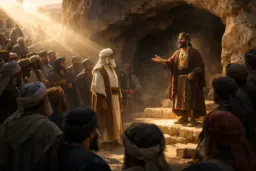
As he tries to buy a piece of land to bury Sarah, Avraham becomes involved in lengthy negotiations (Bereshit 23). After he has turned to the children of Chet, he asks them to speak to Efron the son of Tzohar, the owner of the Cave of Machpela. It is in this cave that he would like to bury his dear wife Sarah.
At first, Efron gives the impression that he wants to give the land to Avraham without any monetary compensation. But when Avraham refuses to accept this offer, Efron states that in that case, he would like to receive four hundred shekels,[1] an abnormally high sum of money, with the sarcastic comment that this price is of no significance “between me and you” (23:15). Avraham hands him the amount and buries Sarah.
The commentators carefully examined every part of these negotiations and suggested many explanations in order to understand what they were all about. Some suggest that Avraham refused to receive this piece of land as a gift because he realized that the children of Chet wanted him and his family to become part of their culture – in other words to assimilate and become one of them. By giving the land to him instead of selling it, they would draw him in as “one of the family” and all distinction between him and them would be blurred.
Avraham, on the other hand, wanted to make it abundantly clear that he needed to stay a “stranger” and secure a piece of land where only Hebrews would be buried. Any attempt to assimilate him into the culture of the children of Chet was unacceptable.
Others maintain that Avraham wanted to impress on all those present that one day, in the messianic times, the dead will be resurrected, and that therefore a burial place should hold the bones of the deceased for eternity. Therefore, such a place could never be touched or ploughed.
Efron, who does not believe in any of this, suggests that he could easily give the land to him since after several years they would clear the land of any remains and the original owner would be able to use it again for agriculture. Therefore, he would not really lose the land by giving it to Avraham for several years. It was just a temporary arrangement. The commentators have offered many more solutions.
However, there may be another reason why Avraham was not satisfied with the circumstances under which he could become the owner of the land. Efron may have intended never to give or sell the cave to Avraham. Avraham realized that all Efron’s diplomatic talk and his generous offer to give him the land for free was nothing but a clever way to refuse any such deal. Even when Efron actually asked for money, it was never truly his intention to sell Avraham the cave.
In order to understand this properly, we must enter Efron’s frame of mind at the time of the negotiations and understand something about human psychology. We need to examine Efron’s position before and after the negotiations.
In all probability, Efron was an unknown figure before this incident. He did not stand out, had no special status in the community of the children of Chet, and but for this particular incident, it is likely that no one would have heard of him. However, he suddenly becomes the center of attention. All eyes turn to him and in a matter of moments he realizes that he has become the most important man. He and nobody else has to deal with Avraham, a man whom the Hittites called “the mighty prince among us” (23:6), one of the most impressive people of his time.
At that moment, Efron tastes power. He realizes that the very idea of Avraham negotiating with him gives him, Efron, a great amount of prestige and standing in his community. (This is analogous to a case in which an average citizen of the United States is invited to the White House for a private audience with the President.)
If Efron reaches a settlement with Avraham, he can no longer enjoy this spotlight and will have to return once again to the status of the common man. The only way he is able to ensure that he stays at the center of attention is by dragging out the negotiations as long as he can. Therefore, Efron is not at all interested in solving the “problem.” The reverse is true: he wants to complicate the situation as long as possible so that he can enjoy his unprecedented prestigious status.
It is for this reason that he asks for an extravagant sum. He hopes that Avraham will refuse to pay it and that the negotiations will go on for a long time. In fact, Efron might have hoped that Avraham would become hostile, in which case the dispute concerning his land would take on a completely different character. It would turn into a much larger conflict, many more people would hear of it and Efron would become a nationally-known figure.
However, to Efron’s chagrin, Avraham accepts his offer and is prepared to pay the entire sum in cash. With no other option, Efron is forced to accept. However, it undermines his very intention. No longer will he enjoy his earlier position, and his “finest hour” will be over within minutes. The children of Chet will go home, Avraham buries Sarah and Efron’s name will no longer be a household word. His role as a leader and a tough, world-renowned negotiator has come to an end. Nothing could be worse.
In case our interpretation is correct, we would suggest that the Torah comes to warn us that when we confront our enemies, we should never forget that some of them may not be at all interested in peace even when they call for it. After all, they realize that once they have negotiated a true peace, they will become has-beens. Their names will no longer be on the lips of millions of people and they will fade into oblivion. No longer will they appear on the front page of international newspapers or on television. For them, that is the greatest curse. Better to keep a conflict going, even at the cost of lives, rather than live with the knowledge that one no longer plays any role in world events.
This may not only be the story of Efron but also of many modern “negotiators”. Think of Yasser Arafat and others like him. It always pays to listen not only to what negotiators say, but also what they don’t say!
[1] The Bible scholar E.A. Speiser states that Avraham could have bought a whole village for this sum (Anchor Bible, 171).