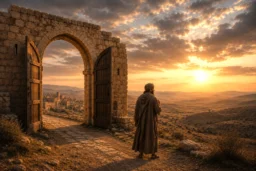
And God spoke to Moshe: when you cross over the Jordan into the land of Canaan, you shall designate for yourselves ….. (six) cities of refuge. There, an accidental murderer may flee so that he may not die … so that someone who murders someone unintentionally may have a place to flee.
Bamidbar 35:9-15
A city full of accidental murderers. Can you imagine what they said to one another when they wanted to strike up a conversation? “What brings you here? How did it happen that you killed somebody?”
“And what about you?”
And a lengthy conversation follows, with more and more accidental murderers joining in. All of them must have lived with intense trauma, reliving the terrible accident in their dreams, sweating day and night, unable to function normally.
One need only think of the first murder, when Cain killed Hevel:
And He (God) said to him, what have you done? The voice of your brother’s blood cries out to Me from the ground. And therefore you shall be more cursed than the ground which opened its mouth to receive your brother’s blood from your hand. If you work the soil, it shall no longer yield its strength to you.
You shall become a “na ve-nad”, a ceaseless wanderer on the earth.
And Cain said to the Lord, my punishment is too great to bear, since you have banished me this day from the soil and I must avoid Your presence and become a restless wanderer on the earth – anyone who meets me may kill me.
Bereshit 4:10-14
Cain had no idea that it was physically possible to kill another person, as he was the first one to do so. Nor did he have intention to kill.
But the moment a person kills his fellow—with or without intention—his whole world becomes a City of Refuge. He becomes a ceaseless wanderer. The world becomes a prison.
And as murder became more and more prevalent, we became indifferent to the holiness of human life. Mankind no longer has a home. We are always on the run, even when we have a place to live.
This results in a profound loneliness. People chase new experiences, careers, new relationships…. But once an immediate goal is achieved, we quickly grow impatient and move on to the next pursuit.
There is no Menuchat haNefesh, no tranquillity of the soul.
And so we become imprisoned in a world of uncertainty and upheaval.
All the unrest we encounter in our lives, our need to travel (including space travel), the constant searching for ourselves without finding what we seek, is the result of our taking human life too much for granted. In many cases, this is also a cause for taking drugs to calm us down, psychiatrists, and therapy.
Even our obsession with technology, our need to control and to acquire, and our desire for power—all are influenced by our having become ceaseless wanderers, not only literally, but also psychologically.
By not giving our fellow man a place to dwell, we lose it ourselves.
But above all, what turns us into a bundle of nerves is our desire to avoid—perhaps out of fear—the presence of God and to escape the consequences of a meaningful life. Such is the state of mind of modern man; thinking that he is fine, he is blind even to his impoverished state and to the fact of his own restlessness.
But none of this is inevitable. By turning inward to encounter God, facing our fears, and then afterwards turning outward to appreciate our own lives and the lives of others, we can once more find rest. We stop being “accidental killers” of meaning. The world ceases to be a mere City of Refuge and becomes once more a home.
Questions for the Shabbat Table
- The Torah creates Cities of Refuge for people who killed unintentionally. Why do you think the Torah focuses so much on someone who never meant to cause harm?
- What does menuchat ha-nefesh (inner tranquillity) mean to you? Is it something that comes from external circumstances or from within?
- The essay ends by saying that we can become “accidental killers of meaning.” What are some small everyday habits that build meaning instead of diminishing it?
Diving Deeper
The essay links humanity’s restlessness to the loss of reverence for human life. Is Rav Cardozo making a historical claim, a psychological claim, or a theological one? Could there be other reasons why modern society struggles to find inner peace—or are these ultimately different expressions of the same spiritual problem?