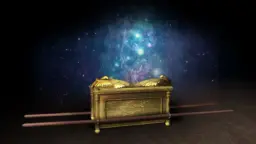
The cloud covered the Tent of Meeting and the glory of the Eternal filled the Mishkan. Moshe could not enter the Tent of Meeting because the cloud was over it and the glory of the Lord filled the Mishkan. Whenever the cloud lifted from over the Mishkan, the children of Israel continued all their journeys. But if the cloud was not lifted, they did not journey until the day it was lifted. For over the Mishkan a cloud of the Eternal rested by day and fire would appear in it by night, in view of all the house of Israel throughout their journeys.
Shemot 40:34-38
With these words the book of Shemot closes. In many ways these lasts verses reflect the dialectic inherit in Judaism and its relationship to God. At the same time, it is a retrospective view of all that happened until now and what still will happen in the future fom the biblical perspective.
Compared to God’s existence, nothing else exists.
We are told that when the glory of the Lord filled the Tabernacle, not even Moshe was able to enter the Tent of Meeting. When God’s glory is fully present, there is no place for the human being, not even for somebody as great and godly as Moshe. God’s presence takes up all space and therefore there is no space for a human being.
This does not mean that there is no place for the human being within the Tabernacle. Rather, it means that wherever God “is” in His full glory, there is no space for anything else. Not even for human beings, because where God is fully “present”,there is neither space nor time.
Or, to put it differently, compared to God’s existence, we do not even really exist. There is only one real existence and that is the unconditional existence of God, which by definition is infinite and beyond anything and everything. Compared to His existence, nothing else exists.
This is the meaning of the famous words uttered at the end of all prayers: “Ein Od”, “there is nothing but Him”.
It is for this reason that the Kabbalists turned the tables on us and claimed that the universe was not created “Yesh me-Ayin”, out of nothing”, often called “creatio ex nihilo”, but that the reverse is true: The universe was created “Ayin me Yesh” — nothing from something. The Ayin, the nothingness, which reflects the conditional existence of the universe was created out of Yesh, the ultimate and the only real Somethingness that is God. Compared to God our reality does not really exist. Only God is a Yesh, a real absolute infinite existence, and when He created the finite universe, it could be nothing but naught compared to Himself.
Spinoza’s triangle and the unpreventable paradox.
The fact that “nothingness” shines through everywhere in all that what we experience as reality makes a paradox unpreventable. What we as human beings experience as nothingness is the result of the absolute infinite unconditional existence of God, the ultimate Somethingness. And what God sees as nothingness is for us the somethingness from which our very existence is built.
When we look for God, He is not to be found in the place where we expect Him to be; we expect Him to be in what we call somethingness in the same limited way we experience ourselves.
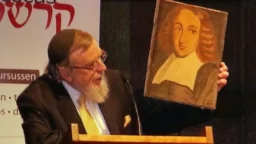
The very fact that we use words like “is” and “existence” when we speak about God just highlights the paradox. God “is” not and does not “exist”. He is much more. To claim that He merely exists is the ultimate form of idol worship, the bringing down of God to human proportions. As Spinoza says:
I believe that if a triangle could speak, it would say … that God is eminently triangular, while a circle would say that the divine nature is eminently circular. Thus each would ascribe to God its own attributes, would assume itself to be like God and look on everything else as ill shaped.[1]
Indeed, His absolute existence is totally beyond. And in that world, we cannot exist, since we can live only in time and inspace.
It is for this reason that when the Glory of the Eternal filled the Tabernacle, nobody, not even Moshe, could enter. At that moment Moshe could not exist; there was no “moment” and there was no “existence” in human terms.
In fact the Tabernacle itself did not “exist”, which is beautifully expressed by the sages when they claim that the Ark, which was at the center from which God “spoke” inside the Tabernacle, did not have any measurements.[2] It represented God’s infinite “existence” and consequently could not “be” in human terms.
God’s absence and our existence
What this means is that what we experience as the great mystery of all existence becomes absolute nothingness once God’s existence breaks through. It is this “nothingness” which creates the problem of good and evil and all the paradoxes which confront us daily. They are the result of God’s absolute existence and the nothingness which is to us the reality in which we live. As such they remain incomprehensible. They reflect the clash between God’s absolute “existence” beyond time and space and our finite existence.
Only when the absolute existence of God leaves the (non-existing) Tabernacle and the Glory of God “lifted up from over the Mishkan” did Moshe “come into existence” and was able to enter.
The fact that God could withdraw His own absolute existence so as to make space for the world in all its “non-existence” is one of the great mysteries with which the sages of the Kabbalah were confronted. For lack of a better explanation, they called this “Tzitzum”, the “withdrawal of God”. But this is nothing more than an admission that they could not explain this ultimate paradox on which all existence and nothingness is founded. How after all could God withdraw? This withdrawal is itself the pinnacle of the paradoxical.
But it also is the foundation of why the Jewish Tradition sees God as very close, and why we can make contact with God at all. It is precisely His infinite (non) existence that makes it possible for God to make contact with us and be the Mover behind all human history.
One way to understand this is that since God is beyond time and space, there are no limits on Him. As such, He is capable of doing anything, including entering space and time and being close to us. (That this explanation is not without its problems is well represented by the question of whether God can call Himself out of existence!)
Everything is God and God is everything
Rabbi Shneur Zalman of Liady, (1747-1813) the first Lubavitcher Rebbe, seems to try to solve this problem in his famous work called “Tanya”. He introduces a rather controversial concept. Instead of holding on to the concept of creatio ex nihilo,(or, as we called it earlier, nihilo ex creatio), he maintains that there is actually no difference between existence and non-existence: Everything is God. He maintains that the universe cannot be compared to a vessel which once it has been fashioned by an artist, is now able to stand on its own without the help of the artist. Such a thing is possible only when something is made from “something”. But in the case of the universe, it is a matter of creation from nothing (or nothing from something). What it definitely is not is something from something.
This [creatio ex nihilo] is [even] more wondrous than, for example, the splitting of the Red Sea. For then, God drove back the sea by a strong east wind all night, and the waters were split and not merely ceased their flow, but stood upright as a wall. If God had stopped the wind, the waters would have instantly flowed downward, as is their way and nature, and undoubtedly they would not have stood upright like a wall … How much more so is it in the creation of something out of nothing, which transcends nature, and is far more miraculous than the splitting of the Red Sea, that surely with the withdrawal of the power of the Creator from the thing created, God forbid, the created being would revert to naught and utter non-existence. Rather, the activating force of the Creator must continuously be present in the thing created to give it life and existence.[3]
In other words, the water itself would turn into nothingness were it not that God keeps His hand on it, and so with the rest of the universe. If God is not in everything, it would not exist. The Tanya is seemingly arguing that everything “is” God. Rabbi Shneur Zalman came very close to Spinoza’s “Deus Siva Natura” (God is equal to nature), which is called Pantheism. The difference is that for Spinoza, God did not create the world but was always there, while the Tanya seems to say that God created the world by deciding to create the world from and out of Himself. For Spinoza, God is only immanent, while for Rabbi Shneur Zalman, He is also transcendent. This is called Panentheism.[4]
According to the Tanya, God can easily be close to us and interact with us, since we can only exist as long as God is in us. Were He not, we would cease to exist.
The Biblical story as a dream
All these theories are remarkable and daring, confronting us with the many paradoxes inherent in the issue of the Somethingness of God and the Nothingness of the universe. It is as if the suggestion is made that God dreams up this world, which only exists from our perspective but not from the perspective of God, to Whom it is only a dream with no external reality.
This throws a new light on the biblical stories themselves. It would mean that all these stories are dream-states in God. They only take place in God’s mind.[5] But human beings, being part of the dream, experience them as reality.
This has far reaching-consequences, many of which are difficult to follow. One of them is whether we really have freedom of will. When all that we do is the result of a Divine dream, this would mean that we only believe that we have freedom of will, while in fact we do not. It reminds me of a statement by the famous Yiddish author Isaac Bashevis Singer: We must believe in freedom of will; we have no choice![6]
So when the glory of God would enter the Tabernacle, God would be Himself and only within Himself as the only Somethingness. And when He dreamed that His glory would leave the Tabernacle, Moshe, the product of His dream would be able to enter.
But if the biblical stories are dream-states of God, the same is true of all human history to this very day. We are still living in Biblical times!
It is with this message that the book of Shemot ends. Or as John Ruskin (1811-1900) said: “God alone can finish”.
Questions to Ponder
- Rabbi Cardozo distinguishes the Tanya’s “Panentheism” from Spinoza’s “Pantheism”. Do you think the difference is fundamental? What impact, if any, would adopting Spinoza’s view have on normative Halakhah? What about the Tanya’s view?
- The Tanya seems to imply that creation is miraculous because without God’s hand constantly supporting it, it would fall back into chaos. The Rambam (Maimonides) holds the opposite view:
For all forces are angels! How blind, how perniciously blind are the naive?! If you told someone who purports to be a sage of Israel that the Deity sends an angel who enters a woman’s womb and there forms an embryo, he would think this a miracle and accept it as a mark of the majesty and power of the Deity … But if you tell him that God placed in the sperm the power of forming and demarcating these organs … then he will recoil.
For he [the naive person] does not understand that the true majesty and power are in the bringing into being of forces which are active in a thing although they cannot be perceived by the senses …[7]
Is there a way to reconcile this view with that of the Tanya? Which of these views do you agree with?
- How is Rabbi Cardozo’s suggestion that the physical world is God’s “dream-state” different from the idea, popularized by the movie “The Matrix” that the world is a “simulated reality”? What impact would the truth of this idea have on Halakhic observance? Might the Torah itself be God’s dream-state even though the physical world has an independent reality?
- Shemot ends on a rather uncertain note, with the Israelites stuck in the desert, but guided by God in a very intimate manner. Do you feel that this state of being is a metaphor for our reality, or is something completely unnatural? Would you be happy in such an existence?
Notes
[1] Correspondence “Between Spinoza and Hugo Boxel on Ghosts”, in Improvement of the Understanding, Ethics and Correspondence, trans. R.H.M. Elwes (NY, Cosimo, 2006) p: 392.
[2] See: Baba Batra 98b-99a; Yoma 21a; Megillah 10b.
[3] Tanya, Sha’ar HaYichud Ve-HaEmunah, chapter 2, pp.153-154 (Vilna, 1930.)
[4] See the interesting discussion of this matter by Rabbi Zvi Ashkenazi, also called the Chacham Zvi, the Chief Rabbi of Amsterdam (1660-1718) in his Responsa “Chacham Tzvi”, Responsum 18, in which he discusses whether Rabbi Chacham David Nietto (1654-1728) of London was a hidden follower of Spinoza’s “Deus Siva Natura”!
[5] See my The Torah as God’s Mind, A Kabbalistic Look into the Pentateuch, BepRon Publications, Jerusalem, 1988.
[6] See also: Shaul Magid, Hasidism on the Margin, Reconciliation, Antinomianism, and Messianism in Izbica/Radzin Hasidism. (The University of Wisconsin Press, Wisconsin, 2003.) On the teachings of the Chassidic master, Rabbi Gershon Henokh of Radzin, determinism and freedom of will.
[7] The Guide for the Perplexed II:4-6