“We cannot go up against the people, for they are stronger than we”
Bamidbar 13:31
June 2025. As I write, the war with Iran has begun. It is the war that we all knew was coming. And we all knew that a painful price would have to be paid. We knew that many would be killed and wounded. We also find ourselves 617 days past the catastrophe of October 7, 2024—an unspeakable day of horror in which 1,195 innocent people were brutally murdered, women violated, and babies burned alive. Another 250 were taken hostage, many tortured in captivity. For us, this was not only a day of atrocity—it was a theological and moral rupture.
This war has thrust Israel into a profound moral crisis. Our soldiers, with tremendous courage, fight daily not only against Hamas but against accusations of genocide, war crimes, and cruelty—accusations utterly false, yet spread like gospel through media channels across the globe. The irony is grotesque. The nation reborn from the ashes of Auschwitz now stands accused of Nazi-like crimes by those who know little and care less about the complexities on the ground.
And yet, amid this absurdity lies an aching truth: we must fight. To stop now would be to guarantee future wars and further bloodshed. The choice is tragic: collateral damage today, or untold devastation tomorrow. It is not a choice we make lightly. It is not a choice anyone should have to make. But it is a choice that we must make.
This is the war we wage—with our enemies, and within our own souls.
A people uneasy with victory
This moral dissonance is not new. After the Six-Day War, Chief of Staff Yitzhak Rabin observed:
The joy of soldiers is incomplete and their celebrations are marred by sorrow and shock… The terrible price which our enemies paid touched the hearts of many of our men as well. It may be that the Jewish people never learned and never accustomed itself to feel the triumph of conquest and victory.
In Siach Lochamim, a collection of postwar testimonies, a soldier put it more starkly:
I believe that one of the things characteristic of us is the sense of the tragedy of conquerors. We are just not used to this. It is part of our Jewish education… when you watch it all, it is destruction, and it is depressing.
For millennia, the Jewish ethos has centered around justice, not conquest; around conscience, not domination. We are commanded to be a mamlekhet kohanim v’goy kadosh—a kingdom of priests and a holy nation (Shemot 19:6). And yet, from our inception, we have been entangled with war.
The dissonance of destiny
Parashat Shelach is no exception. The parashah begins with a mission: send men to spy out the land of Canaan, a land promised to the Israelites. But the mission ends in despair. Ten of the twelve spies return with a demoralizing report: “We cannot go up against the people, for they are stronger than we” (Bamidbar 13:31). They see giants, invincible fortresses, and a land that “devours its inhabitants.”
But perhaps the true fear was not military. Perhaps their fear was moral. As Rabbi Abraham Joshua Heschel wrote, “The prophets remind us that morally speaking, there is no limit to the concern one must feel for the suffering of human beings.” Could it be that the spies were recoiling at the idea of conquering a land already inhabited—of beginning a spiritual mission with bloodshed?
If so, they were naïve. Or perhaps—tragically sincere.
God and war: a theological tension
The conquest of Canaan is one of the most ethically challenging moments in the Torah. Maimonides explains in Hilchot Melachim (6:1) that before waging war, Israel was required to offer peace to the Canaanite nations—on condition that they accept the seven Noachide laws,including abandoning idol worship. Only if they refused could Israel engage in war.
But why was this bloodshed necessary? Could God not have relocated the Canaanites before the Israelites arrived? Why must the birth of a moral and spiritual nation begin with violence?
Perhaps because morality is not forged in abstraction. Perhaps because it is precisely in the darkest moments—amid war, pain, and chaos—that the challenge of being a light to the nations becomes real. Holiness is not about avoiding war; it is about preserving one’s humanity within it.
The protest of the spies
Could this have been the true protest of the meraglim, the spies? Their report was not only tactical—it was existential. They understood, perhaps too well, the tension between Divine promise and moral cost. They feared that the burden of being chosen would mean, as Elie Wiesel once quipped, undertaking a spiritual “suicide mission.”
Yet Moshe rebukes them, not for their caution, but for their lack of faith. He tells them, in effect: “You fear war will sully your mission, but the greater failure is refusing to engage. You do not have the luxury of remaining pure by remaining passive.”
The Israelites’ punishment is not destruction, but delay. God sends them wandering for 40 years—not because war is wrong, but because disengagement from moral responsibility is worse.
The war we do not want
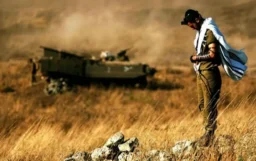
Even today, the ethos of the Jewish soldier reflects this tension. We do not want war. We do not celebrate it. We fight because we must, not because we can.
Golda Meir once said:
One day, we may be able to forgive the Arabs for killing our children. But we will never forgive them for forcing us to kill theirs.
This statement has been much debated. But it captures something essential about the Jewish spirit: a refusal to let pragmatism eclipse conscience. We are commanded to remember and blot out the memory of Amalek, but we are also commanded not to rejoice at the downfall of our enemy (Proverbs 24:17). The Talmud teaches that when the Egyptians drowned at the Reed Sea, the angels wished to sing, and God silenced them: “My creatures are drowning, and you wish to sing?” (Megillah 10b).
Even just war, if it becomes celebrated, becomes corrupted.
Sanctifying the Battlefield
To be a Jew is to bear the paradox of holiness in a world of violence. We are not pacifists. But neither are we aggressors. We live in the shadow of Cain and the cry of Abel. And yet, we are told: You shall be holy, for I the Lord your God am holy (Vayikra 19:2). This is not a command to withdraw from history, but to sanctify it.
Moshe taught that war itself must be reimagined. The Torah demands ethical constraints: rules of engagement, compassion toward captives, concern for trees in the battlefield (Devarim 20:19–20). Even the destruction of an enemy must be weighed against the image of God in every human soul.
In this sense, the IDF is a modern continuation of an ancient ideal: to be strong, yet restrained; powerful, yet humble; victorious, yet broken-hearted.
The tragedy of being chosen
In the end, the tragedy of this war—and of every war Israel fights—is not only the death toll. It is the unbearable irony that a people commanded to be a blessing to all nations must, at times, take up arms and be condemned by those very nations. When humankind ceased to heed the words of the Hebrew prophets, it invented the media.
But perhaps this is the greatest testimony to what it means to be am segulah, a treasured people. It doesn’t mean that we are morally perfect, but that we are morally haunted. We do not fight with joy, but with tears. And even when the world calls us monsters, we remain obsessed with justice.
To be chosen is not to be better—it is to be burdened.
May we carry that burden with courage and moral fortitude. And may the day soon come when we will no longer need to justify our survival.
Questions to Ponder
- In this essay, Rabbi Cardozo reads the spies’ fear not as cowardice, but as moral recoil. How do you distinguish between ethical conscience and moral evasion? When does moral sensitivity become paralysis?
- The essay suggests that refusing to fight in order to remain “pure” may itself be a moral failure. Do you agree that pacifism can be more unethical than violence—or does this reasoning risk justifying anything done in the name of necessity?
- Jewish tradition demands both the eradication of Amalek and compassion for the enemy. Can a single moral framework genuinely hold both imperatives without tearing itself apart?
- Golda Meir’s statement about being forced to kill others’ children expresses anguish rather than justification. Do you hear in it moral clarity, or dangerous moral exceptionalism? Why does this line still provoke such discomfort?
- If the Jewish people are uniquely uneasy with victory, as Rabin suggested, is this a moral achievement—or a psychological residue of centuries of powerlessness?
- Rabbi Cardozo rejects both pacifism and triumphalism. Do you find this position sustainable in the long term, or does a society eventually drift toward one extreme or the other?