On six days work may be done, but on the seventh day there shall be a sabbath of complete rest, a sacred occasion. You shall do no work; it shall be a sabbath of The Eternal throughout your settlements.
Vayikra 23:3
There is perhaps no natural phenomenon which has fascinated human beings so much as light. Light moves with a speed of 186,000 miles a second. That means that in one second light could circumnavigate the earth at the equator seven and a half times!
Another phenomenal aspect of light is that its speed cannot be influenced. For example, if there were a source of light (i.e. a laser that shoots photons) on top of a plane in flight, to an observer on the ground the velocity of this light remains the same in all directions: 186,000 miles a second.
All of this is miraculous.
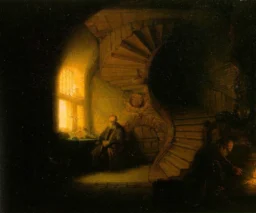
But all of this does not come even close to the greatest of miracles which light shows us. And that is that it “strolls”. It symbolizes rest. This was not demonstrated by any scientist but by the great Dutch painter Rembrandt van Rijn (1606-1669) who is called the “magician of light” and is very well described in a Dutch poem:
The light strolls through the house touching things.
We eat our bread converted in the sun.
You have spread the white cloth and put grasses in a vase.
This is the day on which works rests.
The palm is open to the light.[1]
The evening light sinks in through the windows, the brown furniture thinks of itself.[2]
In Rembrandt’s paintings we see how light touches the faces of human beings. The light does indeed seem to stroll. And the human being in the picture, at the hands of Rembrandt, answers this light with fabulous colors of the face and garments, by which everything seems to come to life. In no other painting does Rembrandt show his genius as a “magician of light” more than in his famous “Night Watch”, depicting the militia company in Amsterdam. Standing in front of this painting, one can actually see the light strolling.
The leisurely light of Shabbat
For Jews, this kind of “strolling light” is introduced Friday afternoon when the sun starts to set, announcing the Shabbat. This light radiates through the windows, and after sunset, its spiritual equivalent, an inner light symbolized by the Shabbat candles, takes over. It touches everything and appears to set the home ablaze. It blesses the furniture, the carpet on the floor, the silver cutlery, the plates on the table and the bread we eat.
Once touched by this light, the furniture starts to think of itself as it turns from an It into a Thou. Everything around us speaks to us as a persona with a soul and feelings. It speaks a primordial language where words disappear, and a more meaningful spiritual prose emerges. These are utterances of light, which are deeper than we can ever fully grasp.
This light compels us to stop working, because we experience something so amazing that it refutes “work” in the conventional sense of the word. It reveals a mystery which no scientist can describe, and that we can only experience. It sends a message that there are more things in heaven and earth than we can ever know. Things have their mystery.
It is this light which teaches us to abstain from driving a car, using our computers and our cellphones; to cease speaking about our finances.
Instead of believing that abstaining from these devices is “old fashioned”, we realize that it is “future fashioned”. We gain an empathy for the mystery. By abstaining, we create. We are transformed by awe, which instantaneously creates an open space between all our worldly affairs and our inner life. We grow spiritually; we see new horizons and transform ourselves.
Shabbat inaugurates a path for the mysterious light to enter and asks us to sanctify the day, to sing songs of praise and learn the words of God. This is the highest form of creativity. It is the bride of Shabbat, who on her arrival, transforms us into higher beings.
A mystery experienced only through abstinence
One can only fully experience the strength of this abstention and creativity when one actually withdraws from the outer world and replaces it with inner creativity. Mere contemplation of the mystery will not lead to this experience.
There is no way to see the strolling of the light unless one actually opens the door to let it in. One cannot talk aboutmystery. One must be grasped by it. And that is only possible when insight and creative inaction become one. It happens when all the limbs quiver and move and an upheaval agitates the whole of one’s being. It requires action as a leap. It is as if we are hit with eternity.
Indeed, abstinence on Shabbat is not a state of passivity. It requires great courage to say “No” to the car, the computer, and the cellphone. These items are the presentation of our inability to deal with our inner world. They have become our addiction to which we are no longer able to let go. It is the poverty of our souls which forces us to step into our cars or use our computers and cellphones because we cannot imagine our lives without them. Rather than our ruling over these objects, we are enslaved to them and owned by them.
The tragedy of modernity
This is the tragedy of modern life. For so many of us, our laziness and fear keep us from refraining. We cannot deal with creative abstinence. We are incapable of creating a path for the light.
Instead of realizing this, too many of us convince ourselves that we are “progressive” and that we can only laugh at those who observe Shabbat.
But the real victim of modernity is the “progressive” person. It is not progressiveness but spiritual narrow-mindedness that has overtaken him. He is at war with the world, not able to escape it, and consequently has no inner rest. He must keep himself busy so as not to fall victim to the mystery, which scares him as nothing else, and would demand that he contemplate what his life is really all about.
And thus, many come to believe that they are only human when they stay constantly busy. They argue vehemently against the laws of Shabbat, because observing these laws would reveal their lack of inner peace. They cannot deal with real life because it would force them to expose themselves to the mystery of being.
Shabbat in times of war
This is the reason why Shabbat observance is most important in time of war.[3] When living under enormous pressure, people have no outlet and no way to process the psychological consequences. Instead, we become glued to the television, the radio, or social media, incapable of letting go. Through enduring this ongoing barrage of news, we become undone by our own obsession.
Those who observe Shabbat, on the other hand, do not go shopping, answer phone calls or emails, watch television or drive. For one entire day, we do not need these addictions. Just like the mysterious light of Shabbat, we stroll. Unlike the sprinter who runs to reach the finish line without taking notice of his surroundings, we see the beauty of nature around us. We observe the inner beauty of our spouses and the sweetness of our children.
I always wonder when I pass the scene of a car accident what could have been so important that people were prepared to risk their lives. In their rush to get somewhere they failed to realize that they were already “there”.
Shabbat sets priorities in perspective. It objects to our way of living, protests against our indifference to the meaning of life, and rebels against our superficiality. We can only stroll with ourselves when we have no attachments.
In times of war, even an atheist or agnostic should try to observe Shabbat. Put the car, the computer, and the cellphone aside, and allow the light to stroll in. For one day during the week the war should not be allowed to enter, only the light.
Questions to Ponder
- Rabbi Cardozo points out that abstaining from certain activities on Shabbat is not merely passive but requires active creativity. How can the concept of “creative abstinence” be reconciled with the notion of rest? Is it possible that this form of creativity might be experienced differently by individuals with varying levels of spiritual and religious engagement?
- How can individuals find a balance between utilizing modern technologies for practical purposes and maintaining a sense of inner peace and spiritual fulfillment? How does refraining from mundane activities such as driving, using technology, and conducting business create space for inner creativity and spiritual growth? What insights can be gained from this intentional pause in our daily routines?
- Rabbi Cardozo suggests that the true experience of Shabbat’s light and mystery requires active participation and abstinence from certain activities. Can this profound experience of light and mystery be achieved through other means or practices outside of the specific context of Shabbat?
- Rabbi Cardozo highlights the importance of Shabbat observance during times of war and extreme tension. How can the principles of Shabbat — rest, reflection, and detachment from everyday concerns — be applied to other stressful or high-pressure situations in life? Can these principles be adapted to provide relief and perspective in various contexts, not just within the Jewish tradition?
- The essay critiques the modern notion of progressiveness, suggesting that it leads to spiritual narrow-mindedness and a lack of inner rest. How can progressiveness and traditional observance be seen as complementary rather than contradictory? Is there a way to integrate progressive values with spiritual practices to create a more holistic approach to life?
- Reflect on your own experiences with Shabbat observance or moments of intentional rest and reflection. How have these practices influenced your relationship with time, technology, and the pursuit of meaning in your life? What lessons can be gleaned from the article’s exploration of the transformative power of Shabbat?
Notes
[1] Ida Gerhardt, 1905-1997, quoted by Breukel: God and the Scientists, 1991, SCM Press LTD, p.65.
[2] Martinus Nijhoff, 1894-1953, ibid, p62.
[3] This essay was written soon after the Hamas attacks of 7th October 2023.