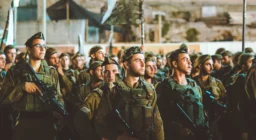
Words on my Grandsons Enlisting in the Israeli Defense Forces
My very dear twin grandsons,
When contemplating the fact that next week you will be enlisting in the Israeli army, many thoughts that I believe are of great importance for you to know come to mind.
When I was as old as you are now, living in a small town in the Netherlands, joining the Dutch army was never a real topic we thought about. It was simply not on the agenda. Only a few of us were called up; military service was something to be ignored. No wars or terrorist attacks were on the horizon.
Children of the Old World
My brother and I were born after the Holocaust, and although our parents and my parents-in-law had all been in hiding while this terrible tragedy took place (in a similar manner to Anne Frank), and some of our family members had been murdered, our parents told us little about it. The Holocaust was far removed from our daily discussion and never occupied us—as was the case in other families. No doubt our parents did so to protect us.
The possibility of an upcoming war or terrorist attack was quite simply a foreign concept in the Netherlands.
My brother and I went to secondary school, planning to join our father in business or go to college. We had a peaceful life playing with our friends, going on trips on our bicycles, playing soccer and holding innocent parties and debate sessions. The only “disturbance” that annoyed us was that we sometimes had a lot of homework and that we were forced to waste a considerable amount of time learning the dates of Dutch wars hundreds of years ago by heart. Even the Holocaust was never a real topic in our (non-Jewish) school; it was ignored, and nobody protested (which is scandalous!).
A peaceful and relaxing life, with an occasional hiccup, was all we encountered. Ours was a blissful, easy life.
However, once I married your dear grandmother and some of our children were born and we decided to come on Aliyah, we encountered a world which we never had imagined.
Aliya and its challenges
Once we were in Israel, we were confronted with several cruel wars and terrorist attacks and the necessity to serve in the army. We were in no way prepared for all this; nobody had explained to us how this would drastically change our lives. At the time we were still young, and it was easier to adjust. We loved living in Israel and still do. Now that I am 76 years old, however, I realize how much this new life took us by total surprise—suddenly a whole new world appeared.
I now realize that we who came on Aliyah are a “bridging generation,” a kind of viaduct from the Diaspora to Israel. We still have one foot in “cultured” Europe, with our other foot in Israel. We brought a whole civilization with us, including a Jewish one, which is almost absent in Israel. This is the reason that when we get older, despite having been in Israel for 40 and even 50 years, we sometimes have difficulties in getting used to real Israeli life, which is rooted in the world and culture of the Middle East that possess an entirely different attitude and nature.
This change in mentality and culture was a metamorphosis that I think we are still not used to.
When we arrived in Israel there were soldiers everywhere. There was constant talk of war. Terrorist attacks took place close to home; attacks in which we lost some dear friends. We also have friends who lost children in several Israeli wars.
My brief stint in the Army
I was called up to the army for a short period of time (I was already 40 and had a grandchild!). This shocking surprise was only to increase. I was part of a company (“pluga”) comprising 150 Ger Chassidim and some people, like myself, who were born outside of Israel. Our Hebrew was far from ideal—which led to all sorts of misunderstandings between the officers and us, and we constantly had to ask them to speak slower so that we were able to understand them (which did not work!).
On one occasion, one of the officers who was twenty years younger than we were, started to curse us because we had made a mistake. The language he used was so vulgar that we could not bear it, and I stepped forward and told him that we, from outside Israel, were not used to that kind of language and were not prepared to listen to this kind of insults. I was not aware at all that such critique towards an officer was absolutely unacceptable and could get me into trouble. It was another example of my complete “stranger status” in the army. To the surprise of all, the officer apologized and said I was right—something that was a kind of “marvel” in the army!
Whatever the case, it was all foreign to me, as it was to my fellow soldiers. It was frightening, especially when the Gulf War broke out in the middle of our service and we had to run for our lives when it looked like a rocket was coming in our direction. We also had to learn and and practice how to enter bombed buildings wearing gas masks to save people.
While I am very proud that I served, I cannot claim that I overly enjoined it—my entire Dutch comfortable life had been uprooted!
Defending more than just a country
But today, at 76 years old, I stand before you, my grandsons, who now are enlisted. And this serves as a kind of wakeup call. It suddenly hits me how much your lives are totally different at this stage in your lives than mine was nearly 60 years ago.
While you are surely a little nervous, what hits me the most is the joy with which you and your fellows join the army. I know that you have been looking forward to this for years. All I can say is that I never have seen or heard of another country where such joy was displayed when people join an army.
Most citizens in other countries see it is as their duty to enlist, but also as a burden (no doubt there are some exceptions). However, I have discovered in this beautiful country called Israel that so many people like you cannot wait to be enlisted.
What is the secret behind this? No doubt it has nothing to do with times of war, God forbid. We have an army that takes every precaution to avoid causing any unnecessary harm to even our arch enemies. (I never forget what Golda Meir once said: “We are capable of forgiving the Arabs for killing our children. We are not capable of forgiving them for forcing us to kill their children.”)
While there are many possible explanations for this enigma of enlisting in the Israeli Defense Forces, there is one explanation that many of us do not consider that I believe to be of the greatest importance.
There is a fundamental difference between joining the Israeli army and all other armies.
While other soldiers want to defend their country and its people, for Jewish soldiers there is another dimension at play: the army not only defends the State of Israel. Israel’s army defends an idea and a mission that comprise 4,000 years of Jewish history, Jewish values, ethics, holiness, divinity, defending Jews outside the Land of Israel, Judaism, and being Jewish, together with the concern for the wellbeing of the entire world. This is a purpose that constitutes an entirely different way of perceiving and living life.
An honor and a privilege
When one enters the Israeli army, you are not merely serving to protect the citizens of Israel. An Israeli soldier bears not only a duty to enlist in compulsory military service, but is granted the zechut, privilege, to fulfill a holy commandment, a mitzva, of guarding his fellow Jews. This is a mitzva that elevates one to a different spiritual experience with rules and expectations of its own.
Serving in Israel’s army signifies defending and spreading an eternal idea in which we Jews are seen as the Am HaNivhar, the Chosen People, and a “light unto the nations” (Isaiah 49:6), such that we assume responsibility for the wellbeing of all of humankind and inspire it with moral values. Although often many people do not want to recognize this, it is the full truth. We defend the free world against all the cruelty that threatens other nations, that often they themselves do not want to see.
It is the exalted ideas and values found in Tanakh, the Bible, that are at stake. The call for holiness stands at the center of this mission . In Judaism it is not sufficient to be a “good” person; one must surpass this and achieve sanctity and become sacred.
The famous Russian novelist Leo Tolstoy (1828-1910), author of “War and Peace,” once expressed this beautifully as follows:
“The Jew is that sacred being who has brought down from heaven an everlasting fire and has illumined with it the entire world. He is the religious source, spring and fountain out of which all of the rest of the peoples have drawn their beliefs and their religions. The Jew is the pioneer of liberty… The Jew is the pioneer of civilization… The Jew is the emblem of civilized and religious toleration.”
(See J. H. Hertz, “A Book of Jewish Thought.”)
The great philosopher and mathematician Blaise Pascal (1623-1662), author of “Pensees,” once wrote:
“It is that in certain parts of the world we can see a peculiar people… and this is called the Jewish people… For whereas the people of Greece and Italy, Sparta, Athens and Rome and others came so much later (than the Jews), they have perished so long ago, while these [Jews] still exist , despite the efforts… to wipe them out hundreds of times… My encounter with this people amazes me…”
(See Jonathan Sacks, “Radical Then, Radical Now.”)
Indeed, we outlived all our enemies, the Egyptians, the Romans , the Greeks, the Persians and so on. We have stood at all their tombstones. Not one of these peoples remain, their offspring may still be alive, but not as a people nor with the national identities of their parents. But we, the smallest of the smallest of all nations, are not only still alive, but after nearly 2,000 years and the tremendous tragedy of the Holocaust returned to our ancient homeland. This is unprecedented!
We have had an enormous influence on all of humankind that is entirely unproportionate to our number.
As Catholic scholar Thomas Cahill (1940) puts it:
The Jews gave us [the gentiles] the Outside and the Inside, the outer outlook and our inner life. We can hardly get up in the morning or cross the street without being Jewish. We [gentiles] dream Jewish dreams and hope Jewish hopes. Most of our best words, in fact – new, adventure, surprise; unique, individual, person, vocation; time, history; future; freedom, progress, spirit, faith, hope, justice – are the gifts of the Jews…
(Thomas Cahill, “The Gifts of the Jews.”)
This is what you as new soldiers come to defend and teach when you enlist in the Israeli army. This is sui generis, an entirely unique phenomenon.
Like entering a mikve
Let me explain this further in another way: Joining the Israeli army is akin to entering a Sukkah, the ritual booth used on the festival of Sukkot, or a Mikve, ritual bath.
When entering a Sukkah or a Mikve, one’s entire body is encompassed by the mitzva, the sacred commandment he fulfills. It is not only a limb or limbs that are involved in performing the mitzva, but every part of one’s body—from your head to your feet. Nothing of the experience is external; your very physical being is immersed in the Mikve and Sukkah.
Since beginning your years of study in Yeshivat Har Etzion, a Hesder Yeshiva in Gush Etzion, an institution of higher religious study that combines Torah education and army service, and having received a significant Jewish education from your parents, you have been immersed in the great values of Judaism. These, alongside your guns and other necessary weaponry, will inspire and protect you.
No army can defend its country unless there is something that surpasses that very army.
Like Abraham, our forefather, and Moshe Rabbenu (Moses, our Teacher), and many others who embarked on shelichut, a mission, that gave them the strength to fight our enemies and spread our values, so are you on this holy day when you enlist in our army.
In this instance, it is the greatest concept ever to appear on our globe, the world that you defend: Tanach and the exalted Jewish values that give you the inspiration to serve our nation.
As Ben Gurion stated at the United Nations: “The Bible is our mandate.”
When I served in the army, I met with many people who could be considered “secular” soldiers—they were not! Once I started speaking with them, I discovered that all of them, without exception, were driven by these higher biblical values. Whether consciously or sub-consciously, they bore the Jewish flame, and they were proud of it.
A mission of Tzedek, “justice,” honesty, and deep spirituality.
It is also one of your great missions in the army to inspire your fellow Jews to be proud Jews. You must become the “Chosen People” within the army, serve as an example and cause a Kiddush Hashem, sanctification of God’s name! You must demonstrate what it means to be a real Jew.
For all these reasons, I sometimes wonder whether our contemporary sages should not suggest a new berachah, blessing, upon entering the army: “Blessed are You God, King of the Universe, Who has sanctified us with His mitzvot to safeguard and protect our people, our Tanach, our holy mission and all of humankind.”
Since both of you, together with all your friends studying in your Hesder Yeshiva, will serve in the Armored Corps, when entering your tank you should think that you are entirely encompassed by the holiness of the steel of the tank precisely as one is surrounded by the sacred waters of the Mikve. You enter your tank not for war like other armies, but for the sake of peace.
May God bless you!
Your grandfather.